If you run an electrolytic cell for a known time at a known current, exactly how much metal will plate out? Faraday’s laws give you a direct calculation chain from amps and seconds to grams of product.
The Key Relationships
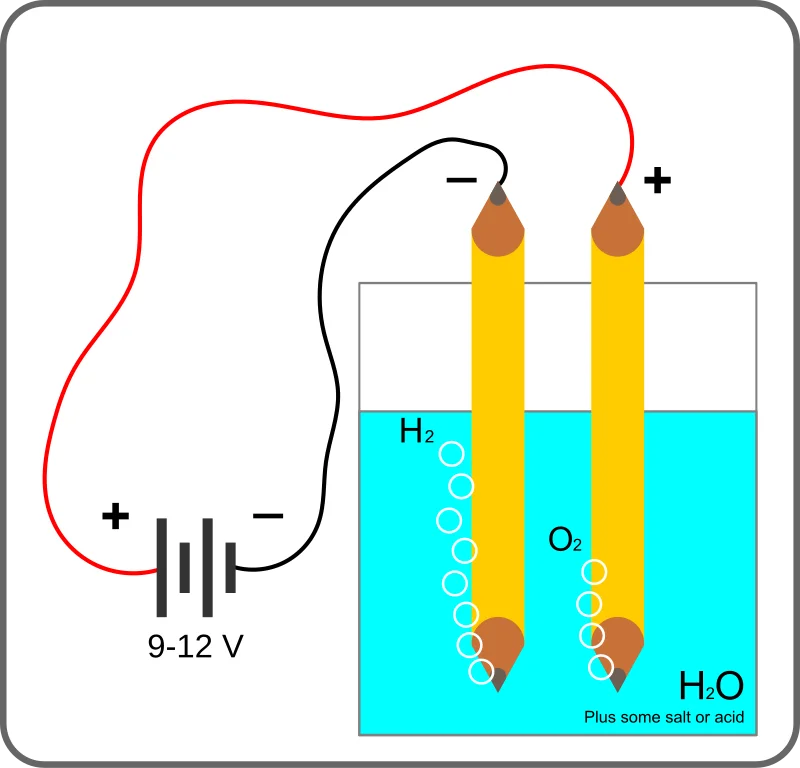
Water electrolysis — a practical application of Faraday's laws. The external battery drives current through the solution. At the cathode, water is reduced to H₂ gas; at the anode, water is oxidized to O₂. Faraday's law predicts the mass of gas produced: q = It gives total charge, then moles of electrons = q/F. Credit: Wikimedia Commons, CC BY-SA 3.0
The Calculation Chain
Every Faraday’s law problem follows the same four-step chain:
Current and time -> Charge -> Moles of electrons -> Moles of substance -> Grams
q = It - Convert current (amps) and time (seconds) to charge (coulombs)
n(e-) = q/F - Convert charge to moles of electrons
Use stoichiometry - The half-reaction tells you the ratio of moles of electrons to moles of substance
m = n x M - Convert moles of substance to grams using molar mass
Worked Example
How many grams of copper are deposited when a 3.00 A current runs through a CuSO4 solution for 2.00 hours?
Half-reaction: Cu2+ + 2e- -> Cu (n = 2 electrons per copper atom)
Step 1: Convert time to seconds: 2.00 h x 3600 s/h = 7200 s
Step 2: Calculate charge: q = It = (3.00 A)(7200 s) = 21,600 C
Step 4: Moles of Cu: 0.2239 mol e- x (1 mol Cu / 2 mol e-) = 0.1120 mol Cu
Step 5: Grams of Cu: 0.1120 mol x 63.55 g/mol = 7.12 g Cu
Important Unit Relationships
Quantity
Symbol
Unit
Definition
Current
I
Ampere (A)
Coulombs per second (C/s)
Time
t
Seconds (s)
-
Charge
q
Coulombs (C)
I x t
Faraday’s constant
F
C/mol
96,485 C per mole of electrons
Moles of electrons
n
mol
q / F
Comparing Two Electrolytic Cells in Series
When two electrolytic cells are connected in series (same current flows through both), the same charge passes through each. The mass deposited at each cathode depends on the molar mass of the metal and the number of electrons in its half-reaction.
Example: Cells containing AgNO3 and CuSO4 are connected in series. The same current flows through both.
Silver: Ag+ + 1e- -> Ag (1 electron per atom, M = 107.9 g/mol)
Copper: Cu2+ + 2e- -> Cu (2 electrons per atom, M = 63.55 g/mol)
For the same charge: more silver is deposited because each silver atom requires only 1 electron, while each copper atom requires 2.
A current of 5.00 A flows through a solution of AgNO3 for 30.0 minutes. How many grams of silver are deposited? (Ag: 107.9 g/mol, the half-reaction is Ag+ + e- -> Ag)
Click to reveal answer
10.1 g Ag. t = 30 x 60 = 1800 s. q = It = 5.00 x 1800 = 9000 C. n(e-) = 969000,485 = 0.0933 mol. Since 1 mol e- deposits 1 mol Ag: mass = 0.0933 x 107.9 = 10.1 g.
Two electrolytic cells are connected in series. One contains Ag+ solution and the other contains Cu2+ solution. If 1.08 g of silver is deposited, how much copper is deposited?
Click to reveal answer
0.318 g Cu. Moles of Ag = 107.91.08 = 0.0100 mol. Since Ag+ + e- -> Ag, this required 0.0100 mol e-. The same charge flows through the Cu cell: Cu2+ + 2e- -> Cu, so 0.0100 mol e- produces 20.0100 = 0.00500 mol Cu. Mass = 0.00500 x 63.55 = 0.318 g Cu.