
Circulatory Applications
Every equation in this chapter was derived by physicists studying water in pipes. But the MCAT’s favorite application of fluid mechanics is not plumbing — it’s the human circulatory system. Blood vessels are pipes. The heart is a pump. Blood is a viscous fluid. The physics translates directly, and the exam exploits that connection relentlessly.
This section pulls together everything from the previous ten sections — continuity, Poiseuille, Bernoulli, hydrostatic pressure — and applies it all to the body. It also explains some surprising clinical phenomena: why aneurysms keep growing, why a 50% blockage drops flow by 94%, why your blood pressure differs by 100+ mmHg between your head and your feet, and why standing up too fast makes you dizzy.
The Circulatory System as a Fluid Network
The cardiovascular system is a closed-loop fluid circuit. The heart generates a pressure difference (). Blood flows through a branching network of vessels. The flow obeys exactly the same equations you’ve been working with throughout this chapter:
| Fluid concept | Circulatory application |
|---|---|
| Continuity equation () | Why capillary blood flow is so slow |
| Poiseuille’s law () | Why mild atherosclerosis is so devastating |
| Bernoulli’s equation | Why aneurysms grow and stenotic vessels collapse |
| Hydrostatic pressure () | Why blood pressure differs head vs. feet |
Continuity and Capillary Blood Flow
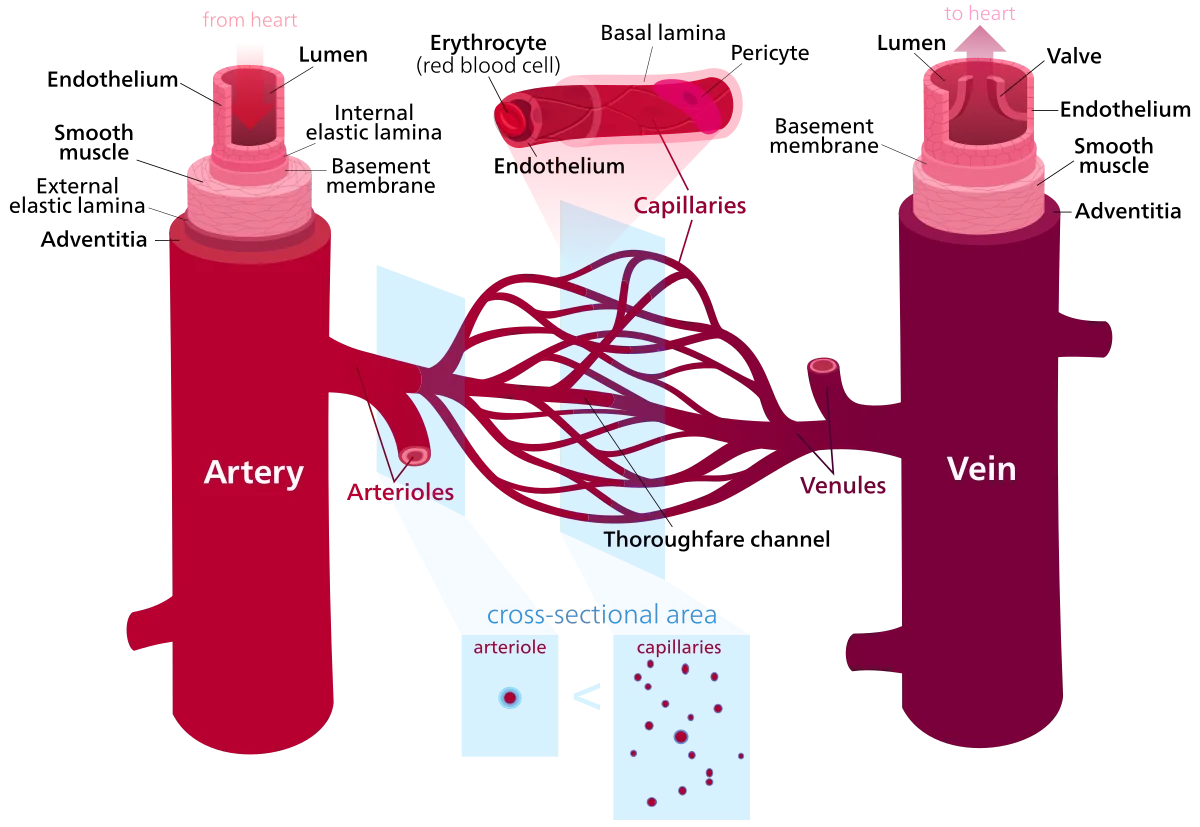
Blood leaves the heart through the aorta at ~40 cm/s. By the time it reaches the capillaries, it has slowed to ~0.03 cm/s — about a thousand times slower. Why?
Continuity equation + total cross-sectional area. The aorta is a single tube (cross-section ~4 cm²). It branches into thousands of arteries, millions of arterioles, and billions of capillaries. The combined cross-sectional area of all the capillaries is ~3000–6000 cm² — over a thousand times the area of the aorta.
if total rises by 1000×, drops by 1000×.
Poiseuille’s Law and Atherosclerosis
Atherosclerosis (plaque buildup in arterial walls) narrows the vessel radius. Poiseuille’s law reveals why even moderate narrowing has catastrophic effects on flow.
Because flow scales with :
- 25% radius reduction → flow = 32% of normal.
- 50% radius reduction → flow = 6.25% of normal.
- 75% radius reduction → flow = 0.4% of normal.
A “50% blocked artery” sounds moderate. The actual flow is 6% of normal — enough to cause ischemia (tissue death from insufficient blood supply) and trigger a heart attack or stroke.
The body compensates for arterial narrowing in two ways:
- Increase — the heart pumps harder (raising blood pressure). This works in the short term but overworks the heart and eventually causes heart failure.
- Vasodilate other vessels — nitroglycerin and similar drugs widen coronary arteries. Because of the dependence, even a small radius increase restores a lot of flow. (5% wider radius → ~22% more flow. 25% wider → 144% more flow.)
Bernoulli’s Equation and Aneurysms
An aneurysm is a localized balloon-like bulge in an artery wall. What does the physics say about flow through one?
Apply continuity, then Bernoulli:
- The aneurysm has a larger cross-sectional area than the normal vessel.
- By continuity, blood slows down in the bulge.
- By Bernoulli, slower blood = higher static pressure in the bulge.
- That extra pressure pushes outward on the already-weakened wall, causing the aneurysm to grow larger.
This is a self-reinforcing positive-feedback loop: bigger aneurysm → slower blood → more pressure on the wall → bigger aneurysm. Eventually it can rupture, which in the aorta is often fatal. This is why doctors monitor known aneurysms carefully and intervene surgically before they reach a critical size.
Stenosis: The Opposite of Aneurysm
A stenosis is a narrowing of a vessel, usually from plaque. Same physics, opposite direction:
- Smaller cross-section → blood speeds up (continuity).
- Faster blood → lower lateral pressure (Bernoulli).
- Low pressure can pull flexible vessel walls inward, worsening the narrowing.
So stenosis also has a positive-feedback loop, just running the other way. And it combines with Poiseuille’s effect to drastically reduce downstream flow.
Blood Pressure Measurement
When blood pressure is measured with a sphygmomanometer (the inflatable arm cuff), the underlying physics is fluid flow:
- The cuff inflates above systolic pressure, completely compressing the brachial artery → flow stops.
- The cuff slowly deflates. When the cuff pressure drops just below systolic pressure, blood squirts through the partially compressed artery — but only briefly during each systole.
- That intermittent, turbulent flow produces audible Korotkoff sounds (heard through a stethoscope).
- As cuff pressure drops below diastolic pressure, the artery is fully open all the time, flow becomes laminar, and the sounds disappear.
So systolic = the cuff pressure where you first hear Korotkoff sounds; diastolic = the pressure where the sounds vanish. The whole technique works because turbulent flow is audible and laminar flow is silent.
Hydrostatic Pressure and Posture
Blood pressure isn’t constant throughout the body — gravity pulls blood downward, so there’s a hydrostatic column () on top of whatever pressure the heart provides.
Standing upright, blood pressure in your feet is higher than at your heart by , where is the vertical distance heart-to-feet (~1.3 m). With kg/m³:
So if heart-level BP is , foot-level BP is roughly . Brain-level BP (~0.4 m above the heart) is roughly .