
Bernoulli's Equation
Stand in a hot shower with the water running hard. Watch the curtain. Within a few seconds, it creeps inward and clings to your legs.
You might think the water is somehow pulling the curtain — but the water never touches the curtain. What’s actually happening: the air inside the shower is moving (rushing upward with the steam, swirling around). That moving air has lower pressure than the still air outside the curtain. The higher outside pressure pushes the curtain in.
That counterintuitive idea — fast-moving fluid has lower pressure than slow-moving fluid — is the punch of Bernoulli’s equation, one of the most elegant ideas in fluid dynamics. Once you internalize it, you can explain shower curtains, airplane lift, why a window slams shut when wind blows past, and how a doctor uses a venturi nebulizer to spray medication.
Bernoulli’s Equation: Energy Conservation for Fluids
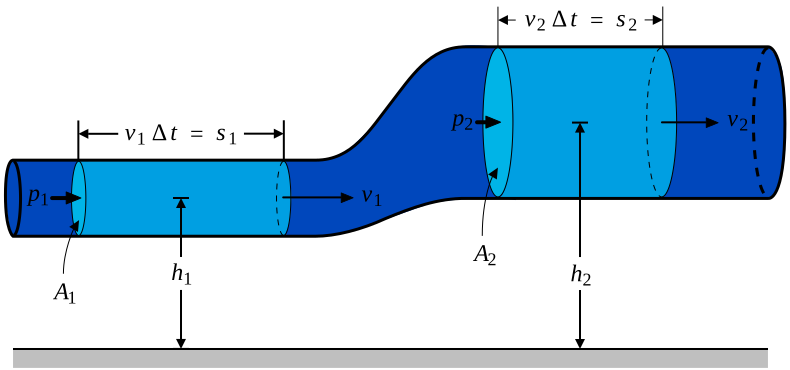
Bernoulli’s equation is just conservation of energy applied to a flowing fluid. The same way a roller coaster trades PE for KE on the way down, a moving fluid trades among three forms of energy: pressure energy, kinetic energy, and gravitational potential energy.
Between any two points along a streamline:
The Big Takeaway: Speed Up → Pressure Down
The most-tested consequence of Bernoulli’s equation is dead simple:
When fluid velocity increases, pressure decreases. And vice versa.
Often this is the only thing you need to know for an MCAT question. The exam describes a situation where fluid speeds up and asks what happens to the pressure — the answer is essentially always “it decreases.”
Blood flows through a horizontal artery that narrows to half its diameter at a plaque. Compared with the wide section, the narrow section has...
Watch the tracer particles speed up as they squeeze through the throat, and keep an eye on the two standpipe gauges: P₁ sits over the wide section and P₂ over the constriction. Tighten the constriction or raise the flow rate and watch P₂ fall. The drop scales with , so small changes in speed produce large changes in pressure.
Assumptions (When Bernoulli’s Applies)
Bernoulli’s holds for an ideal fluid:
- Incompressible — constant density (true for liquids).
- Non-viscous — no internal friction (an approximation; works well for water and air at moderate speeds).
- Laminar flow — smooth, non-turbulent.
- Steady flow — flow rate constant in time.
When viscosity matters (narrow blood vessels, thick fluids), Bernoulli’s alone isn’t enough — you need Poiseuille’s law (§4.6) to capture the viscous losses.
Special Cases
Case 1: Fluid at rest (). Bernoulli reduces to , or — exactly the hydrostatic pressure equation from §4.3. No coincidence: hydrostatics is just Bernoulli with no flow.
Case 2: Same height (). Bernoulli reduces to . Pure horizontal-flow case. This is the version that shows up in 90% of MCAT problems. Speed up → pressure drops; slow down → pressure rises.
Case 3: Open tank draining (Torricelli’s theorem). A tank with a hole at depth below the water surface drains at — the same speed an object would have after falling from height . Pure energy conservation: gravitational PE → KE.
Applications
- Airplane lift. Air moves faster over the curved upper surface of a wing than the flatter lower surface. Faster air → lower pressure on top → net upward force = lift. (Real aerodynamics is more complex — angle of attack and circulation matter too — but the Bernoulli explanation is the one the MCAT expects.)
- Shower curtain effect. Fast-moving air inside the shower has lower pressure than the still air outside → net inward force on the curtain.
- Chimney draft. Hot air rises fast in the chimney, creating low pressure at the base → fresh air gets sucked in from the room to feed the fire.
- Carburetors and atomizers. Fast air over a small tube of liquid creates low pressure that pulls the liquid up, where it gets sprayed into a fine mist (think nebulizers, perfume sprayers, paint sprayers).
- Wind blowing past a window. Fast outside air lowers outside pressure → indoor pressure pushes the window outward (or the curtains inward) — sometimes hard enough to slam doors shut.
Worked Example
Water flows through a horizontal pipe that narrows from 4 cm² to 1 cm². The pressure in the wide section is 200,000 Pa and the velocity is 1 m/s. Find the pressure in the narrow section. ( kg/m³.)
- Step 1 — Continuity. m/s.
- Step 2 — Bernoulli (same height, so terms cancel). .
- .
- Pa.
Pressure dropped by 7500 Pa as the fluid sped up — exactly as Bernoulli predicts.
Pa. Continuity: m/s. Bernoulli (same ): → → Pa. Pressure drops where fluid speeds up.
m/s. Torricelli: m/s. Same speed an object would reach by falling 5 m from rest — pure energy conservation (gravitational PE → KE).
At the constriction (narrow section). The narrow section has the lowest pressure (Bernoulli). A side tube there can draw liquid up from a reservoir (atmospheric pressure pushes the liquid up the tube into the low-pressure region). This is exactly how perfume sprayers, paint sprayers, and medical nebulizers work.