
Venturi Effect
Hold two sheets of paper a couple centimeters apart in front of your face. Now blow hard between them. Most people expect the sheets to fly apart — but they actually pull together.
That’s a parlor trick, but the physics is real and important. The fast-moving air between the sheets has lower pressure than the still air outside the sheets. Higher outside pressure pushes the sheets inward.
This is the Venturi effect — the predictable consequence of fluid speeding up through a constriction (and, by Bernoulli, dropping in pressure). Once you see this pattern, you’ll see it everywhere: airplane lift, perfume sprayers, asthma attacks, atherosclerosis, the Pitot tube on the wing of every commercial aircraft.
The Venturi Effect
The Venturi effect is what happens when fluid passes through a constriction (a narrow section) in a pipe. It’s a direct combination of the continuity equation (§4.7) and Bernoulli’s equation (§4.8).
The logic chain:
- Continuity: the same volume of fluid must pass through the narrow section per second as the wide section. So fluid velocity increases in the constriction.
- Bernoulli: as velocity increases, pressure decreases.
- Result: the narrow section has higher velocity and lower pressure than the wide sections on either side.
The Venturi Tube
A Venturi tube is a pipe with a deliberately narrowed middle section (called the throat). Pressure gauges at the wide and narrow sections show a measurable pressure difference — lower in the throat where the fluid is moving fastest.
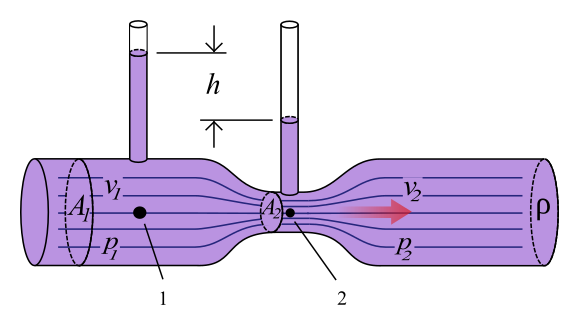
Practical uses of the Venturi tube:
- Measuring flow rate. Measure the pressure difference between the wide and narrow sections, plug into Bernoulli, and you get the flow rate. Industrial flow meters do exactly this.
- Aspirators and atomizers. The low-pressure zone in the throat draws in a secondary fluid through a side tube. This is how perfume sprayers, paint sprayers, and old-school carburetors all work.
- Medical nebulizers. Use the Venturi effect to draw liquid medication into a fast airstream and break it into a fine mist for inhalation.
The Pitot Tube
A pitot tube measures fluid velocity (most commonly airspeed on an aircraft). It works by comparing two pressure measurements:
- Total (stagnation) pressure — measured by a tube pointing directly into the oncoming flow. The fluid is brought to a halt at the tube opening, converting all its KE into pressure: .
- Static pressure — measured by a port flush with the surface, perpendicular to the flow.
The difference between total and static pressure is the dynamic pressure (), and from that you back out velocity:
Venturi Effect in the Body
The Venturi effect is responsible for several biological phenomena:
Airway narrowing in asthma. When bronchi constrict, air velocity in the narrowed airways increases (continuity). The resulting lower pressure can cause further collapse of the flexible airway walls, worsening the obstruction. This is a positive-feedback loop: narrowing → faster air → lower internal pressure → more collapse → more narrowing.
Atherosclerotic vessels. Blood flowing past a partial blockage speeds up. The Venturi-effect low-pressure zone at the narrowing can pull the vessel walls inward, worsening the obstruction over time.
Worked Example
Air flows through a horizontal Venturi tube. The wide section has area 20 cm² and the throat has area 5 cm². If air moves at 4 m/s in the wide section, what’s the air velocity in the throat?
- Continuity: m/s.
Air moves 4× faster through the throat (because area dropped by 4×). And by Bernoulli, the pressure in the throat is lower than in the wide section — that’s the suction effect that makes Venturi devices useful.