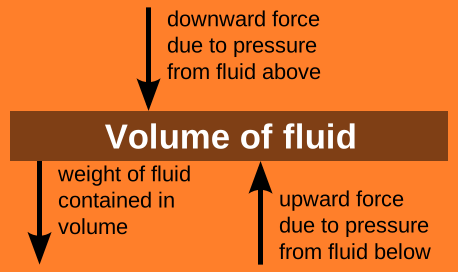
Ever notice that your ears hurt when you swim down to the bottom of a pool, but not while standing in the shallow end? That pain is hydrostatic pressure — the weight of all the water sitting above you, pressing on your eardrums.
The deeper you go, the more water sits above you, the bigger the pressure. The relationship is dead simple: pressure increases linearly with depth, period. Same idea explains why dams are thicker at the bottom (more pressure to hold back), why deep-sea creatures have specialized anatomy (they live under hundreds of atmospheres of pressure), and why your blood pressure in the veins of your feet is higher than in your head when you’re standing up.
Hydrostatic Pressure
In a stationary fluid, pressure increases linearly with depth.
Three insights pop out of this equation:
1. Pressure depends only on depth, not on the shape or width of the container. A narrow tube and a giant lake at the same depth have the same pressure at the bottom. This sounds wrong (the lake has vastly more water above you!) — but the extra water also spreads over a much larger area at the bottom. Pressure is force per area, and the two cancel exactly.
Hydrostatic pressure increases linearly with depth. At any given depth, pressure is the same regardless of the container's shape. Credit: Wikimedia Commons, CC BY-SA
2. Pressure is the same at all points at the same depth (within a single connected fluid). Move horizontally — pressure doesn’t change. Only vertical position matters.
3. Layered fluids: add each layer’s contribution. If you have oil floating on water, the pressure at the bottom isn’t ρwaterg(htotal). It’s ρoilghoil+ρwaterghwater. Each layer above contributes independently.
Worked Example
A diver descends to 10 m in the ocean (ρseawater=1025 kg/m³). What’s the absolute pressure at that depth?
So at just 10 m down, the diver experiences twice the surface pressure. At 20 m, ~3 atm. At 30 m, ~4 atm. Each 10 m of water adds another atmosphere — that’s the rule of thumb every scuba diver learns.
Pascal’s Law
Pascal’s law says that pressure applied to an enclosed fluid is transmitted equally and undiminished to every point in the fluid and to the walls of the container.
Plain English: push on one part of a confined fluid, and the entire fluid feels the same pressure increase.
Hydraulic Systems
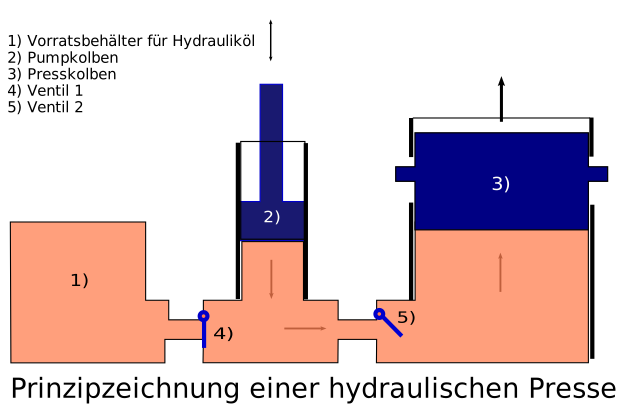
Pascal’s law is the principle behind hydraulic lifts, hydraulic brakes, hydraulic presses, and even the hydraulic systems that move heavy excavator arms. A small force applied to a small piston produces a pressure increase that’s transmitted to a large piston, where the same pressure × bigger area = much bigger output force.
A hydraulic lift uses Pascal's law. The same pressure acts on both pistons, but the larger piston has more area, producing a proportionally larger force. Credit: Wikimedia Commons, CC BY-SA
Worked Example: Hydraulic Lift
A mechanic pushes with 100 N on a piston of area 0.01 m². The car sits on a piston of area 1 m². What force lifts the car?
P1=F1/A1=100/0.01=10,000 Pa.
F2=P×A2=10,000×1=10,000 N.
The mechanic’s 100 N becomes 10,000 N at the lifting piston — enough to easily lift a small car. The area ratio (100×) is the force multiplier.
The catch (Pascal’s law isn’t free): if the small piston gets pushed down 1 meter, the large piston only rises 0.01 m (1 cm). Same volume of fluid moves, but spread over a much larger piston. Work done is identical on both sides: 100×1=10,000×0.01=100 J. Conservation of energy strikes again — there’s no free lunch in physics.
A tank contains oil (ρ=800 kg/m³) floating on water (ρ=1000 kg/m³). The oil layer is 2 m thick; the water layer beneath is 3 m deep. What is the gauge pressure at the bottom?
Click to reveal answer
≈ 45,080 Pa. Add each layer's contribution: P=ρoilghoil+ρwaterghwater=(800)(9.8)(2)+(1000)(9.8)(3)=15,680+29,400=45,080 Pa. You can't just use ρgh with one density when fluids are layered.
In a hydraulic lift, the input piston has radius 2 cm and the output piston has radius 20 cm. If you apply 50 N to the input, what force does the output piston exert?
Click to reveal answer
5000 N.A=πr2, so the area ratio is (20)2/(2)2=100. F2=F1×(A2/A1)=50×100=5000 N. Notice you only need the *ratio* of the radii squared — the π cancels.
A submarine descends to 200 m below the ocean surface. What is the gauge pressure at that depth, in atm?
Click to reveal answer
About 20 atm. Use the rule of thumb: every 10 m of water adds ~1 atm. At 200 m → ~20 atm gauge. (Math check: ρgh≈1000×10×200=2×10⁶ Pa = 20 atm.) Total absolute pressure ≈ 21 atm.