Put your thumb partly over the end of a garden hose. The water that was streaming out gently now sprays out fast. You didn’t change the faucet, the pressure, or the water supply — you just made the opening smaller. Yet the water is way faster.
Why? The same amount of water still has to come out per second. If it has less area to go through, it has to move faster to get the same volume out per unit time.
That intuition is the continuity equation, and it underlies everything from garden hoses, to plumbing, to why blood slows down in your capillaries (which is critical for letting oxygen exchange happen).
Conservation of Mass in Fluids
For an incompressible fluid (one whose density doesn’t change — like water or blood), whatever flows into a pipe has to flow out. Mass can’t accumulate inside a rigid tube or vanish into thin air. That conservation of mass leads directly to the continuity equation.
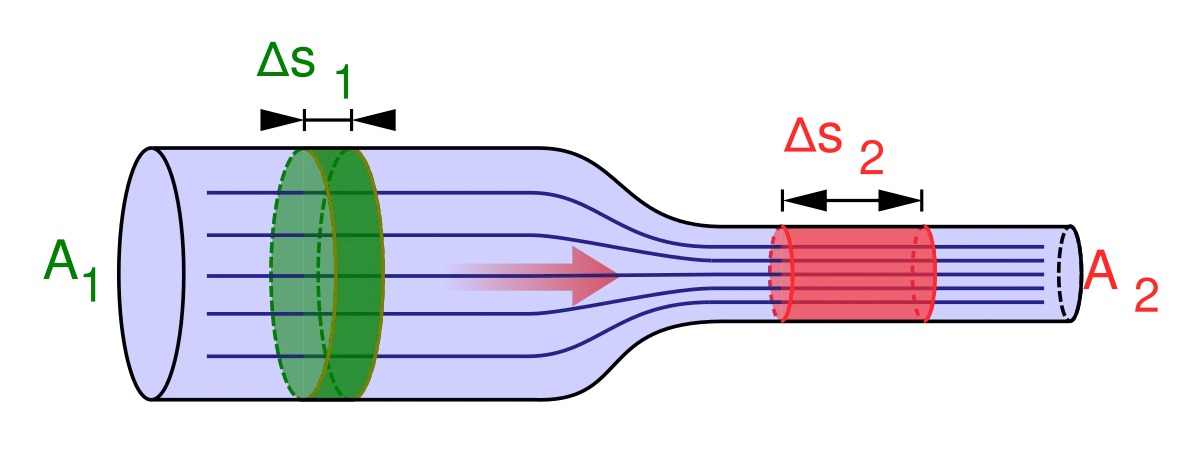
The key insight: when the cross-sectional area shrinks, velocity grows (and vice versa). Inversely proportional.
The continuity equation in action. As the pipe narrows, the same volume of fluid must pass through a smaller area per unit time, so velocity increases. A1v1=A2v2. Credit: Wikimedia Commons, CC BY-SA
Halve the area → double the velocity.
Quarter the area → quadruple the velocity.
The Importance of Total Cross-Sectional Area
Here’s where most students trip up: the continuity equation uses the total cross-sectional area at a given level of the system, not the area of a single tube.
The circulatory system is the canonical example. The aorta is one big tube. It branches into arteries, then arterioles, then billions of capillaries. Each individual capillary is microscopic — but with billions of them in parallel, the total cross-sectional area of all the capillaries combined is roughly 600 times the area of the aorta.
Vessel type
Total cross-section (cm²)
Velocity (cm/s)
Aorta
~3–5
~40
Arteries
~20
~10
Arterioles
~40
~5
Capillaries
~3000–6000
~0.03
Venules
~250
~0.5
Veins
~80
~5
Vena cavae
~14
~15
Notice the pattern: blood speeds up again in the veins and vena cavae as the total cross-section shrinks on the return trip. The continuity equation works in both directions — area and velocity always trade.
When Continuity Does NOT Apply
The continuity equation assumes:
Incompressible fluid — density stays constant. Valid for liquids; not valid for gases at varying pressures. (For the MCAT, blood and water are always incompressible.)
Steady flow — flow rate doesn’t change with time. Real heartbeats are pulsatile, but MCAT problems typically assume steady-state.
No leaks — no fluid enters or leaves the system between the two points. If a pipe has a hole or a side branch, you have to account for it separately.
Worked Example
A garden hose has a diameter of 2 cm. You attach a nozzle that narrows the opening to 0.5 cm diameter. If water flows through the hose at 1 m/s, what’s the speed coming out of the nozzle?
So the water comes out 16× faster than it was moving inside the hose — about 36 mph. That’s exactly why nozzles let you spray water across a yard.
Blood flows through the aorta (radius = 1.5 cm) at 30 cm/s. If the total cross-sectional area of all capillaries is 3000 cm², what is the blood velocity in the capillaries?
Click to reveal answer
About 0.07 cm/s.Aaorta=πr2=π(1.5)2≈7.07 cm². vcap=(Aaorta⋅vaorta)/Acap=(7.07×30)/3000≈0.07 cm/s. This very slow velocity is biologically critical — it gives RBCs time to exchange O₂ and CO₂ across capillary walls.
A pipe narrows from a diameter of 10 cm to a diameter of 5 cm. The fluid velocity in the wide section is 2 m/s. What is the velocity in the narrow section?
Click to reveal answer
8 m/s. Area scales with diameter squared, so halving diameter cuts area by 4×. v2=v1×(A1/A2)=2×4=8 m/s. Fluid moves 4× faster in the narrow section.
If a single artery branches into 5 smaller arteries, each with 41 the cross-sectional area of the original, how does blood velocity compare in the smaller arteries?
Click to reveal answer
54 (80%) of the original speed. Total area in the smaller arteries: 5×(1/4)A=(5/4)A. By continuity: A1v1=(5/4)A⋅v2 → v2=(4/5)v1=0.8v1. Blood slightly *slows* even though each individual branch is narrower — total area went up, so velocity went down.