Why does a 100,000-ton steel ship float, while a tiny iron pebble sinks the moment you toss it in a pond?
It’s not about weight — the ship weighs millions of times more than the pebble. It’s about how the mass is distributed through space. The ship is mostly hollow, so its average mass-per-volume is low. The pebble is solid iron, so its mass-per-volume is high.
That mass-per-volume property is density, and it’s the foundation of every fluids problem on the MCAT — floating, sinking, pressure, buoyancy, even why ice floats on water (a fact essential to aquatic life).
Density
Density tells you how much mass is packed into a given amount of space.
The density of water is the single most important reference value in fluid mechanics — memorize it and you’re ready for almost any density problem.
Substance
Density (kg/m³)
Density (g/cm³)
Water (4°C)
1000
1.00
Ice
917
0.917
Air (sea level)
1.2
0.0012
Blood
~1060
~1.06
Bone
~1900
~1.9
Mercury
13,600
13.6
Unit Conversions
The two density units you’ll encounter on the MCAT are kg/m³ and g/cm³. Convert between them by multiplying or dividing by 1000:
1 g/cm³ = 1000 kg/m³.
g/cm³ → kg/m³: multiply by 1000.
kg/m³ → g/cm³: divide by 1000.
Why 1000? There are 1000 g per 1 kg, and 1,000,000 cm³ per 1 m³ (100 cm per side, cubed). When you divide those out, the net factor is 1000. Don’t memorize the derivation — just remember the 1000.
Specific Gravity
Specific gravity (SG) compares an object’s density to the density of water. It’s a dimensionless ratio — no units.
Specific gravity gives you an instant float-or-sink prediction:
SG < 1 → less dense than water → floats.
SG = 1 → same density as water → neutrally buoyant (suspended at any depth).
SG > 1 → denser than water → sinks.
Why Ice Floats
Ice has a density of 917 kg/m³ (SG = 0.917), making it less dense than liquid water. This is unusual — most solids are denser than their liquid form (think of how candle wax sinks when you drop a chunk into melted wax).
Water is weird because of hydrogen bonding. When water freezes, the H-bonds lock molecules into an open hexagonal lattice with more empty space than the disordered liquid arrangement. So 1 mL of liquid water becomes more than 1 mL of ice (about 9% bigger), and the ice floats.
This anomaly is critical for life on Earth: ice floats on top of lakes and oceans, insulating the liquid water below and allowing aquatic life to survive winter. If ice were denser than water, lakes would freeze from the bottom up, killing fish and disrupting global climate.
Applying Density to the MCAT
Most MCAT density problems come in one of three flavors:
Calculate density from mass and volume (or rearrange to find mass or volume).
Predict floating or sinking from specific gravity.
Compare densities of layered liquids — the densest fluid always settles to the bottom.
When a passage shows you layered liquids, denser ones are always lower. Oil floats on water (oil’s SG ≈ 0.9). Mercury sits below water (SG = 13.6 — way denser). A common test setup: oil/water/mercury layers in a single tube.
Worked Example
A statue has a mass of 5400 g and a volume of 600 cm³. What’s its density? Will it float in water? In mercury?
ρ=m/V=5400/600=9.0 g/cm³.
SG = 9.0 → much denser than water → sinks in water (it’s likely brass or copper).
Compare to mercury (SG = 13.6) → the statue is less dense than mercury → floats in mercury.
That last result feels strange but it’s real — gold (SG ≈ 19) sinks in mercury, but most metals (steel, copper, brass) actually float on it.
A block of wood has a mass of 600 g and a volume of 800 cm³. What is its density in g/cm³? Will it float or sink in water?
Click to reveal answer
ρ=600/800=0.75 g/cm³. Specific gravity is 0.75 — less than 1 — so the block floats. In fact, 75% of its volume will be submerged (the submerged fraction equals the ratio of the object's density to the fluid's density).
What is the specific gravity of blood (ρ=1060 kg/m³)? Would a red blood cell (ρ=1100 kg/m³) sink or float in plasma (ρ=1025 kg/m³)?
Click to reveal answer
SG of blood = 1.06. A red blood cell (1100 kg/m³) is denser than plasma (1025 kg/m³), so it sinks in stationary plasma. This is the basis of the erythrocyte sedimentation rate (ESR) lab test.
A solid iron cube weighs 200 g and has 4 cm sides. What is its density in g/cm³ and in kg/m³?
Click to reveal answer
ρ=3.13 g/cm³ = 3125 kg/m³. Volume = 43=64 cm³. Density = 200/64≈3.1 g/cm³. Multiply by 1000 to convert to kg/m³ ≈ 3125 kg/m³. (Note: real iron is ~7.9 g/cm³ — this hypothetical cube would actually have to be hollow or be a different metal.)
Lying on a bed of nails — somehow — doesn’t hurt. Hundreds of nail tips share your weight, so each one bears only a tiny fraction. Now stand on a single nail. Same total weight, all concentrated on one tiny area. Excruciating.
The number that captures this difference is pressure: force divided by the area over which the force acts. Same force can be gentle (spread over big area, low pressure) or devastating (focused on a tiny point, high pressure). Snowshoes use this principle to keep you on top of snow; stiletto heels use it to leave dents in hardwood floors. Both are about pressure, not weight.
Defining Pressure
Pressure is a scalar, not a vector. At any point in a fluid, pressure pushes equally in every direction — up, down, sideways, all the same. This is fundamentally different from force, which has a specific direction. A force pushes; pressure squeezes.
Pressure Units
The MCAT uses four pressure units interchangeably. You have to be fluent in all of them.
Unit
Abbreviation
Value at 1 atm
Pascal
Pa
101,325 Pa
Atmosphere
atm
1 atm
Millimeters of mercury
mmHg
760 mmHg
Torr
torr
760 torr
Key relationships:
1 atm = 101,325 Pa ≈ 105 Pa (use the approximation on the MCAT — much faster).
1 atm = 760 mmHg = 760 torr (mmHg and torr are exactly the same thing, different name).
1 atm ≈ 14.7 psi (rarely tested, but might appear in a passage).
Atmospheric Pressure
The atmosphere is a column of air about 100 km tall. That air has weight, and it presses down on everything below it. At sea level, that pressure is 1 atm = 101,325 Pa.
Atmospheric pressure decreases with altitude because there’s less air above you the higher you go:
Sea level: 1 atm.
Denver (~1.6 km): 0.83 atm.
Top of Mt. Everest (~8.8 km): ~0.33 atm — about a third of sea-level pressure.
Cruising altitude of a commercial plane (~10 km): ~0.25 atm (which is why cabins are pressurized — you’d black out otherwise).
This is why hikers feel short of breath at high altitudes: each lungful contains ~⅓ as many oxygen molecules at the top of Everest as at sea level.
Gauge Pressure vs. Absolute Pressure
This distinction trips up many students. There are two ways to report pressure:
Absolute pressure is the total pressure at a point, including the atmospheric pressure pushing on everything. Always positive.
Gauge pressure is the pressure above (or below) atmospheric pressure. A flat tire reads 0 on a tire gauge, but the air inside is still at 1 atm — gauge zero just means “same as atmospheric.”
Blood pressure readings (80120 mmHg) are gauge pressures. They tell you how much the blood pressure exceeds atmospheric, not the absolute pressure in your arteries (which is actually 120 + 760 = 880 mmHg during systole).
Pressure in Fluids vs. Solids
In a solid, force can act in a specific direction over a specific area — a nail pressing into wood, a hammer striking a chisel. In a fluid, pressure acts equally in every direction at any given point.
That’s a direct consequence of fluids being unable to resist shear stress: if the pressure in a fluid were higher in one direction than another, the fluid would simply flow until the imbalance disappeared. So at every microscopic point, the fluid is squeezed equally from all sides.
Worked Example
A 70 kg person stands on one foot. The bottom of their shoe has area 0.02 m². What pressure does their foot exert on the floor? (g=10 m/s².)
Force = mg=700 N.
Pressure = F/A=700/0.02=35,000 Pa = 35 kPa.
That’s about a third of an atmosphere — substantial, but spread over enough area that the floor doesn’t notice. Now switch to a stiletto heel with area 0.0001 m² instead: pressure = 700/0.0001=7,000,000 Pa = 7 MPa. That’s why stilettos make dents and regular shoes don’t.
A patient's blood pressure reads 80120 mmHg. Convert the systolic pressure to atmospheres and to pascals.
Click to reveal answer
Systolic = 120 mmHg. In atm: 120/760≈0.158 atm. In Pa: 0.158×101,325≈16,000 Pa. Remember: these are *gauge* pressures. Absolute systolic ≈ 120+760=880 mmHg ≈ 1.16 atm.
A scuba tank gauge reads 200 atm. What is the absolute pressure of the air inside?
Click to reveal answer
Pabs=201 atm.Pabs=Pgauge+Patm=200+1=201 atm. At very high gauge pressures, the difference between gauge and absolute is negligible (<0.5%) — but conceptually you should always know which one you're working with.
An elephant weighing 50,000 N stands on four feet, each with area 0.05 m². What pressure does each foot exert?
Click to reveal answer
250,000 Pa (~2.5 atm) per foot. Force per foot = 50,000/4=12,500 N. Pressure = 12,500/0.05=250,000 Pa. (For comparison, a human in heels can momentarily produce *higher* pressure per heel than this elephant produces per foot, despite the huge weight difference — area matters more than weight.)
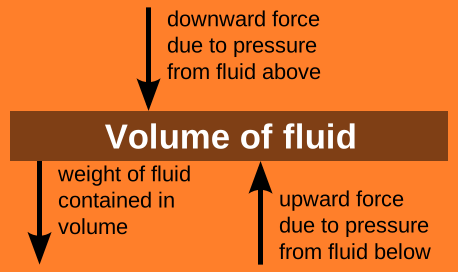
Ever notice that your ears hurt when you swim down to the bottom of a pool, but not while standing in the shallow end? That pain is hydrostatic pressure — the weight of all the water sitting above you, pressing on your eardrums.
The deeper you go, the more water sits above you, the bigger the pressure. The relationship is dead simple: pressure increases linearly with depth, period. Same idea explains why dams are thicker at the bottom (more pressure to hold back), why deep-sea creatures have specialized anatomy (they live under hundreds of atmospheres of pressure), and why your blood pressure in the veins of your feet is higher than in your head when you’re standing up.
Hydrostatic Pressure
In a stationary fluid, pressure increases linearly with depth.
Three insights pop out of this equation:
1. Pressure depends only on depth, not on the shape or width of the container. A narrow tube and a giant lake at the same depth have the same pressure at the bottom. This sounds wrong (the lake has vastly more water above you!) — but the extra water also spreads over a much larger area at the bottom. Pressure is force per area, and the two cancel exactly.
Hydrostatic pressure increases linearly with depth. At any given depth, pressure is the same regardless of the container's shape. Credit: Wikimedia Commons, CC BY-SA
2. Pressure is the same at all points at the same depth (within a single connected fluid). Move horizontally — pressure doesn’t change. Only vertical position matters.
3. Layered fluids: add each layer’s contribution. If you have oil floating on water, the pressure at the bottom isn’t ρwaterg(htotal). It’s ρoilghoil+ρwaterghwater. Each layer above contributes independently.
Worked Example
A diver descends to 10 m in the ocean (ρseawater=1025 kg/m³). What’s the absolute pressure at that depth?
So at just 10 m down, the diver experiences twice the surface pressure. At 20 m, ~3 atm. At 30 m, ~4 atm. Each 10 m of water adds another atmosphere — that’s the rule of thumb every scuba diver learns.
Pascal’s Law
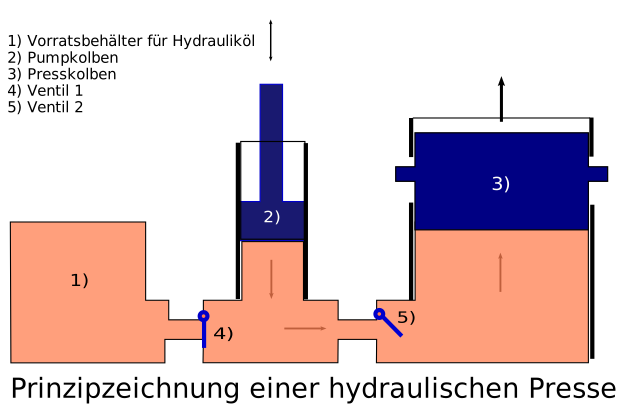
Pascal’s law says that pressure applied to an enclosed fluid is transmitted equally and undiminished to every point in the fluid and to the walls of the container.
Plain English: push on one part of a confined fluid, and the entire fluid feels the same pressure increase.
Hydraulic Systems
Pascal’s law is the principle behind hydraulic lifts, hydraulic brakes, hydraulic presses, and even the hydraulic systems that move heavy excavator arms. A small force applied to a small piston produces a pressure increase that’s transmitted to a large piston, where the same pressure × bigger area = much bigger output force.
A hydraulic lift uses Pascal's law. The same pressure acts on both pistons, but the larger piston has more area, producing a proportionally larger force. Credit: Wikimedia Commons, CC BY-SA
Worked Example: Hydraulic Lift
A mechanic pushes with 100 N on a piston of area 0.01 m². The car sits on a piston of area 1 m². What force lifts the car?
P1=F1/A1=100/0.01=10,000 Pa.
F2=P×A2=10,000×1=10,000 N.
The mechanic’s 100 N becomes 10,000 N at the lifting piston — enough to easily lift a small car. The area ratio (100×) is the force multiplier.
The catch (Pascal’s law isn’t free): if the small piston gets pushed down 1 meter, the large piston only rises 0.01 m (1 cm). Same volume of fluid moves, but spread over a much larger piston. Work done is identical on both sides: 100×1=10,000×0.01=100 J. Conservation of energy strikes again — there’s no free lunch in physics.
A tank contains oil (ρ=800 kg/m³) floating on water (ρ=1000 kg/m³). The oil layer is 2 m thick; the water layer beneath is 3 m deep. What is the gauge pressure at the bottom?
Click to reveal answer
≈ 45,080 Pa. Add each layer's contribution: P=ρoilghoil+ρwaterghwater=(800)(9.8)(2)+(1000)(9.8)(3)=15,680+29,400=45,080 Pa. You can't just use ρgh with one density when fluids are layered.
In a hydraulic lift, the input piston has radius 2 cm and the output piston has radius 20 cm. If you apply 50 N to the input, what force does the output piston exert?
Click to reveal answer
5000 N.A=πr2, so the area ratio is (20)2/(2)2=100. F2=F1×(A2/A1)=50×100=5000 N. Notice you only need the *ratio* of the radii squared — the π cancels.
A submarine descends to 200 m below the ocean surface. What is the gauge pressure at that depth, in atm?
Click to reveal answer
About 20 atm. Use the rule of thumb: every 10 m of water adds ~1 atm. At 200 m → ~20 atm gauge. (Math check: ρgh≈1000×10×200=2×10⁶ Pa = 20 atm.) Total absolute pressure ≈ 21 atm.
Step into a swimming pool and you immediately feel lighter. Try to push a beach ball underwater and it pushes back with surprising force.
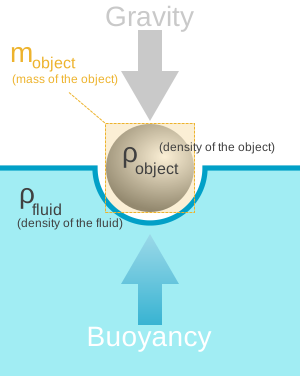
Both experiences are buoyancy — an upward force that every fluid exerts on every object that’s submerged (or partly submerged) in it. The amount of upward push depends on how much fluid the object displaces, not on the object itself.
Archimedes worked this out 2200 years ago — supposedly while taking a bath, then running naked through Syracuse shouting “Eureka!” The legend may be embellished, but the physics he discovered is exactly what the MCAT still tests. Buoyancy is one of the most reliably tested topics in fluids.
🎯 Predict First
A block of wood with density 500 kg/m³ floats in water (density 1000 kg/m³). How much of the block sits below the waterline?
Test your prediction below. Set the two densities, press Drop, and watch where the block settles. Compare the red weight arrow with the blue buoyant force arrow: the block stops sinking exactly when the two arrows match, and if the buoyant force maxes out (fully submerged) before it can match the weight, the block sinks.
The critical detail: buoyant force depends on the fluid’s density (not the object’s), and on the volume displaced (which equals the volume of the object that’s actually submerged).
Buoyancy in action. The upward buoyant force equals the weight of the fluid displaced. Whether the object floats or sinks depends on how its weight compares to that buoyant force. Credit: Wikimedia Commons, CC BY-SA
Floating vs. Sinking
Whether an object floats or sinks depends on how its density compares to the fluid:
ρobject<ρfluid → floats (buoyant force can match the object’s weight before it’s fully submerged).
ρobject=ρfluid → neutrally buoyant (hovers wherever you put it).
ρobject>ρfluid → sinks (even fully submerged, buoyancy can’t match the weight).
For a floating object, the buoyant force exactly equals the object’s weight:
Fb=mg⇒ρfluid⋅Vsubmerged⋅g=ρobject⋅Vtotal⋅g
This rearranges to a powerful and famous result:
Apparent Weight
When you weigh an object while it’s submerged in a fluid, the scale reads less than the object’s true weight, because the buoyant force pushes up and partially supports it.
Why Steel Ships Float
A solid steel block (ρ≈7800 kg/m³) sinks the moment it touches water. So how does a steel ship float?
The trick is shape. A ship isn’t a solid block — it’s a hollow shell that encloses an enormous volume of air. The relevant quantity is the average density of the entire ship (steel hull + air-filled interior), and that average density is much less than water.
Same way: Vdisplaced for a ship is huge — the hull pushes aside a lot of water. The weight of that displaced water (the buoyant force) exceeds the ship’s total weight. As long as the average density of the ship-plus-its-internal-air is less than water, it floats. Crush the same ship into a solid steel cube and it sinks.
Buoyancy in Different Fluids
An object that sinks in one fluid might float in another. A swimmer who barely floats in a freshwater pool (ρ=1000 kg/m³) bobs effortlessly in the Dead Sea (ρ≈1240 kg/m³) because the saltier, denser water provides more buoyant force per unit volume displaced.
The same logic applies in gases: a helium balloon rises in air because helium (ρ≈0.16 kg/m³) is much less dense than air (ρ≈1.2 kg/m³). The buoyant force from the displaced air exceeds the weight of the helium plus the balloon material. Same physics — just less dramatic, because gas densities are tiny.
Common MCAT Buoyancy Traps
“The heavier object experiences more buoyancy.” Wrong. Buoyant force depends on volume displaced and fluid density, not on the object’s weight or mass.
“The buoyant force on a sinking object is zero.” Wrong. A sinking object still experiences a buoyant force — it just isn’t big enough to prevent sinking. Fb<mg for any sinking object, but Fb>0.
Confusing ρfluid with ρobject. The buoyant force formula uses the fluid’s density. The object’s density only matters for the object’s weight.
Worked Example
A 5 kg object with volume 0.004 m³ is fully submerged in water. Find the buoyant force and the apparent weight. (g=9.8 m/s².)
Fb=ρwater⋅V⋅g=1000×0.004×9.8=39.2 N.
Actual weight: mg=5×9.8=49 N.
Apparent weight: 49−39.2=9.8 N.
Object density: ρ=m/V=5/0.004=1250 kg/m³ > 1000 kg/m³ → it does sink. But underwater it feels only 51 as heavy as it does on land.
A 5 kg object with a volume of 0.004 m³ is fully submerged in water. What is the buoyant force, and what is the apparent weight?
Click to reveal answer
Fb=39.2 N, apparent weight = 9.8 N.Fb=ρwater⋅V⋅g=1000×0.004×9.8=39.2 N. Actual weight =5×9.8=49 N. Apparent = 49−39.2=9.8 N. The object sinks (its density 1250 kg/m³ > 1000 kg/m³) but feels much lighter underwater.
A block of wood (ρ=600 kg/m³) is placed in oil (ρ=800 kg/m³). What fraction of the block is submerged?
Click to reveal answer
75% submerged. Fraction submerged = ρobject/ρfluid=600/800=0.75. Three-quarters of the block is below the oil surface; one-quarter is above.
A boat with mass 2000 kg is floating in seawater (ρ=1025 kg/m³). What volume of seawater does it displace?
Click to reveal answer
About 1.95 m³. A floating boat displaces a weight of water equal to its own weight: ρwaterVg=mg⇒V=m/ρwater=2000/1025≈1.95 m³. (Equivalently, ~1950 L or about 8 standard bathtubs of water.)
Pull a rubber band: it stretches a lot. Hang the same weight from a steel wire: it stretches almost imperceptibly. Both deform — the question is how much and whether they snap back.
Every solid material deforms under force. Some return to their original shape (elastic), others stay deformed (plastic), and pushing too hard breaks them entirely. This section gives you the language — stress, strain, Young’s modulus, elastic limit — to describe all of that quantitatively.
The MCAT doesn’t lean heavily on this topic, but it’s on the AAMC content list and shows up in passages about bones, tendons, materials engineering, and biomechanics. It also marks the natural boundary between solid mechanics and the fluid mechanics in the rest of this chapter.
Stress: Force per Area
Stress measures how much force is applied per unit cross-sectional area. The formula looks identical to pressure — but stress applies specifically to solids being deformed.
There are three kinds of stress:
Tensile stress — pulling/stretching forces (a rubber band being stretched, a tendon being loaded).
Compressive stress — squeezing/crushing forces (stepping on a soda can, your femur supporting your weight).
Shear stress — forces parallel to a surface in opposite directions (sliding the top of a deck of cards sideways while holding the bottom).
Strain: The Response to Stress
Strain measures how much the material actually deforms in response to stress. It’s a dimensionless ratio.
Young’s Modulus: Stiffness
Young’s modulus (also called the elastic modulus) measures stiffness — how much stress is needed to produce a given strain.
Material
Young’s Modulus (GPa)
Relative stiffness
Steel
~200
Very stiff
Bone (cortical)
~18
Stiff
Tendon
~1.5
Moderately flexible
Rubber
~0.01
Very flexible
The Elastic Limit
Below the elastic limit (a.k.a. yield point), a material returns to its original shape when force is removed — like a stretched rubber band snapping back. Above the elastic limit, the material undergoes plastic (permanent) deformation — it stays bent or stretched even after you let go. Push even further and you reach the fracture point, where the material breaks.
You’ve seen this every time you’ve bent a paperclip a little (it springs back) versus bent it a lot (it stays bent) versus bent it back-and-forth too many times (it snaps).
Why This Matters for Fluids
This section sits inside the fluids chapter because it marks the boundary between solid and fluid behavior. The defining property of a fluid is that it cannot resist shear stress — apply any shearing force and the fluid simply flows in response. Solids, in contrast, can hold a fixed deformation against shear (within their elastic range).
That single distinction — solids resist shear, fluids don’t — is the reason fluid mechanics exists as its own branch of physics. Once you can’t assume things hold their shape, all the equations change. Everything in the rest of this chapter (Bernoulli, continuity, viscosity, Pascal’s law) flows (literally) from this property.
Worked Example
A bone of cross-sectional area 4×10⁻⁴ m² is loaded with a 2000 N compressive force (about 200 kg pushing down). If the bone is 0.4 m long and Young’s modulus for bone is 1.8×10¹⁰ Pa, how much does it shorten?
Stress: σ=F/A=2000/(4×10−4)=5×106 Pa.
Strain: ε=σ/E=(5×106)/(1.8×1010)≈2.78×10−4.
ΔL=ε⋅L0=2.78×10−4×0.4≈1.1×10⁻⁴ m = 0.11 mm.
So a 200 kg load shortens the bone by only about a tenth of a millimeter. Bone is impressively stiff — which is why your skeleton can support you without obviously deforming.
A wire with cross-sectional area 2×10⁻⁶ m² and original length 3 m stretches by 0.6 mm under a 400 N load. What is Young's modulus?
Click to reveal answer
E=1×10¹² Pa = 1000 GPa. Stress = F/A=400/(2×10−6)=2×108 Pa. Strain = ΔL/L0=0.0006/3=2×10−4. E=σ/ε=1012 Pa. Extremely stiff — consistent with a very rigid metal.
What is the fundamental difference between a solid and a fluid in terms of how they respond to stress?
Click to reveal answer
Solids can resist shear stress; fluids cannot. Apply a shear force to a solid and it deforms to a fixed shape and holds it. Apply the same force to a fluid and it flows continuously for as long as the force is applied. Both solids and fluids resist compressive stress.
A tendon stretches 2% under load (strain = 0.02). If Young's modulus for the tendon is 1.5×10⁹ Pa, what is the stress?
Click to reveal answer
σ=3×10⁷ Pa.σ=E⋅ε=(1.5×10⁹)(0.02)=3×10⁷ Pa = 30 MPa. (For context, this is roughly the maximum stress a healthy tendon can handle before approaching its fracture point.)
Try drinking honey through a straw. Now try the same straw with water. The water flows easily; the honey barely moves. Same straw, same suction — wildly different flow.
The difference is viscosity: a fluid’s internal resistance to flow. Viscosity is to fluids what friction is to solids — and it has huge implications for everything from blood circulation, to IV drip rates, to why your motor oil gets a “winter” rating.
This section also introduces Poiseuille’s law, an equation with a single, dramatic feature: flow depends on the fourth power of the tube radius. That r4 explains atherosclerosis, why thin needles drip slowly, and why a stuffy nose feels so much worse than the slight swelling actually warrants.
Viscosity: Fluid Friction
Viscosity (η, Greek “eta”) measures a fluid’s resistance to flowing. High-viscosity fluids (honey, syrup, motor oil) flow slowly. Low-viscosity fluids (water, alcohol, air) flow easily.
The SI unit of viscosity is the pascal-second (Pa·s). Blood is about 3–4 × 10⁻³ Pa·s — roughly 3 to 4 times more viscous than water (the cells in suspension cause the extra resistance).
Viscosity generally decreases as temperature increases. Warm honey pours faster than cold honey. This is also why blood flows more easily at body temperature than at room temperature.
Laminar vs. Turbulent Flow
Fluid flow comes in two fundamentally different patterns:
Laminar flow is smooth, orderly, layered flow. Each layer slides past its neighbor without mixing. In a pipe, the velocity profile is parabolic — fastest at the center, dropping to zero right at the walls (where friction with the pipe halts the fluid).
Turbulent flow is chaotic — eddies, vortices, swirling, mixing. It happens at high speeds, in wide pipes, and in low-viscosity fluids.
Poiseuille’s Law
This is the single most important equation in MCAT fluid dynamics. It describes the volume flow rate of a viscous fluid through a cylindrical tube — a blood vessel, an IV line, a pipe.
The r4 Dependence: THE Key Insight
Of all the variables, the radius matters far more than anything else because it appears as the fourth power. This is the single most important takeaway from the entire fluid-dynamics section.
Putting numbers to it:
Radius change
Flow change
Clinical example
2× radius
16× flow
Wide-open vasodilation
1.5× radius
~5× flow
Moderate vasodilation
0.75× radius
~32% of original
Mild atherosclerosis
0.5× radius
~6% of original
Moderate atherosclerosis
0.25× radius
~0.4% of original
Severe stenosis
Effects of the Other Variables
While radius dominates, the other variables still matter:
Pressure difference (ΔP): Flow is directly proportional. Double the pressure gradient → double the flow. This is why the heart pumps harder when arteries narrow — it has to overcome more resistance.
Viscosity (η): Flow is inversely proportional. Thicker blood (dehydration, polycythemia) flows more slowly. Dehydration also raises clotting risk for the same reason — sluggish flow.
Length (L): Flow is inversely proportional. A longer tube = more resistance. Rarely changes in blood vessels (they don’t get longer overnight), but matters for IV lines and catheters.
Resistance to Flow
Poiseuille’s law can be rewritten in a form that looks just like Ohm’s law for circuits (V=IR):
This analogy isn’t a coincidence. Many physical systems share the structure “driving force = (rate of flow) × resistance” — fluid in pipes, current in wires, heat in walls, even gas through membranes.
Worked Example
A blood vessel with radius r has its radius cut in half by atherosclerotic plaque. By what factor must the heart raise blood pressure to maintain the original flow rate?
Original flow: Q0∝r4.
New flow with half-radius: (r/2)4=r4/16 — only 161 of original.
To restore flow to Q0, the pressure difference must rise by a factor of 16.
That’s why severe atherosclerosis is so dangerous: not only does it slow flow drastically, it forces the heart to work enormously harder, leading to hypertension, heart strain, and eventually failure.
An artery's radius is reduced by 50% due to plaque buildup. By what factor must the pressure difference increase to maintain the original flow rate?
Click to reveal answer
16×.Q∝r4, so halving r cuts flow to (1/2)4=1/16 of normal. To restore the original Q, ΔP must increase 16-fold. This is why atherosclerosis leads to hypertension and heart failure — the heart has to work enormously harder to keep blood flowing through narrowed vessels.
A nurse compares two IV catheters: one with twice the radius of the other, but half the length. How does the flow through the larger, shorter catheter compare?
Click to reveal answer
32× more flow. Doubling radius: flow ×24 = 16. Halving length: flow ×2 (Q ∝ 1/L). Combined: 16×2=32. This is why trauma patients get large-bore, short IV catheters — to maximize fluid delivery rate.
In a horizontal pipe, the pressure difference and length are unchanged, but the fluid is replaced with one that has 4× the viscosity. What happens to the flow rate?
Click to reveal answer
It drops to 41 of the original.Q∝1/η, so 4× the viscosity → 41 the flow. (For perspective, switching from water to honey would change viscosity by ~10,000× and slow flow to a near-stop.)
Put your thumb partly over the end of a garden hose. The water that was streaming out gently now sprays out fast. You didn’t change the faucet, the pressure, or the water supply — you just made the opening smaller. Yet the water is way faster.
Why? The same amount of water still has to come out per second. If it has less area to go through, it has to move faster to get the same volume out per unit time.
That intuition is the continuity equation, and it underlies everything from garden hoses, to plumbing, to why blood slows down in your capillaries (which is critical for letting oxygen exchange happen).
Conservation of Mass in Fluids
For an incompressible fluid (one whose density doesn’t change — like water or blood), whatever flows into a pipe has to flow out. Mass can’t accumulate inside a rigid tube or vanish into thin air. That conservation of mass leads directly to the continuity equation.
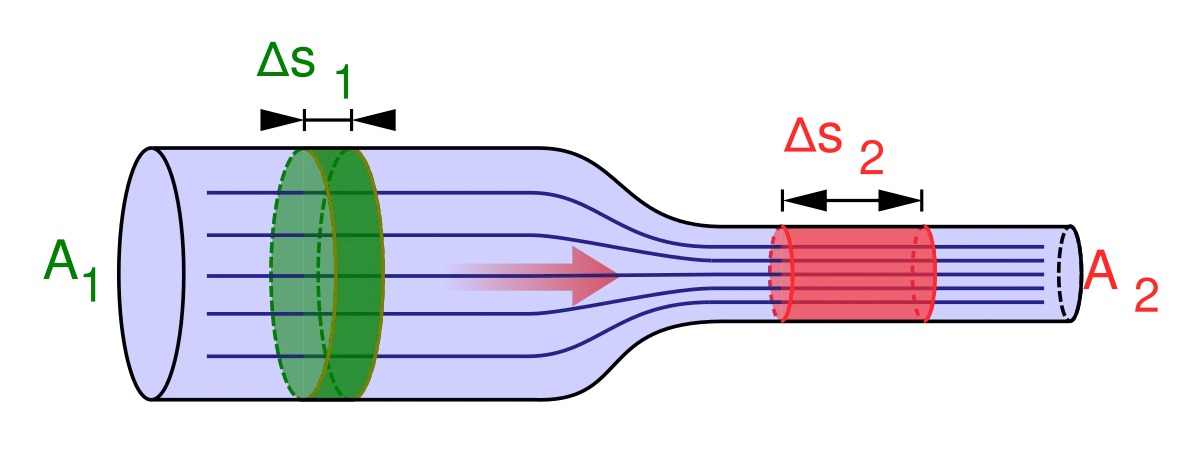
The key insight: when the cross-sectional area shrinks, velocity grows (and vice versa). Inversely proportional.
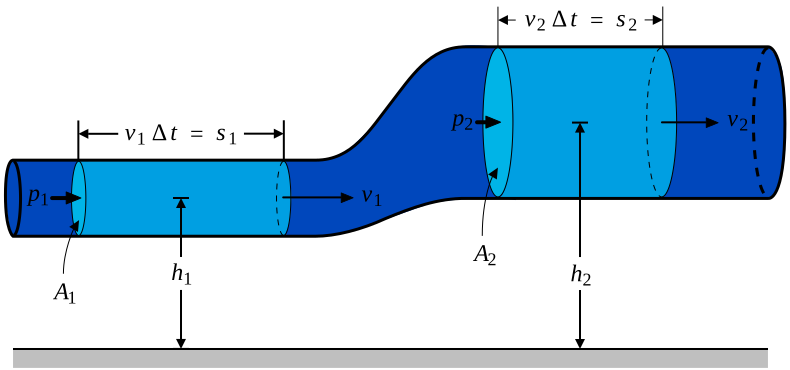
The continuity equation in action. As the pipe narrows, the same volume of fluid must pass through a smaller area per unit time, so velocity increases. A1v1=A2v2. Credit: Wikimedia Commons, CC BY-SA
Halve the area → double the velocity.
Quarter the area → quadruple the velocity.
The Importance of Total Cross-Sectional Area
Here’s where most students trip up: the continuity equation uses the total cross-sectional area at a given level of the system, not the area of a single tube.
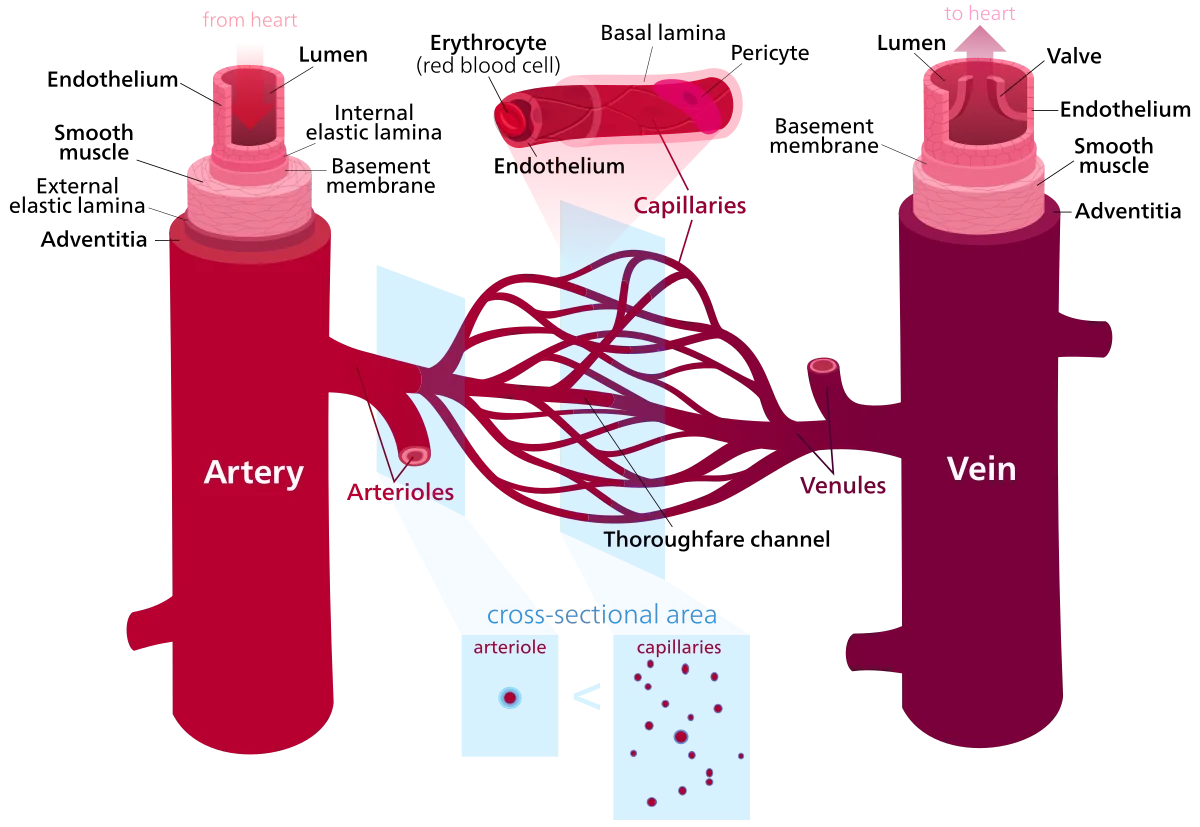
The circulatory system is the canonical example. The aorta is one big tube. It branches into arteries, then arterioles, then billions of capillaries. Each individual capillary is microscopic — but with billions of them in parallel, the total cross-sectional area of all the capillaries combined is roughly 600 times the area of the aorta.
Vessel type
Total cross-section (cm²)
Velocity (cm/s)
Aorta
~3–5
~40
Arteries
~20
~10
Arterioles
~40
~5
Capillaries
~3000–6000
~0.03
Venules
~250
~0.5
Veins
~80
~5
Vena cavae
~14
~15
Notice the pattern: blood speeds up again in the veins and vena cavae as the total cross-section shrinks on the return trip. The continuity equation works in both directions — area and velocity always trade.
When Continuity Does NOT Apply
The continuity equation assumes:
Incompressible fluid — density stays constant. Valid for liquids; not valid for gases at varying pressures. (For the MCAT, blood and water are always incompressible.)
Steady flow — flow rate doesn’t change with time. Real heartbeats are pulsatile, but MCAT problems typically assume steady-state.
No leaks — no fluid enters or leaves the system between the two points. If a pipe has a hole or a side branch, you have to account for it separately.
Worked Example
A garden hose has a diameter of 2 cm. You attach a nozzle that narrows the opening to 0.5 cm diameter. If water flows through the hose at 1 m/s, what’s the speed coming out of the nozzle?
So the water comes out 16× faster than it was moving inside the hose — about 36 mph. That’s exactly why nozzles let you spray water across a yard.
Blood flows through the aorta (radius = 1.5 cm) at 30 cm/s. If the total cross-sectional area of all capillaries is 3000 cm², what is the blood velocity in the capillaries?
Click to reveal answer
About 0.07 cm/s.Aaorta=πr2=π(1.5)2≈7.07 cm². vcap=(Aaorta⋅vaorta)/Acap=(7.07×30)/3000≈0.07 cm/s. This very slow velocity is biologically critical — it gives RBCs time to exchange O₂ and CO₂ across capillary walls.
A pipe narrows from a diameter of 10 cm to a diameter of 5 cm. The fluid velocity in the wide section is 2 m/s. What is the velocity in the narrow section?
Click to reveal answer
8 m/s. Area scales with diameter squared, so halving diameter cuts area by 4×. v2=v1×(A1/A2)=2×4=8 m/s. Fluid moves 4× faster in the narrow section.
If a single artery branches into 5 smaller arteries, each with 41 the cross-sectional area of the original, how does blood velocity compare in the smaller arteries?
Click to reveal answer
54 (80%) of the original speed. Total area in the smaller arteries: 5×(1/4)A=(5/4)A. By continuity: A1v1=(5/4)A⋅v2 → v2=(4/5)v1=0.8v1. Blood slightly *slows* even though each individual branch is narrower — total area went up, so velocity went down.
Stand in a hot shower with the water running hard. Watch the curtain. Within a few seconds, it creeps inward and clings to your legs.
You might think the water is somehow pulling the curtain — but the water never touches the curtain. What’s actually happening: the air inside the shower is moving (rushing upward with the steam, swirling around). That moving air has lower pressure than the still air outside the curtain. The higher outside pressure pushes the curtain in.
That counterintuitive idea — fast-moving fluid has lower pressure than slow-moving fluid — is the punch of Bernoulli’s equation, one of the most elegant ideas in fluid dynamics. Once you internalize it, you can explain shower curtains, airplane lift, why a window slams shut when wind blows past, and how a doctor uses a venturi nebulizer to spray medication.
Bernoulli’s Equation: Energy Conservation for Fluids
Bernoulli’s equation is just conservation of energy applied to a flowing fluid. The same way a roller coaster trades PE for KE on the way down, a moving fluid trades among three forms of energy: pressure energy, kinetic energy, and gravitational potential energy.
Between any two points along a streamline:
P1+21ρv12+ρgh1=P2+21ρv22+ρgh2
Bernoulli’s equation in a pipe. The sum of pressure energy, kinetic energy, and gravitational potential energy per unit volume stays constant along a streamline. Credit: Wikimedia Commons, CC BY-SA
The Big Takeaway: Speed Up → Pressure Down
The most-tested consequence of Bernoulli’s equation is dead simple:
When fluid velocity increases, pressure decreases. And vice versa.
Often this is the only thing you need to know for an MCAT question. The exam describes a situation where fluid speeds up and asks what happens to the pressure — the answer is essentially always “it decreases.”
🎯 Predict First
Blood flows through a horizontal artery that narrows to half its diameter at a plaque. Compared with the wide section, the narrow section has...
Watch the tracer particles speed up as they squeeze through the throat, and keep an eye on the two standpipe gauges: P₁ sits over the wide section and P₂ over the constriction. Tighten the constriction or raise the flow rate and watch P₂ fall. The drop scales with v2, so small changes in speed produce large changes in pressure.
v₁: 2.0 m/sv₂: 5.6 m/sP₁: 110 kPaP₂: 96.6 kPa
Assumptions (When Bernoulli’s Applies)
Bernoulli’s holds for an ideal fluid:
Incompressible — constant density (true for liquids).
Non-viscous — no internal friction (an approximation; works well for water and air at moderate speeds).
Laminar flow — smooth, non-turbulent.
Steady flow — flow rate constant in time.
When viscosity matters (narrow blood vessels, thick fluids), Bernoulli’s alone isn’t enough — you need Poiseuille’s law (§4.6) to capture the viscous losses.
Special Cases
Case 1: Fluid at rest (v1=v2=0). Bernoulli reduces to P1+ρgh1=P2+ρgh2, or ΔP=ρgΔh — exactly the hydrostatic pressure equation from §4.3. No coincidence: hydrostatics is just Bernoulli with no flow.
Case 2: Same height (h1=h2). Bernoulli reduces to P1+21ρv12=P2+21ρv22. Pure horizontal-flow case. This is the version that shows up in 90% of MCAT problems. Speed up → pressure drops; slow down → pressure rises.
Case 3: Open tank draining (Torricelli’s theorem). A tank with a hole at depth h below the water surface drains at v=2gh — the same speed an object would have after falling from height h. Pure energy conservation: gravitational PE → KE.
Applications
Airplane lift. Air moves faster over the curved upper surface of a wing than the flatter lower surface. Faster air → lower pressure on top → net upward force = lift. (Real aerodynamics is more complex — angle of attack and circulation matter too — but the Bernoulli explanation is the one the MCAT expects.)
Shower curtain effect. Fast-moving air inside the shower has lower pressure than the still air outside → net inward force on the curtain.
Chimney draft. Hot air rises fast in the chimney, creating low pressure at the base → fresh air gets sucked in from the room to feed the fire.
Carburetors and atomizers. Fast air over a small tube of liquid creates low pressure that pulls the liquid up, where it gets sprayed into a fine mist (think nebulizers, perfume sprayers, paint sprayers).
Wind blowing past a window. Fast outside air lowers outside pressure → indoor pressure pushes the window outward (or the curtains inward) — sometimes hard enough to slam doors shut.
Worked Example
Water flows through a horizontal pipe that narrows from 4 cm² to 1 cm². The pressure in the wide section is 200,000 Pa and the velocity is 1 m/s. Find the pressure in the narrow section. (ρwater=1000 kg/m³.)
Step 2 — Bernoulli (same height, so h terms cancel).P1+21ρv12=P2+21ρv22.
200,000+21(1000)(1)2=P2+21(1000)(16).
200,500=P2+8000⇒P2=192,500 Pa.
Pressure dropped by 7500 Pa as the fluid sped up — exactly as Bernoulli predicts.
Water flows through a horizontal pipe that narrows from 4 cm² to 1 cm². Pressure in the wide section is 200,000 Pa and velocity is 1 m/s. Find the pressure in the narrow section. (ρ=1000 kg/m³)
A large water tank has a small hole 5 m below the water surface. How fast does water exit the hole? (Tank open to atmosphere.)
Click to reveal answer
v≈9.9 m/s. Torricelli: v=2gh=2×9.8×5≈98≈9.9 m/s. Same speed an object would reach by falling 5 m from rest — pure energy conservation (gravitational PE → KE).
In a Venturi tube (a pipe that narrows in the middle), fluid speeds up and pressure drops in the constricted section. Where would you place a vertical tube to draw liquid up by suction (an “atomizer”)?
Click to reveal answer
At the constriction (narrow section). The narrow section has the lowest pressure (Bernoulli). A side tube there can draw liquid up from a reservoir (atmospheric pressure pushes the liquid up the tube into the low-pressure region). This is exactly how perfume sprayers, paint sprayers, and medical nebulizers work.
Hold two sheets of paper a couple centimeters apart in front of your face. Now blow hard between them. Most people expect the sheets to fly apart — but they actually pull together.
That’s a parlor trick, but the physics is real and important. The fast-moving air between the sheets has lower pressure than the still air outside the sheets. Higher outside pressure pushes the sheets inward.
This is the Venturi effect — the predictable consequence of fluid speeding up through a constriction (and, by Bernoulli, dropping in pressure). Once you see this pattern, you’ll see it everywhere: airplane lift, perfume sprayers, asthma attacks, atherosclerosis, the Pitot tube on the wing of every commercial aircraft.
The Venturi Effect
The Venturi effect is what happens when fluid passes through a constriction (a narrow section) in a pipe. It’s a direct combination of the continuity equation (§4.7) and Bernoulli’s equation (§4.8).
The logic chain:
Continuity: the same volume of fluid must pass through the narrow section per second as the wide section. So fluid velocity increases in the constriction.
Bernoulli: as velocity increases, pressure decreases.
Result: the narrow section has higher velocity and lower pressure than the wide sections on either side.
The Venturi Tube
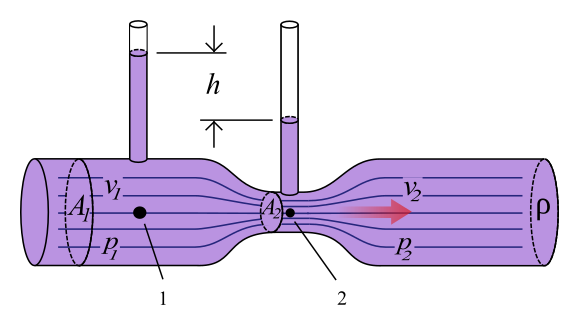
A Venturi tube is a pipe with a deliberately narrowed middle section (called the throat). Pressure gauges at the wide and narrow sections show a measurable pressure difference — lower in the throat where the fluid is moving fastest.
A Venturi tube with manometers (pressure gauges). Fluid speeds up through the throat, and the pressure drops — shown by the lower fluid level in the manometer at the constriction. Credit: Wikimedia Commons, CC BY-SA
Practical uses of the Venturi tube:
Measuring flow rate. Measure the pressure difference between the wide and narrow sections, plug into Bernoulli, and you get the flow rate. Industrial flow meters do exactly this.
Aspirators and atomizers. The low-pressure zone in the throat draws in a secondary fluid through a side tube. This is how perfume sprayers, paint sprayers, and old-school carburetors all work.
Medical nebulizers. Use the Venturi effect to draw liquid medication into a fast airstream and break it into a fine mist for inhalation.
The Pitot Tube
A pitot tube measures fluid velocity (most commonly airspeed on an aircraft). It works by comparing two pressure measurements:
Total (stagnation) pressure — measured by a tube pointing directly into the oncoming flow. The fluid is brought to a halt at the tube opening, converting all its KE into pressure: Ptotal=Pstatic+21ρv2.
Static pressure — measured by a port flush with the surface, perpendicular to the flow.
The difference between total and static pressure is the dynamic pressure (21ρv2), and from that you back out velocity:
v=ρ2(Ptotal−Pstatic)
Venturi Effect in the Body
The Venturi effect is responsible for several biological phenomena:
Airway narrowing in asthma. When bronchi constrict, air velocity in the narrowed airways increases (continuity). The resulting lower pressure can cause further collapse of the flexible airway walls, worsening the obstruction. This is a positive-feedback loop: narrowing → faster air → lower internal pressure → more collapse → more narrowing.
Atherosclerotic vessels. Blood flowing past a partial blockage speeds up. The Venturi-effect low-pressure zone at the narrowing can pull the vessel walls inward, worsening the obstruction over time.
Worked Example
Air flows through a horizontal Venturi tube. The wide section has area 20 cm² and the throat has area 5 cm². If air moves at 4 m/s in the wide section, what’s the air velocity in the throat?
Continuity: A1v1=A2v2⇒v2=(20/5)(4)=16 m/s.
Air moves 4× faster through the throat (because area dropped by 4×). And by Bernoulli, the pressure in the throat is lower than in the wide section — that’s the suction effect that makes Venturi devices useful.
Air flows through a horizontal Venturi tube with wide section area 20 cm² and throat area 5 cm². If velocity in the wide section is 4 m/s, what is the velocity in the throat?
Click to reveal answer
16 m/s. Continuity: v2=(A1/A2)v1=(20/5)(4)=16 m/s. Air moves 4× faster through the throat because the area is reduced 4×. Pressure also drops in the throat (Bernoulli).
Why might a partially blocked airway (asthma) collapse further during forced exhalation? Explain using the Venturi effect.
Click to reveal answer
Air speeds up through the narrowing (continuity) and pressure drops (Bernoulli). Because the airway walls are flexible, the higher pressure *outside* the airway pushes the walls inward — narrowing the airway further. The result is a positive-feedback loop: more narrowing → faster air → lower internal pressure → more collapse.
A Venturi atomizer has a side tube that opens into the throat of the Venturi tube. Why does liquid get drawn up that side tube when air flows through the main tube?
Click to reveal answer
Because the throat pressure is below atmospheric. Fast air through the throat creates low pressure (Venturi effect). Atmospheric pressure pushes liquid up the side tube into the low-pressure throat, where the airstream then carries the liquid away as a fine mist. This is exactly how perfume bottles, paint sprayers, and medical nebulizers work.
A water strider walks on a pond without sinking. A steel needle, carefully placed flat, floats on water despite being denser than water. A paper towel sucks up a spill, pulling water upward against gravity.
None of this can be explained by buoyancy or pressure. They all rely on surface tension and capillary action — forces that come from the molecular interactions at fluid surfaces and interfaces. These effects matter especially at small scales: thin tubes, narrow gaps, fine fibers. They’re also crucial in biology — surfactant in your lungs prevents the alveoli from collapsing every time you exhale.
Surface Tension
Molecules in the interior of a liquid are pulled equally in all directions by neighboring molecules. The forces cancel, and the molecule doesn’t experience any net pull.
Molecules at the surface are different. They have neighbors below them and to the sides — but no neighbors above. So they get pulled inward and sideways but not outward. That uneven pull creates surface tension, which makes the surface behave like a stretched elastic membrane.
Surface tension (γ) is measured in N/m (force per unit length of surface). Water has a relatively high surface tension (~0.073 N/m at 20°C) because of strong hydrogen bonds between water molecules.
Surfactants. Substances like soap dramatically reduce surface tension by inserting themselves into the surface and breaking up the hydrogen-bond network. This is why soapy water “wets” things better — it spreads and penetrates fabric far more easily than plain water.
Two types of intermolecular attraction matter for how fluids interact with surfaces:
Cohesion = attraction between molecules of the same substance (water-to-water). Cohesion is what creates surface tension.
Adhesion = attraction between molecules of different substances (water-to-glass). Adhesion is what makes water cling to the inside of a glass.
The Meniscus
Look at water in a thin glass tube — the surface curves upward at the edges. That curved surface is the meniscus, and its shape tells you which force is winning:
Concave meniscus (curves up at the edges) = adhesion > cohesion. Fluid is more attracted to the container walls than to itself. Example: water in glass.
Convex meniscus (curves down at the edges) = cohesion > adhesion. Fluid is more attracted to itself than to the walls. Example: mercury in glass.
Capillary Action
Capillary action is the ability of a liquid to flow into narrow spaces against gravity, driven by adhesion and surface tension. Dip a thin glass tube into water:
Water molecules adhere to the glass walls and start climbing up.
Surface tension pulls the rest of the water surface upward along with them.
The water column rises until the upward adhesive/surface-tension forces balance the downward weight of the water column.
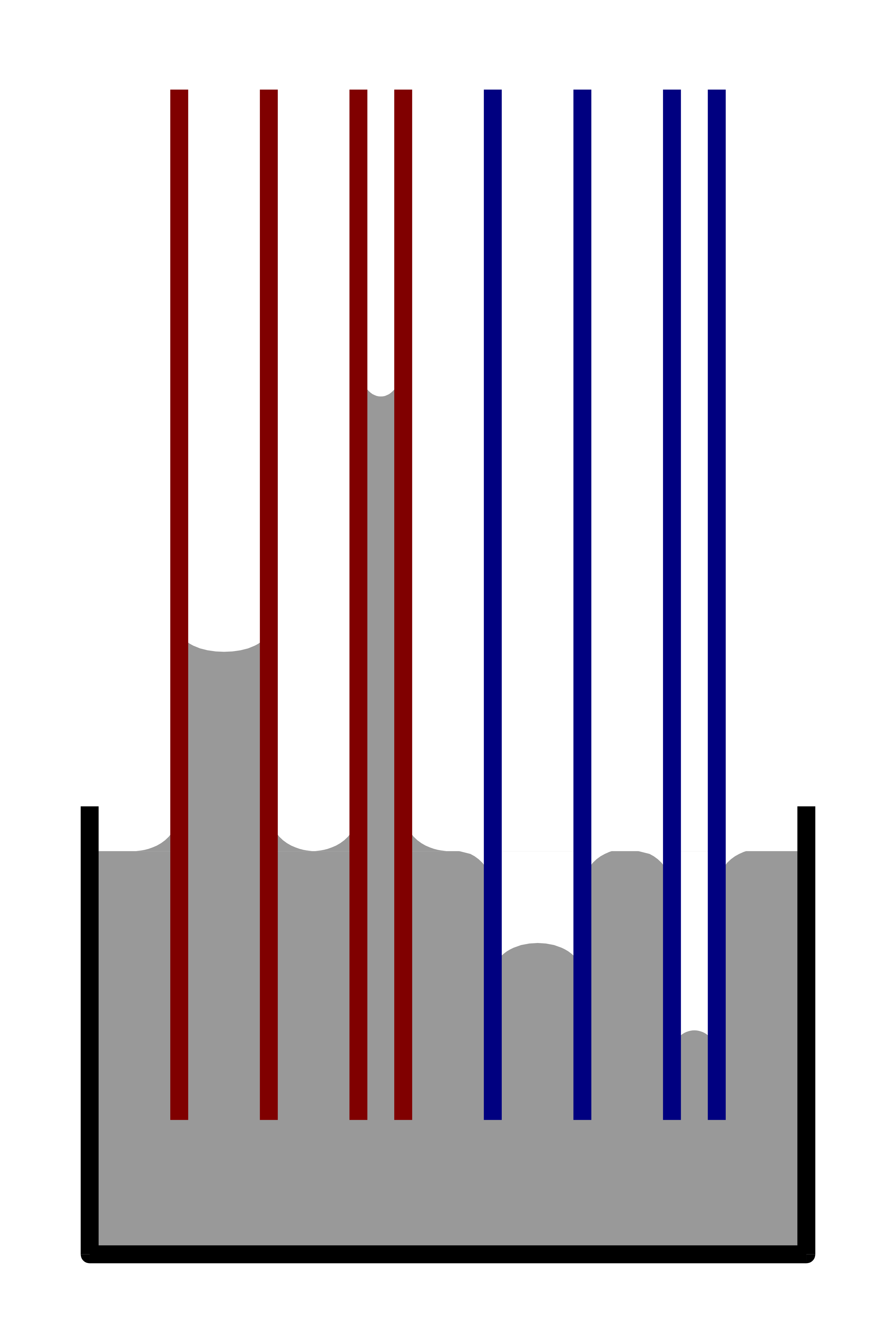
The narrower the tube, the higher the water rises. Why? A narrower tube has a larger surface-area-to-volume ratio, so the surface forces (adhesion, surface tension) win out over gravity (which pulls on the volume).
Capillary action: water rises higher in narrower tubes. Height of rise is inversely proportional to tube radius — adhesion at the surface dominates over the weight of the column. Credit: Wikimedia Commons, CC BY-SA
Mercury: The Opposite Case
Mercury in a glass tube does the opposite of water. Mercury atoms are strongly attracted to each other (high cohesion — that’s why mercury forms beads) but only weakly attracted to glass (low adhesion). So mercury in glass:
Forms a convex meniscus (curves down at the edges).
Shows capillary depression — mercury inside a thin tube sits lower than mercury outside.
Doesn’t wet glass surfaces — it beads up instead of spreading.
This is why mercury thermometers (when they were common) had cleanly readable, non-clinging mercury columns: the mercury didn’t smear on the glass, just rolled cleanly up and down.
Why does water form a concave meniscus in glass, while mercury forms a convex meniscus?
Click to reveal answer
Water in glass: adhesion (water-glass) > cohesion (water-water). Water climbs the glass walls → concave meniscus (curves up). Mercury in glass: cohesion (mercury-mercury) > adhesion (mercury-glass). Mercury pulls away from glass and toward itself → convex meniscus (curves down).
Two glass tubes are placed in water. Tube A has radius 0.5 mm; Tube B has radius 2 mm. Which has the higher water level, and why?
Click to reveal answer
Tube A (smaller radius). Capillary rise is inversely proportional to radius (h=2γcosθ/(ρgr)). Tube B has 4× the radius, so 41 the rise. Narrower tubes have higher surface-area-to-volume ratio, so adhesive forces dominate over gravity.
Why do soapy water and water "wet" surfaces differently? Use the concept of surface tension.
Click to reveal answer
Soap is a surfactant — it lowers water's surface tension. With lower surface tension, the water spreads more easily, penetrates into small gaps and fibers, and "wets" surfaces better. That's why soapy water cleans dishes more effectively than plain water — it can get into all the small crevices.
Every equation in this chapter was derived by physicists studying water in pipes. But the MCAT’s favorite application of fluid mechanics is not plumbing — it’s the human circulatory system. Blood vessels are pipes. The heart is a pump. Blood is a viscous fluid. The physics translates directly, and the exam exploits that connection relentlessly.
This section pulls together everything from the previous ten sections — continuity, Poiseuille, Bernoulli, hydrostatic pressure — and applies it all to the body. It also explains some surprising clinical phenomena: why aneurysms keep growing, why a 50% blockage drops flow by 94%, why your blood pressure differs by 100+ mmHg between your head and your feet, and why standing up too fast makes you dizzy.
The Circulatory System as a Fluid Network
The cardiovascular system is a closed-loop fluid circuit. The heart generates a pressure difference (ΔP). Blood flows through a branching network of vessels. The flow obeys exactly the same equations you’ve been working with throughout this chapter:
Fluid concept
Circulatory application
Continuity equation (A1v1=A2v2)
Why capillary blood flow is so slow
Poiseuille’s law (Q=πΔPr4/(8ηL))
Why mild atherosclerosis is so devastating
Bernoulli’s equation
Why aneurysms grow and stenotic vessels collapse
Hydrostatic pressure (P=ρgh)
Why blood pressure differs head vs. feet
Continuity and Capillary Blood Flow
Blood leaves the heart through the aorta at ~40 cm/s. By the time it reaches the capillaries, it has slowed to ~0.03 cm/s — about a thousand times slower. Why?
Continuity equation + total cross-sectional area. The aorta is a single tube (cross-section ~4 cm²). It branches into thousands of arteries, millions of arterioles, and billions of capillaries. The combined cross-sectional area of all the capillaries is ~3000–6000 cm² — over a thousand times the area of the aorta.
A1v1=A2v2⇒ if total A rises by 1000×, v drops by 1000×.
Total cross-sectional area at each level of the circulatory system. The capillaries have an enormous combined area, which is why blood flows slowest there — giving time for gas and nutrient exchange. Credit: Wikimedia Commons, CC BY-SA
Poiseuille’s Law and Atherosclerosis
Atherosclerosis (plaque buildup in arterial walls) narrows the vessel radius. Poiseuille’s law reveals why even moderate narrowing has catastrophic effects on flow.
Because flow scales with r4:
25% radius reduction → flow = (0.75)4≈32% of normal.
50% radius reduction → flow = (0.5)4=6.25% of normal.
75% radius reduction → flow = (0.25)4≈0.4% of normal.
A “50% blocked artery” sounds moderate. The actual flow is 6% of normal — enough to cause ischemia (tissue death from insufficient blood supply) and trigger a heart attack or stroke.
The body compensates for arterial narrowing in two ways:
Increase ΔP — the heart pumps harder (raising blood pressure). This works in the short term but overworks the heart and eventually causes heart failure.
Vasodilate other vessels — nitroglycerin and similar drugs widen coronary arteries. Because of the r4 dependence, even a small radius increase restores a lot of flow. (5% wider radius → ~22% more flow. 25% wider → 144% more flow.)
Bernoulli’s Equation and Aneurysms
An aneurysm is a localized balloon-like bulge in an artery wall. What does the physics say about flow through one?
Apply continuity, then Bernoulli:
The aneurysm has a larger cross-sectional area than the normal vessel.
By continuity, blood slows down in the bulge.
By Bernoulli, slower blood = higher static pressure in the bulge.
That extra pressure pushes outward on the already-weakened wall, causing the aneurysm to grow larger.
This is a self-reinforcing positive-feedback loop: bigger aneurysm → slower blood → more pressure on the wall → bigger aneurysm. Eventually it can rupture, which in the aorta is often fatal. This is why doctors monitor known aneurysms carefully and intervene surgically before they reach a critical size.
Stenosis: The Opposite of Aneurysm
A stenosis is a narrowing of a vessel, usually from plaque. Same physics, opposite direction:
Smaller cross-section → blood speeds up (continuity).
Low pressure can pull flexible vessel walls inward, worsening the narrowing.
So stenosis also has a positive-feedback loop, just running the other way. And it combines with Poiseuille’s r4 effect to drastically reduce downstream flow.
Blood Pressure Measurement
When blood pressure is measured with a sphygmomanometer (the inflatable arm cuff), the underlying physics is fluid flow:
The cuff inflates above systolic pressure, completely compressing the brachial artery → flow stops.
The cuff slowly deflates. When the cuff pressure drops just below systolic pressure, blood squirts through the partially compressed artery — but only briefly during each systole.
That intermittent, turbulent flow produces audible Korotkoff sounds (heard through a stethoscope).
As cuff pressure drops below diastolic pressure, the artery is fully open all the time, flow becomes laminar, and the sounds disappear.
So systolic = the cuff pressure where you first hear Korotkoff sounds; diastolic = the pressure where the sounds vanish. The whole technique works because turbulent flow is audible and laminar flow is silent.
Hydrostatic Pressure and Posture
Blood pressure isn’t constant throughout the body — gravity pulls blood downward, so there’s a hydrostatic column (P=ρgh) on top of whatever pressure the heart provides.
Standing upright, blood pressure in your feet is higher than at your heart by ρgh, where h is the vertical distance heart-to-feet (~1.3 m). With ρblood≈1060 kg/m³:
ΔP=(1060)(9.8)(1.3)≈13,500 Pa≈100 mmHg
So if heart-level BP is 80120, foot-level BP is roughly 180220. Brain-level BP (~0.4 m above the heart) is roughly 5090.
A patient has an aortic aneurysm where the vessel diameter is twice normal. By what factor does blood velocity change in the aneurysm, and what happens to the lateral pressure on the vessel wall?
Click to reveal answer
Velocity drops to 41 of normal; lateral pressure rises. Diameter doubles → area increases by 4× (A=πr2). By continuity, v decreases by 4×. By Bernoulli, slower velocity → higher static (lateral) pressure on the vessel wall. That extra pressure pushes outward on the weakened wall, worsening the aneurysm — a dangerous positive-feedback loop.
A coronary artery has its radius reduced by 50% from atherosclerotic plaque. By what factor does blood flow decrease? If the body tries to maintain the original flow, by what factor must the pressure gradient increase?
Click to reveal answer
Flow drops to 161 of normal; pressure gradient must rise 16×. Flow ∝ r4, so halving the radius drops flow to (0.5)4=1/16≈6%. To restore Q, ΔP must increase 16×. This is why atherosclerosis leads to hypertension — the heart has to generate enormously higher pressures to force adequate blood through narrowed arteries.
If the systolic pressure at heart level is 120 mmHg, what is it (approximately) at the brain level (~0.4 m above the heart)? (ρblood≈1060 kg/m³, g=10 m/s²)
Click to reveal answer
About 90 mmHg. Hydrostatic drop: ρgh=(1060)(10)(0.4)≈4240 Pa. Convert: 4240/133≈32 mmHg. So brain pressure ≈ 120−32≈88 mmHg. (We use 1 mmHg ≈ 133 Pa.) Conversely, blood pressure in your feet would be ~30 mmHg *higher* than at the heart.