
Buoyancy
Step into a swimming pool and you immediately feel lighter. Try to push a beach ball underwater and it pushes back with surprising force.
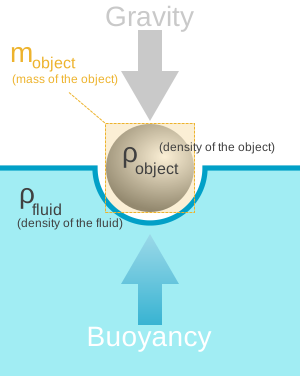
Both experiences are buoyancy — an upward force that every fluid exerts on every object that’s submerged (or partly submerged) in it. The amount of upward push depends on how much fluid the object displaces, not on the object itself.
Archimedes worked this out 2200 years ago — supposedly while taking a bath, then running naked through Syracuse shouting “Eureka!” The legend may be embellished, but the physics he discovered is exactly what the MCAT still tests. Buoyancy is one of the most reliably tested topics in fluids.
A block of wood with density 500 kg/m³ floats in water (density 1000 kg/m³). How much of the block sits below the waterline?
Test your prediction below. Set the two densities, press Drop, and watch where the block settles. Compare the red weight arrow with the blue buoyant force arrow: the block stops sinking exactly when the two arrows match, and if the buoyant force maxes out (fully submerged) before it can match the weight, the block sinks.
Archimedes’ Principle
The critical detail: buoyant force depends on the fluid’s density (not the object’s), and on the volume displaced (which equals the volume of the object that’s actually submerged).
Floating vs. Sinking
Whether an object floats or sinks depends on how its density compares to the fluid:
- → floats (buoyant force can match the object’s weight before it’s fully submerged).
- → neutrally buoyant (hovers wherever you put it).
- → sinks (even fully submerged, buoyancy can’t match the weight).
For a floating object, the buoyant force exactly equals the object’s weight:
This rearranges to a powerful and famous result:
Apparent Weight
When you weigh an object while it’s submerged in a fluid, the scale reads less than the object’s true weight, because the buoyant force pushes up and partially supports it.
Why Steel Ships Float
A solid steel block ( kg/m³) sinks the moment it touches water. So how does a steel ship float?
The trick is shape. A ship isn’t a solid block — it’s a hollow shell that encloses an enormous volume of air. The relevant quantity is the average density of the entire ship (steel hull + air-filled interior), and that average density is much less than water.
Same way: for a ship is huge — the hull pushes aside a lot of water. The weight of that displaced water (the buoyant force) exceeds the ship’s total weight. As long as the average density of the ship-plus-its-internal-air is less than water, it floats. Crush the same ship into a solid steel cube and it sinks.
Buoyancy in Different Fluids
An object that sinks in one fluid might float in another. A swimmer who barely floats in a freshwater pool ( kg/m³) bobs effortlessly in the Dead Sea ( kg/m³) because the saltier, denser water provides more buoyant force per unit volume displaced.
The same logic applies in gases: a helium balloon rises in air because helium ( kg/m³) is much less dense than air ( kg/m³). The buoyant force from the displaced air exceeds the weight of the helium plus the balloon material. Same physics — just less dramatic, because gas densities are tiny.
Common MCAT Buoyancy Traps
- “The heavier object experiences more buoyancy.” Wrong. Buoyant force depends on volume displaced and fluid density, not on the object’s weight or mass.
- “The buoyant force on a sinking object is zero.” Wrong. A sinking object still experiences a buoyant force — it just isn’t big enough to prevent sinking. for any sinking object, but .
- Confusing with . The buoyant force formula uses the fluid’s density. The object’s density only matters for the object’s weight.
Worked Example
A 5 kg object with volume 0.004 m³ is fully submerged in water. Find the buoyant force and the apparent weight. ( m/s².)
- N.
- Actual weight: N.
- Apparent weight: N.
Object density: kg/m³ > 1000 kg/m³ → it does sink. But underwater it feels only as heavy as it does on land.
N, apparent weight = 9.8 N. N. Actual weight N. Apparent = N. The object sinks (its density 1250 kg/m³ > 1000 kg/m³) but feels much lighter underwater.
75% submerged. Fraction submerged = . Three-quarters of the block is below the oil surface; one-quarter is above.
About 1.95 m³. A floating boat displaces a weight of water equal to its own weight: m³. (Equivalently, ~1950 L or about 8 standard bathtubs of water.)