
Surface Tension
A water strider walks on a pond without sinking. A steel needle, carefully placed flat, floats on water despite being denser than water. A paper towel sucks up a spill, pulling water upward against gravity.
None of this can be explained by buoyancy or pressure. They all rely on surface tension and capillary action — forces that come from the molecular interactions at fluid surfaces and interfaces. These effects matter especially at small scales: thin tubes, narrow gaps, fine fibers. They’re also crucial in biology — surfactant in your lungs prevents the alveoli from collapsing every time you exhale.
Surface Tension
Molecules in the interior of a liquid are pulled equally in all directions by neighboring molecules. The forces cancel, and the molecule doesn’t experience any net pull.
Molecules at the surface are different. They have neighbors below them and to the sides — but no neighbors above. So they get pulled inward and sideways but not outward. That uneven pull creates surface tension, which makes the surface behave like a stretched elastic membrane.
Surface tension () is measured in N/m (force per unit length of surface). Water has a relatively high surface tension (~0.073 N/m at 20°C) because of strong hydrogen bonds between water molecules.
Things that change surface tension:
- Temperature. Higher temperature → lower surface tension (faster molecules → weaker effective attractions).
- Surfactants. Substances like soap dramatically reduce surface tension by inserting themselves into the surface and breaking up the hydrogen-bond network. This is why soapy water “wets” things better — it spreads and penetrates fabric far more easily than plain water.
- Intermolecular forces. Stronger intermolecular forces → higher surface tension. Water (H-bonds) > ethanol (weaker H-bonds) > nonpolar liquids.
Adhesion vs. Cohesion
Two types of intermolecular attraction matter for how fluids interact with surfaces:
- Cohesion = attraction between molecules of the same substance (water-to-water). Cohesion is what creates surface tension.
- Adhesion = attraction between molecules of different substances (water-to-glass). Adhesion is what makes water cling to the inside of a glass.
The Meniscus
Look at water in a thin glass tube — the surface curves upward at the edges. That curved surface is the meniscus, and its shape tells you which force is winning:
- Concave meniscus (curves up at the edges) = adhesion > cohesion. Fluid is more attracted to the container walls than to itself. Example: water in glass.
- Convex meniscus (curves down at the edges) = cohesion > adhesion. Fluid is more attracted to itself than to the walls. Example: mercury in glass.
Capillary Action
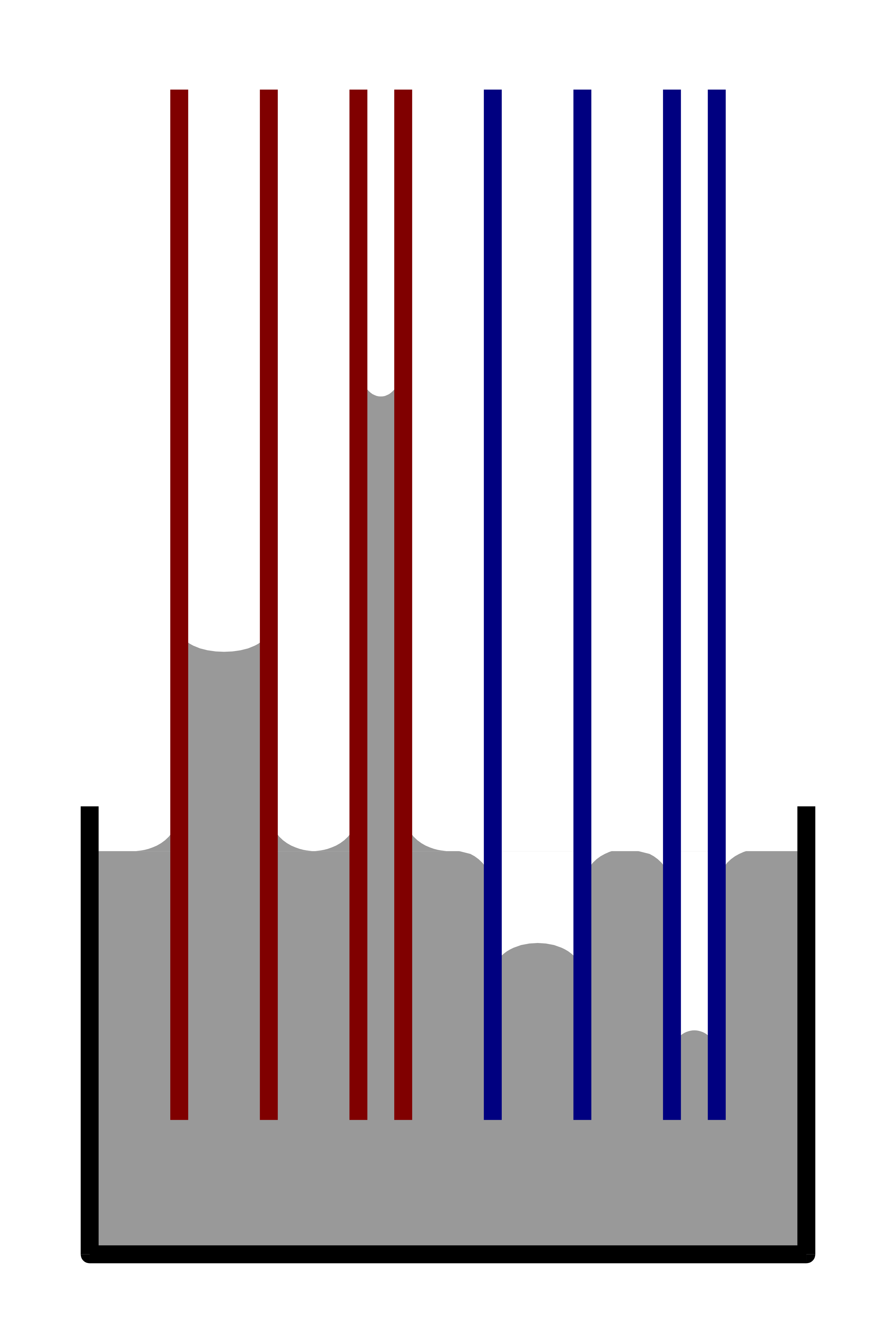
Capillary action is the ability of a liquid to flow into narrow spaces against gravity, driven by adhesion and surface tension. Dip a thin glass tube into water:
- Water molecules adhere to the glass walls and start climbing up.
- Surface tension pulls the rest of the water surface upward along with them.
- The water column rises until the upward adhesive/surface-tension forces balance the downward weight of the water column.
The narrower the tube, the higher the water rises. Why? A narrower tube has a larger surface-area-to-volume ratio, so the surface forces (adhesion, surface tension) win out over gravity (which pulls on the volume).
Mercury: The Opposite Case
Mercury in a glass tube does the opposite of water. Mercury atoms are strongly attracted to each other (high cohesion — that’s why mercury forms beads) but only weakly attracted to glass (low adhesion). So mercury in glass:
- Forms a convex meniscus (curves down at the edges).
- Shows capillary depression — mercury inside a thin tube sits lower than mercury outside.
- Doesn’t wet glass surfaces — it beads up instead of spreading.
This is why mercury thermometers (when they were common) had cleanly readable, non-clinging mercury columns: the mercury didn’t smear on the glass, just rolled cleanly up and down.