A recipe says “add 2 flour.” Two what? Tablespoons? Cups? Bags? The number alone tells you nothing. You need the unit — the thing that says “what kind” and “how much of one.”
Physics is the same. Every measurement is a number plus a unit. Drop the unit and the number means nothing. NASA learned this the hard way in 1999 when the Mars Climate Orbiter burned up in the Martian atmosphere because one team used pounds and another used newtons. A $125 million spacecraft, lost to a unit mix-up.
The MCAT won’t ask you about NASA, but it will test whether you can:
Convert between units in a few seconds.
Spot answer choices that have the wrong dimensions.
Use unit-checking to recover a forgotten formula or catch a math slip.
This is one of those sections where small habits pay off on every other physics problem you’ll ever do.
SI Base Units
The International System of Units (SI) defines seven base units. For the MCAT, you need six:
Quantity
SI Unit
Symbol
Length
meter
m
Mass
kilogram
kg
Time
second
s
Temperature
kelvin
K
Amount of substance
mole
mol
Electric current
ampere
A
Derived Units
Most units you’ll see on the MCAT are built by combining the base units. You don’t need to memorize them all from scratch — recognize the common ones and remember how they’re built:
Quantity
Unit Name
Symbol
In Base Units
Force
newton
N
kg m/s²
Energy / Work
joule
J
kg m²/s²
Power
watt
W
kg m²/s³ (= J/s)
Pressure
pascal
Pa
kg/(m s²) (= N/m²)
Frequency
hertz
Hz
1/s
Electric charge
coulomb
C
A s
Voltage
volt
V
kg m²/(A s³) (= J/C)
Metric Prefixes
The MCAT loves throwing prefixes at you — sometimes three different ones in the same passage. You need these in muscle memory:
Prefix
Symbol
Factor
Everyday example
giga
G
109
GHz (cell phone signal frequency)
mega
M
106
MJ (energy in a candy bar)
kilo
k
103
kg, km, kHz
centi
c
10−2
cm (width of your pinky)
milli
m
10−3
mL (drops in an eyedropper), mmHg
micro
μ
10−6
μm (size of a red blood cell)
nano
n
10−9
nm (wavelength of visible light)
pico
p
10−12
pF (capacitance in a small circuit)
Dimensional Analysis
Dimensional analysis is the single most powerful error-checking tool in physics. The idea: in any valid equation, the units on the left side must match the units on the right side. If they don’t, the equation is wrong. Period.
The method, in three steps:
Write the quantity you’re starting with, including its units.
Multiply by conversion factors arranged so the unwanted units cancel.
Check that only the desired units remain.
Example 1 — speed conversion. Convert 72 km/h to m/s.
72hkm×1 km1000 m×3600 s1 h=360072,000 m/s=20 m/s
The “km” cancels in step 2, the “h” cancels in step 3, and you’re left with m/s.
Example 2 — using units to catch a wrong answer. A passage asks for the kinetic energy of a 2 kg ball moving at 3 m/s. You scramble and write KE=mv, getting 2×3=6 kg·m/s. Pause and check the units: kg·m/s is momentum, not energy. Energy needs an extra factor of velocity. The correct formula is KE=21mv2, giving 21(2)(9)=9 J. Dimensional analysis just saved you a wrong answer.
Using Dimensional Analysis to Recover a Formula
If you blank on a formula mid-test, dimensional analysis can often rebuild it.
Suppose you forget the formula for kinetic energy but remember:
Energy is in joules: kg·m²/s².
The formula must involve mass (kg) and velocity (m/s).
The only way to combine kg and m/s to get kg·m²/s² is mass times velocity squared: mv2. The factor of 21 doesn’t come from units (it comes from calculus), so on the MCAT you might still be off by a small constant — but you’ll be in the right ballpark and you’ll pick the right answer choice.
This trick rescues people on test day more often than they admit.
Common MCAT Unit Conversions
Keep these in your mental toolkit — they show up every test:
Conversion
Value
1 atm
101,325 Pa ≈ 105 Pa
1 atm
760 mmHg = 760 torr
1 L
10−3 m³ = 1000 cm³
1 eV
1.6×10⁻¹⁹ J
1 calorie
4.184 J ≈ 4.2 J
1 Calorie (food)
1000 cal = 1 kcal
0 °C
273.15 K ≈ 273 K
A student calculates the kinetic energy of a ball and gets an answer in units of kg m/s. Is this correct? If not, what are the correct units and what likely went wrong?
Click to reveal answer
This is incorrect. The units kg·m/s are the units of momentum (p = mv), not energy. Kinetic energy has units of kg·m²/s² (joules). The student likely forgot to square the velocity in KE=21mv2. Dimensional analysis catches this immediately: mass (kg) times velocity (m/s) gives kg·m/s, but mass times velocity squared gives kg·m²/s².
How many nanometers are in 1 micrometer?
Click to reveal answer
1000 nm. 1 μm = 10−6 m. 1 nm = 10−9 m. So 1 μm = 10−6 / 10−9 nm = 103 nm = 1000 nm. Moving from micro to nano is three orders of magnitude.
A car is traveling at 90 km/h. What is its speed in m/s?
Click to reveal answer
25 m/s. Use the shortcut: divide km/h by 3.6. 90/3.6=25 m/s. (Long way: 90×1000/3600=90,000/3600=25.)
Your car’s odometer reads 150 miles after a road trip. Your GPS says you ended up only 80 miles from where you started. Both numbers are correct — they just measure different things. The odometer counted every mile your tires turned, even the loops, U-turns, and detours. The GPS only cares about your straight-line distance and direction from start to end.
The odometer is a scalar — a pure number, no direction. The GPS is a vector — number plus direction.
This distinction looks small, but it’s the foundation of every motion problem on the MCAT. Get it wrong and you’ll mix up speed and velocity, distance and displacement, mass and weight — all the classic trap-question pairs.
Scalars
A scalar is fully described by a number and a unit — nothing else needed.
Common MCAT scalars:
Mass (5 kg)
Temperature (310 K)
Speed (20 m/s)
Distance (150 m)
Energy (500 J)
Time (3 s)
Pressure (101,325 Pa)
You can add, subtract, multiply, and divide scalars with ordinary arithmetic. 5 kg + 3 kg = 8 kg, no questions asked.
Vectors
A vector has both magnitude and direction. You need both to fully describe it. “50 newtons” doesn’t mean anything by itself — 50 newtons in which direction?
Common MCAT vectors:
Displacement (80 m east)
Velocity (20 m/s north)
Acceleration (9.8 m/s² downward)
Force (50 N at 30° above horizontal)
Momentum (15 kg·m/s to the right)
On paper, vectors are arrows. The arrow’s length shows magnitude; the arrow’s direction shows where it’s pointing. A long arrow = strong force or fast velocity; a short arrow = weak force or slow velocity.
Vector Components
Any vector pointing somewhere “diagonal” can be split into two perpendicular pieces — one along the x-axis, one along the y-axis. These are called components, and breaking a vector apart this way is called resolving it.
Why bother? Because the math is much easier when everything points along an axis. Splitting a 50 N diagonal force into “30 N to the right” and “40 N up” turns one tricky 2D problem into two easy 1D problems.
If a vector A has magnitude A and makes an angle θ with the x-axis:
To go backward — from components to the full vector — use the Pythagorean theorem and basic trig:
Key Angles to Know
You won’t have a calculator on the MCAT. Memorize these trig values cold:
Angle
sin
cos
tan
0°
0
1
0
30°
0.5
0.87 ≈ 23
0.58 ≈ 31
45°
0.71 ≈ 22
0.71 ≈ 22
1
60°
0.87 ≈ 23
0.5
1.73 ≈ √3
90°
1
0
undefined
Worked Example
A passenger plane is climbing at 200 m/s along a flight path 30° above the horizontal. What are the horizontal and vertical components of its velocity?
vx=vcosθ=200cos(30°)=200×0.87≈173 m/s (forward).
vy=vsinθ=200sin(30°)=200×0.5=100 m/s (upward).
So the plane covers ground at 173 m/s while climbing at 100 m/s. Sanity check: 1732+1002≈30,000+10,000=40,000=200 m/s. ✓
Negative Components and Sign Conventions
A component can be negative. The convention almost everyone uses (and the MCAT defaults to):
Right is positive x; left is negative x.
Up is positive y; down is negative y.
So a vector pointing “30° south of west” has a negative x-component (leftward) and a negative y-component (downward).
Always pin down your coordinate system before solving the problem. The standard “x right, y up” works for most setups, but inclined-plane problems usually tilt the axes to lie along the slope (more on that in §1.11). Whatever you choose, stick with it for the entire problem.
An object moves in a circle at constant speed. Is its velocity constant? Explain.
Click to reveal answer
No, its velocity is not constant. Velocity is a vector — it has both magnitude and direction. Even though the speed (magnitude) is constant, the direction changes continuously as the object moves around the circle. A changing direction means a changing velocity, which means the object is accelerating (centripetal acceleration).
A force of 100 N acts at 60° above the horizontal. What are the horizontal and vertical components?
Click to reveal answer
Horizontal: 100cos60°=100×0.5=50 N. Vertical: 100sin60°=100×0.87=87 N. The horizontal component (adjacent to the angle) uses cosine, and the vertical component (opposite the angle) uses sine. Check: 502+872=2500+7569=10069≈100 N. ✓
You walk 4 blocks east and 3 blocks north. What is your displacement (magnitude and direction)?
Click to reveal answer
5 blocks at about 37° north of east. Magnitude: 42+32=25=5 blocks. Direction: arctan(3/4)≈37° measured from the east axis. (Note this is the classic 3-4-5 right triangle — recognize it on test day to skip the calculation entirely.)
You walk 3 blocks east, then 4 blocks north. How far are you from where you started?
Your first instinct says “7 blocks” — but that’s only the total ground you covered. The straight-line distance from start to finish is 5 blocks, and to find it you have to add the two walks as vectors, not as plain numbers.
That’s the whole game with vectors: 3 + 4 doesn’t always equal 7, because direction matters. A 3 N force pulling right and a 3 N force pulling left don’t combine to 6 N — they cancel to zero.
Almost every MCAT motion problem and force problem comes down to vector addition or subtraction. There are two ways to do it, and you should be comfortable with both.
Graphical Method: Tip-to-Tail
The simplest way to add two vectors: draw them tip-to-tail. The first arrow ends where the second begins. The straight line from the start of the first to the end of the second is your answer (the resultant).
The three-step picture:
Draw the first vector as an arrow.
Place the tail of the second vector at the tip of the first.
Draw the resultant from the tail of the first to the tip of the last.
Tip-to-tail vector addition. Vector B starts where vector A ends. The resultant R goes from the start of A to the end of B. Credit: Wikimedia Commons, CC BY-SA
For the 3-east, 4-north example: R=32+42=9+16=25=5 blocks, at an angle of arctan(4/3)≈53° north of east. Recognize this — it’s the classic 3-4-5 right triangle.
Component Method: The Workhorse
The graphical method is great for two vectors. Once you have three or more — or you need a precise number rather than an estimate from a sketch — switch to the component method. This is what you’ll use most often on the MCAT.
The idea: every vector can be split into x and y pieces (from §1.2). Once everything is in x and y, addition becomes ordinary arithmetic — just add all the x’s together, then all the y’s together, then rebuild the result.
Three steps:
Resolve each vector into x- and y-components.
Add all the x-components to get Rx. Add all the y-components to get Ry.
Recombine using the Pythagorean theorem and arctangent.
Example. Add vector A (5 N at 30° above the x-axis) and vector B (8 N along the x-axis).
Vector
x-component
y-component
A
5cos30°=5×0.87=4.35 N
5sin30°=5×0.5=2.5 N
B
8cos0°=8 N
8sin0°=0 N
Resultant
12.35 N
2.5 N
R=12.352+2.52=152.5+6.25≈12.6 N, pointing arctan(2.5/12.35)≈11.5° above the x-axis.
Vector Subtraction
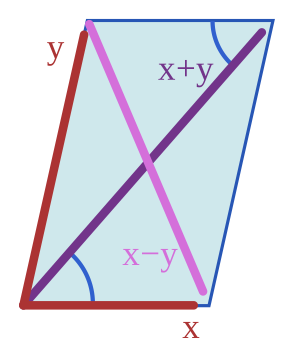
Subtracting vector B from vector A is the same as adding the opposite of B:
A−B=A+(−B)
The negative of a vector has the same magnitude but points the opposite way. Graphically: flip B around 180°, then add it tip-to-tail with A. With components: just subtract each component (x from x, y from y).
Why this matters: vector subtraction is how you find changes. Change in velocity, Δv=vfinal−vinitial, is what gives you acceleration. Change in position, Δr, is displacement. Whenever the MCAT asks “what’s the change in…?” you’re doing vector subtraction.
Worked example. A car moving 30 m/s east turns a corner and ends up moving 30 m/s north. What’s the change in velocity?
Δv=vfinal−vinitial.
In x: 0−30=−30 m/s.
In y: 30−0=+30 m/s.
Magnitude: 302+302=1800≈42.4 m/s.
Direction: northwest (45° above the −x axis).
The car’s speed never changed — but its velocity did, and the magnitude of that change is 42.4 m/s. That’s why the car had to accelerate to make the turn.
Special Cases
A few situations show up so often they’re worth memorizing as shortcuts.
Same direction → magnitudes add. Two 5 N forces both pulling right give 10 N right.
Opposite directions → magnitudes subtract. 5 N right plus 3 N left gives 2 N right.
Perpendicular (90° apart) → Pythagorean theorem. 3 N right plus 4 N up gives 5 N.
Equilibrium → vectors sum to zero. If everything cancels out, the object has no net force on it. By Newton’s first law, that means no acceleration — the object either sits still or coasts at constant velocity. Equilibrium is the entire premise of “free body in balance” problems and inclined-plane setups where things slide at constant speed.
Two forces act on an object: 6 N to the east and 8 N to the north. What is the magnitude and direction of the resultant force?
Click to reveal answer
Magnitude: 10 N. Direction: ~53° north of east. This is a 6-8-10 right triangle (a multiple of 3-4-5). R=62+82=100=10 N. θ=arctan(8/6)≈53° north of east.
What are the three steps of the component method for vector addition?
Click to reveal answer
Resolve, Add, Recombine. (1) Resolve each vector into x- and y-components using sine and cosine. (2) Add all x-components together and all y-components together. (3) Recombine using the Pythagorean theorem for magnitude and arctangent for direction.
A ball is thrown 10 m/s east; a moment later it's moving 10 m/s west (it bounced off a wall). What is the change in its velocity?
Click to reveal answer
20 m/s west.Δv=vf−vi=(−10)−(+10)=−20 m/s in the original (east) direction, which is the same as 20 m/s west. Notice the change in velocity is *bigger* than either velocity alone — that's because the ball reversed direction. This is why bouncing off a wall produces such a large impulse and force on the wall (covered in §1.15).
A jogger runs one full lap around a 400 m track and finishes exactly where she started. She traveled 400 meters of distance — but her displacement is zero. She might have averaged a steady 5 m/s in speed, but her average velocity over the whole lap is also zero.
Wait, what?
This isn’t a word game. Distance, displacement, speed, and velocity are four different physical quantities, and the MCAT writes traps that look identical until you notice which word the question used. This section is where you nail those distinctions down for good.
Position and Displacement
Position (x) is where something is, measured from a chosen origin. “The ball is at x=5 m” only makes sense if you’ve already decided where x=0 is.
Displacement (Δx) is the change in position — how far the object ended up from where it started, plus the direction. It’s a vector.
Distance is the total length of the path traveled. It’s a scalar — always positive, and always greater than or equal to the magnitude of displacement.
| Quantity | Type | Depends on path? | Can be zero for a round trip? |
|----------|------|-------------------|-------------------------------|
| Distance | Scalar | Yes | No (always positive if motion occurred) |
| Displacement | Vector | No | Yes (if start = finish) |
Speed and Velocity
Speed is the rate at which distance changes. Scalar. Always positive.
Velocity is the rate at which displacement changes. Vector. Can be positive, negative, or zero.
The relationship mirrors the one above: speed pairs with distance, velocity pairs with displacement.
Example. A runner finishes a 400 m lap in 80 seconds.
Average speed = 400/80=5 m/s.
Average velocity = 0/80=0 m/s (because displacement is zero).
Same runner. Same 80 seconds. Same physical motion. Two completely different “average” values, depending on which word the question uses. Read carefully.
Average vs. Instantaneous
There’s another pairing that trips students up: average vs. instantaneous.
Average velocity is your displacement over a chunk of time. It tells you the overall trend.
Instantaneous velocity is your velocity at one specific moment — what the speedometer reads right now. On a position-vs-time graph, it’s the slope of the line tangent to the curve at that point.
Imagine a 4-hour road trip where you average 60 mph. That doesn’t mean you went 60 mph the whole time — you probably went 75 on the highway, 30 in town, and 0 at a rest stop. Each of those is an instantaneous velocity at some moment. The average just smooths them all together.
Acceleration
Acceleration is the rate at which velocity changes. Vector.
The biggest misconception about acceleration: students hear “acceleration” and think “speeding up.” That’s only one type. Acceleration just means velocity is changing somehow — speeding up, slowing down, or changing direction. All three count.
Speeding up in your direction of motion → acceleration in the same direction as velocity.
Slowing down → acceleration opposite to velocity (often called deceleration; physicists call it negative acceleration).
Constant velocity (steady speed and steady direction) → zero acceleration, even at 100 mph.
Turning at constant speed → still accelerating, because direction is changing.
Graphs of Motion
🎯 Predict First
An object moves back and forth, momentarily coming to rest at the instant it reverses direction. At that exact instant, what is its acceleration?
Use the simulation below to see how position, velocity, and acceleration graphs connect. Pick a motion type and watch all three graphs draw simultaneously. The key insight: each graph is the slope of the one above it.
Slope of x‑t = velocity (constant). a = 0 throughout.
| Graph | Slope gives you… | Area under curve gives you… |
|-------|---------------------|-------------------------------|
| Position vs. time | Velocity | — |
| Velocity vs. time | Acceleration | Displacement |
| Acceleration vs. time | — | Change in velocity |
This “slopes go down, areas go up” relationship is the conceptual backbone of every kinematics graph problem. Memorize it as a mental staircase: position → velocity → acceleration each step is a slope.
Sign Conventions
Always pin down a positive direction before doing math. Standard convention: rightward and upward are positive.
Once that’s set, the relationship between velocity and acceleration tells you whether the object is speeding up or slowing down:
Positive v + positive a → speeding up (in the positive direction).
Positive v + negative a → slowing down.
Negative v + negative a → speeding up (in the negative direction).
Negative v + positive a → slowing down.
The shortcut: if v and a have the same sign, the object speeds up. If they have opposite signs, the object slows down. The actual signs (positive or negative) just tell you which direction the object is moving and which way the force is pushing.
A car drives 100 m east, then 100 m west. What is the total distance traveled? What is the displacement?
Click to reveal answer
Distance: 200 m. Displacement: 0 m. Distance is the total path length (100 + 100 = 200 m). Displacement is the change in position from start to finish. Since the car returned to its starting point, displacement is zero.
On a velocity-time graph, what does the slope represent? What does the area under the curve represent?
Click to reveal answer
Slope = acceleration. Area = displacement. Slope tells you how quickly velocity is changing (acceleration). Area under the curve tells you the total change in position (displacement) during that time interval.
A car moving east at 20 m/s slows down at 4 m/s². How long until it stops, and how far does it travel before stopping?
Click to reveal answer
5 s, 50 m. Acceleration is opposite to motion (−4 m/s²). Time: vf=vi+at → 0=20+(−4)t → t=5 s. Distance: average velocity is (20+0)/2=10 m/s for 5 s = 50 m. (You’ll formalize these moves with the kinematic equations in §1.5.)
You’re at a stoplight. The light turns green and you mash the gas. Your car accelerates at a steady rate. After 4 seconds, how fast are you going? How many car lengths have you covered? You don’t need calculus to answer either question — five equations handle every constant-acceleration problem you’ll ever see on the MCAT.
The trick isn’t memorizing all five. It’s knowing which one to grab. That decision takes one second once you know the rule, and it saves you minutes per problem.
The Big Five Kinematic Equations
These five equations describe motion with constant acceleration in one dimension. Each one connects four of the five kinematic variables and is missing one. The whole strategy: figure out which variable you don’t know and don’t need — then pick the equation that leaves it out.
How to Solve a Kinematics Problem
Same recipe every time:
Draw a quick diagram. Mark the start and the end.
Define a positive direction. Usually the direction of initial motion.
List knowns. Write down all five variables and circle the three you know.
Pick the equation that contains your three knowns plus the unknown you want.
Solve algebraically first, then plug numbers in.
Check units. If they don’t work out, the equation doesn’t either.
This routine adds maybe 15 seconds to a problem and saves 90 seconds in confused fumbling.
Worked Example 1
A car accelerates from rest at 4 m/s² for 5 seconds. How far does it travel?
Knowns:v0=0, a=4 m/s², t=5 s.
Want:Δx.
Missing (don’t need):v (the final velocity).
Pick: equation 2 (the one without v).
Δx=v0t+21at2=0(5)+21(4)(52)=21(4)(25)=50 m
The car covers 50 m. (Sanity check: that’s about 10 car lengths in 5 seconds — feels right for a brisk acceleration.)
Worked Example 2
A motorcycle going 30 m/s slams on the brakes and stops in 60 m. What was its acceleration?
Knowns:v0=30 m/s, v=0, Δx=60 m.
Want:a.
Missing:t.
Pick: equation 3.
v2=v02+2a(Δx)⇒0=302+2a(60)⇒a=−120900=−7.5 m/s2
The negative sign means the acceleration points opposite to motion — i.e., it’s a deceleration. The brakes pulled the bike backward at 7.5 m/s² for as long as it took to stop.
Free Fall
An object in free fall is influenced only by gravity. No air resistance, no rocket thrust, no rope holding it up — just the steady downward pull of Earth.
In free fall, the only acceleration is g. Replace "a" with "g" (or "−g" if you define upward as positive) in the kinematic equations:
If upward = positive
Equation
Velocity
v=v0−gt
Displacement
Δy=v0t−21gt2
Velocity-displacement
v2=v02−2g(Δy)
That’s it — the Big Five with g swapped in for a.
Key Free-Fall Facts
These three facts solve a huge fraction of free-fall problems by themselves.
1. All objects fall at the same rate (no air resistance). A bowling ball and a tennis ball dropped together hit the ground simultaneously in a vacuum. Mass cancels: F=mg → a=mg/m=g for any mass.
2. An object thrown straight up decelerates at g on the way up, momentarily stops at the peak (v=0), then accelerates at g on the way down. The speed at any given height is the same on the way up and the way down. Mirror-image trip.
3. Time up equals time down (when launched from and caught at the same height). Total air time is twice the time to reach the peak.
Useful Free-Fall Results
For an object dropped from rest (v0=0) with g≈10 m/s²:
Time (s)
Velocity (m/s)
Distance fallen (m)
1
10
5
2
20
20
3
30
45
4
40
80
5
50
125
Notice the distances: 5, 20, 45, 80, 125. The pattern is 21gt2 — distance grows with the square of time. Doubling the fall time quadruples the distance fallen, not just doubles it. This is why falls from heights are so much more dangerous than they intuitively seem.
You throw a ball straight up with an initial velocity of 20 m/s. Using g = 10 m/s², how long does it take to reach the peak and how high does it go?
Click to reveal answer
Time to peak: 2 s. Max height: 20 m. At the peak, v=0. Using v=v0−gt: 0=20−10t, so t=2 s. Using v2=v02−2g(Δy): 0=400−20(Δy), so Δy=20 m.
A 10 kg bowling ball and a 0.5 kg tennis ball are dropped from the same height in a vacuum. Which hits the ground first?
Click to reveal answer
They hit at exactly the same time. Without air resistance, all objects experience the same acceleration due to gravity (g≈9.8 m/s²) regardless of mass. Mass cancels: a=F/m=mg/m=g for every object.
A phone is dropped from a 45 m balcony. Using g = 10 m/s², how long until it hits the ground, and how fast is it moving on impact?
Click to reveal answer
3 s, 30 m/s. Time: Δy=21gt2⇒45=5t2⇒t=3 s. Speed at impact: v=gt=10(3)=30 m/s. (For reference, 30 m/s ≈ 67 mph — which is why you don't drop your phone off a 4th-floor balcony.)
You’re a passenger in a car going 60 km/h and you toss a ball straight up. To you, the ball goes straight up and comes straight back down into your hand. To someone standing on the sidewalk watching you go by, the ball traces a beautiful arc through the air — a parabola.
Both observers are right. The ball is doing two motions at once: a horizontal one (the car’s speed, which the ball still has) and a vertical one (your toss + gravity). Those two motions don’t interfere with each other. They just happen at the same time.
That single idea — horizontal and vertical motion are independent — is the master key to every projectile problem on the MCAT. Master it and the rest is just bookkeeping.
🎯 Predict First
A ball is launched at an angle and reaches the very top of its arc. At that instant, which statement is true?
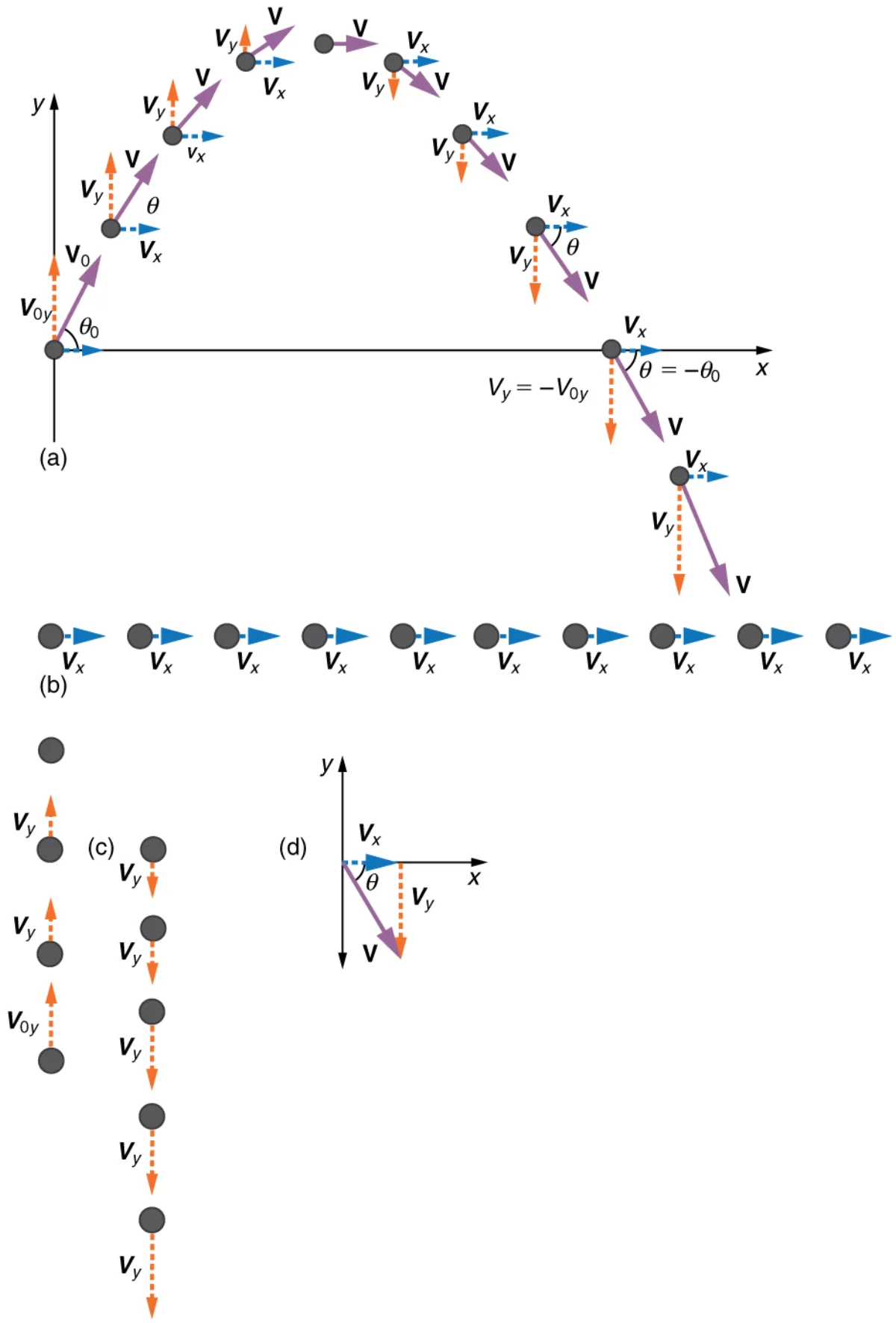
Use the simulation below to explore how launch angle and initial speed change the trajectory. Watch the horizontal velocity (blue) stay rock-steady while the vertical velocity (red) shrinks, hits zero, then grows in the other direction.
The horizontal direction has no acceleration (no force pushes the ball sideways once it’s left your hand), so the horizontal velocity never changes. The vertical direction has constant downward acceleration g — exactly the free fall problem from §1.5.
Solving Projectile Problems: Step by Step
Resolve the initial velocity into horizontal (v0cosθ) and vertical (v0sinθ) components.
Use the vertical equations to find time of flight, max height, or vertical position.
Plug that time into the horizontal equation to find range or horizontal position.
That’s it. Two motions, one shared variable (time), three steps.
Key Projectile Relationships
For a projectile launched from and landing at the same height (level ground):
Trajectory of a projectile on level ground. Horizontal velocity stays constant throughout. Vertical velocity decreases on the way up, hits zero at the peak, then increases on the way down. Credit: OpenStax, CC BY 4.0
Launch Angle Effects
The launch angle dramatically changes the trajectory. Soccer players, kickers, and quarterbacks all unconsciously do this math:
| Angle | Range | Height | Notes |
|-------|-------|--------|-------|
| 45° | Maximum | Moderate | Optimizes range because sin(2×45°)=sin90°=1 |
| 30° | Same as 60° | Lower than 60° | Complementary angles share range |
| 60° | Same as 30° | Higher than 30° | Complementary angles share range |
| 0° | — | 0 | Horizontal launch (rolled off a table) |
| 90° | 0 | Maximum | Straight up and down |
Special Case: Horizontal Launch
When something rolls off a table or flies off a cliff horizontally, the initial vertical velocity is zero. The object then falls like any dropped object vertically, while keeping its horizontal speed.
Time to hit the ground depends only on the height: h=21gt2, so t=2h/g.
Horizontal distance = (horizontal speed) × (time). Faster sideways speed → lands farther away. But the fall time itself doesn’t change — it’s set entirely by the height.
Famous demo: shoot a bullet horizontally and drop a second bullet from the same height at the same instant. They both hit the ground at the same time. The shot bullet just lands much farther away.
Trajectories at different launch angles. Complementary angles (like 30° and 60°) hit the same range. A 45° launch maximizes range. Credit: Wikimedia Commons, CC BY-SA
A ball is launched horizontally at 15 m/s from a 20 m high cliff. How long does it take to hit the ground? (Use g = 10 m/s²)
Click to reveal answer
2 seconds. Horizontal speed doesn’t affect time to fall. Using h=21gt2: 20=5t2, so t=2 s. The ball lands 15×2=30 m from the base of the cliff.
Two projectiles are launched at the same speed, one at 25° and one at 65°. Which has a longer range? Which reaches a greater height?
Click to reveal answer
They have the same range (25° + 65° = 90°, so they’re complementary angles). The 65° projectile reaches a greater height — a steeper angle directs more of the initial velocity vertically, producing a higher peak and a longer time in the air.
A soccer ball is kicked at 20 m/s at 30° above the horizontal. What is its range on level ground? (Use g = 10 m/s², sin 60° ≈ 0.87)
Click to reveal answer
About 35 m.R=gv02sin(2θ)=10202⋅sin60°=10400⋅0.87≈35 m. (For reference, that’s about a third of a soccer field — realistic for a hard kick.)
You’re holding a cup of coffee in a car cruising at a steady 60 km/h. The coffee sits perfectly still in the cup. Then the driver slams the brakes. The car stops — but the coffee doesn’t. It keeps moving forward at 60 km/h and ends up on your lap.
Nothing pushed the coffee forward. The car just stopped around it. The coffee was already moving and had no reason to stop on its own. That single, messy demonstration is Newton’s first law.
The Law of Inertia
This law makes two claims:
Stationary objects don’t start moving on their own. Something has to push them.
Moving objects don’t speed up, slow down, or change direction on their own. Something has to force the change.
The natural state of an object isn’t “at rest.” The natural state is constant velocity — and “at rest” is just the special case where that constant velocity happens to be zero.
This is unintuitive. Everyday experience says that things you stop pushing slow down and stop. But what’s actually slowing them down is friction or air resistance — another force, not the absence of one. Take those away (think hockey puck on ice, or anything in space) and a moving object just keeps going forever.
Inertia and Mass
Inertia is the tendency of an object to resist changes in its motion. Inertia is not a force. It’s a property of matter — like color or temperature, but for “willingness to keep doing what it’s already doing.”
Mass is the quantitative measure of inertia. More mass = more inertia = harder to start, stop, or turn the object.
A loaded freight train has enormous inertia — once it’s rolling, it takes miles of track to stop. A ping-pong ball has almost none — you can stop it with your fingertip. Same physics; the only difference is mass.
Net Force and Equilibrium
The first law isn’t really about no forces — it’s about no net force. An object can have many forces acting on it. What matters is whether they cancel.
Net force = 0 → forces cancel → object is in equilibrium: at rest or moving at constant velocity.
Net force ≠ 0 → forces don’t cancel → object accelerates (Newton’s second law territory, §1.8).
Condition
Net Force
Acceleration
Velocity
Static equilibrium
0
0
0 (at rest)
Dynamic equilibrium
0
0
Constant (moving steadily)
Accelerating
≠ 0
≠ 0
Changing
Note the trap in row two: an object can be moving fast and still be “in equilibrium” as long as nothing is changing. A car cruising at 70 mph on a straight highway with cruise control on is in equilibrium. The forward push from the engine exactly balances air resistance and friction.
Reference Frames
Newton’s first law holds in inertial reference frames — frames that aren’t themselves accelerating. A car cruising at constant velocity is an inertial frame. A car braking, turning, or speeding up is not.
Inside a non-inertial frame, objects look like they accelerate for no reason. The coffee that splashes onto your lap when the car brakes appears (from inside the car) to leap forward by itself — but from the sidewalk’s point of view (an inertial frame), the coffee was just continuing to move while the car decelerated under it.
A hockey puck slides across frictionless ice at 5 m/s. No horizontal forces act on it. What is its velocity 10 seconds later?
Click to reveal answer
Still 5 m/s in the same direction. By Newton's first law, an object in motion stays in motion at constant velocity when no net force acts. With no friction and no other horizontal forces, the puck has no reason to slow, speed up, or turn.
Is a car driving at constant speed around a circular track in equilibrium? Explain.
Click to reveal answer
No. Even though the speed is constant, the direction is constantly changing. Changing direction means changing velocity, which means the car is accelerating (centripetal acceleration). A net force (centripetal force) must be acting on it. Equilibrium requires both the magnitude *and* direction of velocity to be constant.
A bus suddenly accelerates forward. The standing passengers lurch backward. Why?
Click to reveal answer
Inertia — they don't actually move backward. The bus accelerates forward, but the passengers' bodies (by Newton's first law) tend to stay where they were. Relative to the now-moving bus, the passengers appear to slide backward — but from a stationary observer outside, the passengers stayed roughly where they were while the bus moved forward beneath them. Same physics as the coffee in the braking car, just in reverse.
A nurse pushes two hospital beds down the same hallway with the same effort. The empty bed glides easily; the bed carrying a 200 kg patient barely budges. Same push. Different result. Why?
That’s Newton’s second law in one sentence: the same force produces less acceleration on more mass. Push harder, you go faster. Push the same thing that’s heavier, you go slower. It’s the rule that connects “what you do” (force) to “what happens” (acceleration), and it’s the single most-used equation on MCAT physics.
The Law
In plain English, this equation says three things:
Push harder, accelerate faster. Twice the force on the same object → twice the acceleration.
Heavier things are harder to speed up. Twice the mass with the same force → half the acceleration.
Acceleration points where the net force points. Not where the object is going — where the forces are pulling it.
That third point is the one MCAT loves to trick you on. A car braking to a stop is still moving forward, but it’s accelerating backward (because the brake force is backward). Direction of motion ≠ direction of acceleration.
The Newton (the Unit)
One newton (N) is the force needed to accelerate a 1 kg mass at 1 m/s². So 1 N = 1 kg·m/s².
To get a feel for the size: an apple weighs about 1 N. A liter of water weighs about 10 N. A 70 kg adult weighs about 700 N. If you’re ever lost on whether your answer is “way too big” or “way too small,” anchor to these.
Weight vs. Mass
These two words are not interchangeable on the MCAT.
Mass (m) is how much stuff is in an object. Scalar. Measured in kilograms. Doesn’t change if you move to the moon, the bottom of the ocean, or the back of an ambulance.
Weight (W) is the gravitational force pulling that mass downward. Vector. Measured in newtons. Changes everywhere gravity changes.
Everyday version: when your bathroom scale says “150 lb,” that’s actually telling you the gravitational force on your body, not your mass. The MCAT holds you to the physics definitions strictly — if a question gives you “70 kg,” that’s mass; the corresponding weight is about 700 N.
Free-Body Diagrams
A free-body diagram (FBD) is a sketch showing every force acting on one specific object. It’s the most important problem-solving tool in dynamics — and skipping it is the #1 reason students miss force questions. Every MCAT force problem should start with a quick FBD.
How to draw one in 30 seconds:
Draw the object as a box or dot. Ignore everything else in the scene.
Draw an arrow for every force acting on the object, starting from the center.
Label each arrow (weight, normal, friction, tension, push, etc.).
Do NOT draw forces the object exerts on other things. Those go on the other object’s diagram.
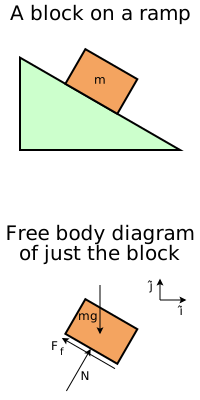
Free-body diagram for a box on a surface. Each arrow represents one force acting on the box. Credit: Wikimedia Commons, CC BY-SA
Common forces on FBDs:
Force
Symbol
Direction
Notes
Weight
W or mg
Downward
Always present near Earth’s surface
Normal force
N or FN
Perpendicular to surface
Surface pushes back on whatever’s touching it
Friction
f
Parallel to surface, opposing motion
Static or kinetic
Tension
T
Along the rope/string
Pulls, never pushes
Applied force
Fapp
Direction of push/pull
Given in the problem
Applying Newton’s Second Law
Once your FBD is drawn, the math is mechanical. Pick a coordinate system (usually x = horizontal, y = vertical), then add up the forces in each direction separately:
x-direction: sum of all x-forces = max
y-direction: sum of all y-forces = may
If the object isn’t accelerating in a direction (e.g., a box sitting on a table isn’t accelerating vertically — it’s just sitting there), then the net force in that direction is zero. That fact alone often unlocks the normal force or tension.
Worked example. You push a 30 kg suitcase across an airport floor with a 60 N horizontal force. Friction opposes the motion at 30 N. What’s the suitcase’s acceleration?
FBD has 4 forces: weight down, normal up (these cancel — no vertical motion), push (60 N forward), friction (30 N backward).
Net horizontal force = 60 − 30 = 30 N forward.
a=Fnet/m=30/30=1 m/s² forward.
That’s it. Three lines of work because we drew the diagram first.
Elevator Problems (Apparent Weight)
The MCAT loves elevator problems because they hide a really clean physics insight inside an everyday experience.
You’ve felt it: when an elevator starts going up, you feel briefly heavier. When it slows down at the top, you feel briefly lighter. Your actual weight (mg) hasn’t changed — but the floor (and the scale, if you’re standing on one) is pushing on you with a different force.
That force is the normal force, and the scale reads exactly that. We call it your apparent weight.
In an elevator accelerating upward, the floor has to do two jobs: hold you up and speed you up. So it pushes harder than usual. In an elevator accelerating downward, the floor still holds you up but doesn’t have to push as hard, because gravity is doing some of the work.
Elevator motion
Acceleration
Normal force (scale reading)
You feel…
Accelerating up
Upward
N = m(g + a) > mg
Heavier
Constant velocity (up or down)
0
N = mg
Normal
Accelerating down
Downward
N = m(g - a) < mg
Lighter
Free fall
g downward
N = 0
Weightless
Notice that constant velocity feels normal — even at the top of a fast-moving elevator, if it’s cruising at steady speed, you feel just like standing on the ground. The “heavy” and “light” sensations only happen during the acceleration phases (start and stop).
A 60 kg person stands on a scale in an elevator accelerating upward at 2 m/s². What does the scale read? (Use g = 10 m/s²)
Click to reveal answer
720 N. The scale reads the normal force: N = m(g + a) = 60(10 + 2) = 60(12) = 720 N. The true weight is mg = 600 N, but the upward acceleration requires extra normal force, making the person feel heavier.
A 5 kg box is pushed with a 30 N horizontal force across a frictionless surface. What is its acceleration?
Click to reveal answer
6 m/s². Using Fnet=ma: 30 N = 5 kg × a, so a = 530 = 6 m/s² in the direction of the applied force. On a frictionless surface, the only horizontal force is the applied force, so it is also the net force.
An 80 kg person stands in an elevator that's slowing down as it rises. The deceleration is 1 m/s². What does the floor push up on them with? (g = 10)
Click to reveal answer
720 N. "Slowing down while rising" means the acceleration vector points downward (opposite to motion). So use N = m(g − a) = 80(10 − 1) = 720 N. The person feels lighter than their normal weight of 800 N — the same sensation you get when an elevator slows to a stop near the top floor.
You’re standing on roller skates in front of a wall. You push the wall with both hands. The wall doesn’t move — but you roll backward across the floor.
Wait. You pushed the wall. So why did you end up moving?
Because the wall pushed you back. Every force in the universe comes in a pair: when you push something, that something pushes back on you with the exact same strength. The wall didn’t move because it’s bolted to a building (lots of mass + lots of friction). You did move, because nothing was holding you in place. Same forces — wildly different outcomes.
That’s Newton’s third law. The single biggest mistake students make is forgetting that the two paired forces act on different objects.
The Law
The two forces in an action-reaction pair are always:
Equal in magnitude. Same number of newtons.
Opposite in direction. They point away from each other.
On different objects. This is the part students forget.
Of the same type. Both gravitational, both contact, both electrical, etc. (You can’t pair gravity with friction.)
The Critical Misconception
Students constantly ask: “If every force has an equal and opposite reaction, why doesn’t everything just cancel and nothing ever accelerates?”
The answer: the two forces act on different objects. Forces only cancel when they’re on the same object.
You push the wall (force on the wall). The wall pushes you (force on you). When you draw a free-body diagram for yourself, only the force on you appears. The force you put on the wall doesn’t show up on your FBD — it shows up on the wall’s FBD. Action-reaction pairs live on separate diagrams. They literally cannot cancel each other.
Identifying Action-Reaction Pairs
To find a reaction force, swap the two objects and reverse the direction. The grammar is “A pushes/pulls B” → “B pushes/pulls A in the opposite direction.”
Action (force on B by A)
Reaction (force on A by B)
You push wall east
Wall pushes you west
Earth pulls you down (gravity)
You pull Earth up (gravity)
Hammer hits nail down
Nail pushes hammer up
Foot pushes ground back
Ground pushes foot forward (friction)
Rocket pushes exhaust gas down
Exhaust gas pushes rocket up
Action-reaction pairs always act on different objects. The forces are equal in magnitude and opposite in direction. Credit: Wikimedia Commons, CC BY-SA
Walking: The Third Law in Action
How do you actually walk? Your foot pushes backward on the ground; the ground pushes forward on your foot (that’s just friction). The forward push on your foot is the only horizontal force on your body, and it’s what accelerates you forward.
On slippery ice, your foot still pushes backward — but the ice can’t push you forward (no friction). Result: your foot slides backward and you don’t go anywhere. Without the reaction force, you can’t accelerate. Walking is Newton’s third law.
The same logic explains how cars drive (tires push road back, road pushes car forward), how swimmers swim (hands push water back, water pushes swimmer forward), and how planes fly (wings push air down, air pushes wings up).
Why the Earth Doesn’t Noticeably Move When You Jump
When you jump, you push the Earth downward and the Earth pushes you upward — equal forces, by the third law. So why does only one of you move?
Because the Earth’s mass is about 6×1024 kg. Plug that into a=F/m and the Earth’s acceleration comes out to a number so absurdly small (about 10−23 m/s²) that no instrument on Earth could ever detect it. You accelerate by several m/s²; the Earth accelerates by basically nothing — but the forces are equal. Mass, not force, is what determines who actually moves.
A 50 kg ice skater pushes off an 80 kg ice skater. If the lighter skater accelerates at 2 m/s², what force does the heavier skater experience? What is the heavier skater's acceleration?
Click to reveal answer
Force on heavier skater: 100 N. Acceleration: 1.25 m/s². The lighter skater experiences a force of F=ma=50×2=100 N. By Newton's third law, the heavier skater experiences the same 100 N in the opposite direction. Their acceleration is a=F/m=100/80=1.25 m/s².
Why don't Newton's third law force pairs cancel each other out?
Click to reveal answer
Because they act on different objects. Forces only cancel when they act on the same object (like weight and normal force on a book sitting still). Action-reaction pairs always act on two different objects and appear on two different free-body diagrams, so they can never cancel.
A book sits on a table. The Earth pulls the book down with weight W. The table pushes the book up with normal force N. Are W and N a Newton's third law pair?
Click to reveal answer
No. They're equal and opposite, but they both act on the *book* — they're a balanced pair from Newton's first law, not a third-law pair. A true third-law pair acts on different objects. The reaction to the Earth pulling the book down is the *book pulling the Earth up* (gravitational pair). The reaction to the table pushing the book up is the *book pushing the table down* (contact pair).
Try shoving a heavy bookcase across a carpeted floor. You push harder, and harder, and nothing happens. Then suddenly — pop — it breaks free and starts sliding. And once it’s moving, it feels noticeably easier to keep it going than it was to get it started.
That moment of “breaking free,” and the drop in effort right after, is the difference between static friction (the force resisting motion before the object slides) and kinetic friction (the force resisting motion during sliding). The MCAT tests this distinction constantly — directly in mechanics, and indirectly in fluid flow, in circuits as resistance, and in biological systems like blood viscosity.
What Is Friction?
Friction is a contact force that opposes the relative motion (or attempted motion) between two surfaces. It always acts parallel to the surfaces — never perpendicular — and points opposite to whichever direction the object is sliding (or would slide if friction got out of the way).
Static Friction
Static friction (fs) acts on objects that are not yet sliding. It actively prevents motion.
The key word here is ”≤” not ”=”. Static friction is not always equal to μsN. It’s only equal to μsN at the very instant the object is about to slip. Before that, static friction self-adjusts to match exactly whatever push you apply.
Push with 10 N → static friction pushes back with 10 N (object doesn’t move).
Push with 50 N → static friction pushes back with 50 N (still doesn’t move).
Push with 80 N where μsN=75 N → static friction can’t keep up, object slips and starts sliding.
This self-adjusting behavior is why, on a flat floor, a heavy box can sit perfectly still while you push gently — the floor’s friction is matching your push exactly, even though that floor is capable of pushing back much harder.
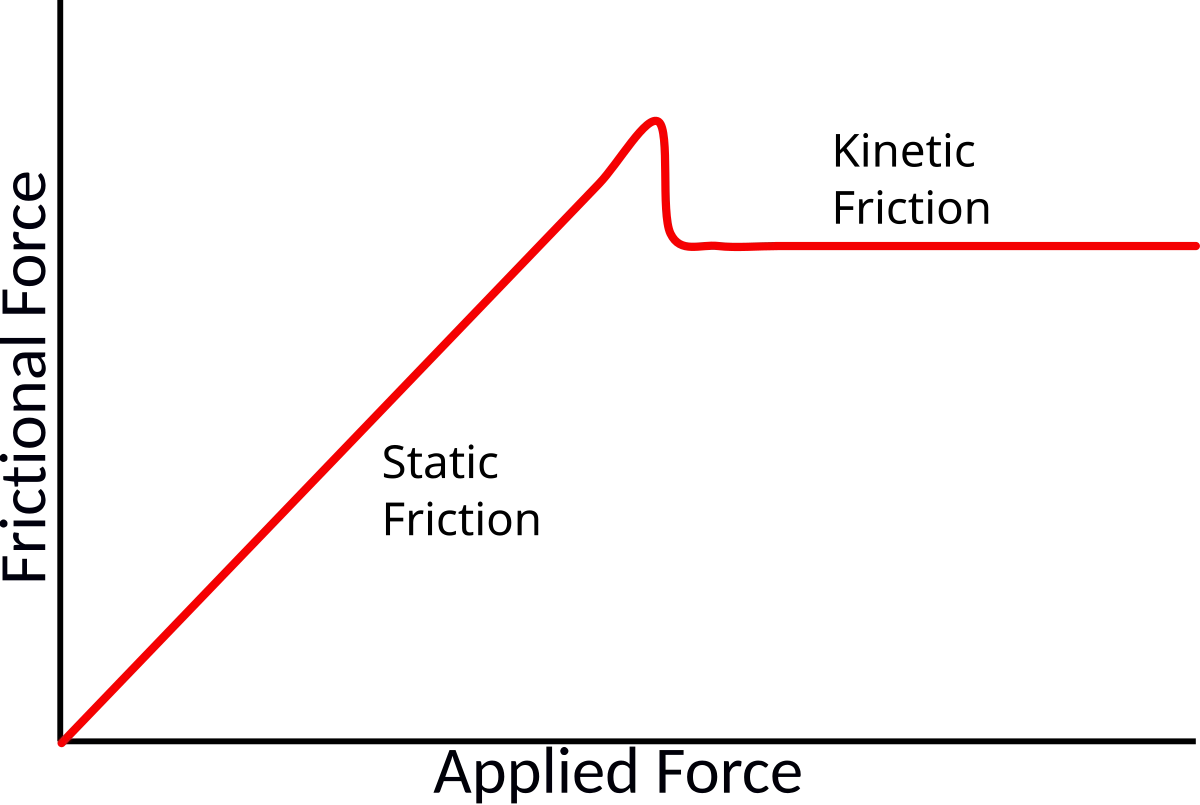
Friction vs. applied force. Static friction matches the applied force (the diagonal line) up to a maximum, then the object breaks free and kinetic friction takes over at a lower, constant value. Credit: Wikimedia Commons, CC BY-SA
Kinetic Friction
Kinetic friction (fk) acts on objects that are already sliding. Unlike static friction, it’s a fixed value.
Static vs. Kinetic: Side by Side
Property
Static Friction
Kinetic Friction
When it acts
Object is not yet sliding
Object is sliding
Magnitude
Variable (0 up to μsN)
Constant (μkN)
Coefficient
μs (larger)
μk (smaller)
Self-adjusting?
Yes — matches applied force
No — always μkN
What Friction Depends On (and Doesn’t)
Friction depends on exactly two things:
The coefficient of friction (μ) — a dimensionless number set by what the two surfaces are made of.
The normal force (N) — how hard the surfaces are squeezed together.
Friction does not depend on:
Contact area. A brick on its side has the same friction as the same brick on its end (assuming same surface, same weight). Doubling the area cuts the pressure but doubles the contact patch — they cancel.
Speed of sliding. Kinetic friction is the same at 1 m/s and 100 m/s.
This is one of those facts that genuinely surprises students because it doesn’t match intuition. Wider tires feel like they should grip more — but in the simple physics-class model of friction, they don’t. (In reality, tire grip involves rubber deformation, which is not simple Coulomb friction; the MCAT uses the simple model.)
Applications of Friction
Walking. Your foot pushes backward on the ground; static friction pushes forward on your foot (the same swap-and-flip from §1.9). Without friction, you couldn’t walk — try it on a wet bathroom floor or a sheet of ice.
Braking. When you brake hard, you want the tires to not slide — you want static friction between the tire and road, not kinetic. Static friction is bigger, so the stopping distance is shorter. If the wheels lock and skid, friction drops to kinetic and the car takes longer to stop. That’s why cars have anti-lock braking systems (ABS): they prevent the wheels from locking, keeping you in the high-friction static regime.
Climbing stairs / running. Same as walking — your shoe pushes back, friction pushes you forward.
Holding a pencil. Static friction between your fingers and the pencil keeps it from sliding out of your grip. Squeeze harder (N increases) and the maximum friction increases proportionally.
Worked Example
A 20 kg box sits on a floor with μs=0.5 and μk=0.3. Use g=10 m/s².
Normal force:N=mg=20×10=200 N.
Maximum static friction:μsN=0.5×200=100 N. So you must push harder than 100 N to get the box moving.
Kinetic friction (once sliding):μkN=0.3×200=60 N.
Force needed for constant velocity: exactly 60 N (just enough to cancel kinetic friction).
If you push at 100 N once it’s already sliding: net force = 100−60=40 N → a=40/20=2 m/s² forward.
Notice: the force to start moving (101 N) is much bigger than the force to keep moving steadily (60 N). That’s the static-vs-kinetic gap in action.
A 20 kg box sits on a floor with μ_s = 0.5 and μ_k = 0.3. What is the minimum force needed to start it sliding? Once sliding, what force keeps it moving at constant velocity? (Use g = 10 m/s²)
Click to reveal answer
To start sliding: just over 100 N. To maintain constant velocity: 60 N.N=mg=200 N. Max static friction =μsN=0.5×200=100 N (must exceed this to start moving). Kinetic friction =μkN=0.3×200=60 N. For constant velocity, applied force must exactly equal kinetic friction.
You place a 5 kg block on a surface and push with 15 N, but it doesn't move. Is the static friction force equal to μsN?
Click to reveal answer
No. Since the block is stationary, net force is zero, so static friction equals exactly 15 N — just enough to balance your push. Static friction only equals μsN at the very moment the object is about to slip. Until then, it self-adjusts.
A car with anti-lock brakes can stop in a shorter distance than a car whose wheels lock during braking. Why?
Click to reveal answer
Because static friction (rolling tires) is greater than kinetic friction (skidding tires).μs>μk for any surface pair, so a tire that's gripping the road experiences a larger backward friction force than a tire that's skidding. ABS prevents the wheels from locking, keeping the car in the higher-friction static regime — and thus shortening the stopping distance.
Place a marble on a flat table. It just sits there. Tilt the table even slightly and the marble starts rolling. Tilt it more — it rolls faster.
Gravity hasn’t changed. It still pulls straight down with the same force. What changed is how that downward pull gets split between two jobs: pulling the marble along the slope (making it slide) and pressing the marble into the slope (making it stay in contact).
Inclined-plane problems show up on nearly every MCAT, and they all reduce to one move: split the weight vector (mg) into a piece along the ramp and a piece perpendicular to the ramp. Master that one move and every incline problem becomes plug-and-chug.
🎯 Predict First
A 2 kg block sits on the verge of slipping on a ramp tilted at 30 degrees. You swap it for a 20 kg block of the same material. What happens?
Test your prediction below. Raise the angle until the block lets go, then drag the mass slider up and down: every force arrow grows and shrinks with the mass, but the slip point never moves.
Static: friction holds (tan θ = 0.47, μs = 0.50). Slips when tan θ > μs (mass does not matter).
The trick to inclines is to tilt your coordinate axes so one axis runs along the slope and the other runs perpendicular to it. This is unusual — every other problem uses x = horizontal, y = vertical — but here it pays off massively. Why? Because the object only moves along the slope. If your axes are aligned with the slope, “motion direction” and “x-axis” are the same thing, and the math collapses to one dimension.
Once you tilt the axes, gravity is the one force that no longer points along an axis. Gravity always pulls straight down, regardless of which way you’ve drawn your axes. So you have to split gravity into two components:
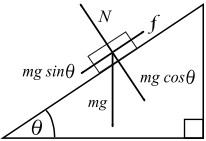
Force decomposition on an incline. Gravity (mg) splits into a component along the ramp (mgsinθ) and a component into the ramp (mgcosθ). The normal force balances the perpendicular component. Credit: Wikimedia Commons, CC BY-SA
The Normal Force on an Incline
On a flat surface, the normal force equals the full weight: N=mg. On an incline, the surface only has to balance the perpendicular component:
N=mgcosθ
This means the normal force is always less than mg on an incline. The steeper the slope (bigger θ), the smaller cosθ, the smaller N. At θ=90° (a vertical wall), N=mgcos90°=0 — a vertical wall provides no support to an object that isn’t held against it.
Frictionless Incline
On a frictionless incline, the only force along the slope is mgsinθ. Apply Newton’s second law along that direction:
ma=mgsinθ
The mass cancels out: a=gsinθ.
Sanity checks (these are great for confirming you wrote the formula right):
At θ=0 (flat surface): a=gsin0°=0. No acceleration on a flat floor. ✓
At θ=90° (vertical drop): a=gsin90°=g. Free fall. ✓
Anywhere in between: a is between 0 and g. ✓
Incline With Friction
When friction is in play, it acts along the slope, opposite to the direction of motion (or attempted motion).
Object sliding down the ramp. Gravity pulls it down the slope; friction pushes it up the slope:
Net=mgsinθ−fk=mgsinθ−μk(mgcosθ)
a=g(sinθ−μkcosθ)
Object pushed up the ramp. Both gravity and friction now point down the slope (friction always opposes motion):
a=g(sinθ+μkcosθ) (this is a deceleration as the object slows on the way up)
When Does an Object Stay Put?
An object on a ramp doesn’t slide as long as static friction can balance the down-slope pull of gravity:
μsN≥mgsinθ
Substitute N=mgcosθ:
μsmgcosθ≥mgsinθ⇒μs≥tanθ
Mass cancels. The object slips at the critical angle where tanθ=μs. Below that angle, friction can hold it. Above it, friction can’t keep up and the object starts sliding.
Worked Example
A 10 kg box sits on a 30° ramp. The coefficient of kinetic friction is 0.2. What is the box’s acceleration down the ramp? (Use g=10 m/s²; sin30°=0.5; cos30°=0.87.)
Compare to a frictionless 30° ramp: a=gsin30°=5 m/s². Adding friction shaved off about 1.7 m/s² of acceleration. As a sanity check: the answer is positive, so the box does slide down (friction wasn’t strong enough to hold it). If you’d gotten a negative number, friction would be strong enough to keep the box stationary, and the actual acceleration would be zero.
A 10 kg box sits on a 30° frictionless ramp. What is the acceleration down the ramp and what is the normal force? (Use g = 10 m/s²)
Click to reveal answer
Acceleration: 5 m/s². Normal force: 87 N.a=gsin30°=10×0.5=5 m/s². N=mgcos30°=10×10×0.87=87 N. Note that acceleration doesn’t depend on mass, but normal force does.
On an incline, what happens to the normal force and friction as the angle increases?
Click to reveal answer
Both decrease. Normal force N=mgcosθ shrinks as θ grows because cosθ shrinks. Since friction depends on N (via f=μN), friction shrinks too. Meanwhile, the down-slope component of gravity (mgsinθ) grows. Steeper ramp = less friction holding you back AND more gravity pulling you down. That’s the double whammy that makes steep slopes so prone to sliding.
A block sits on a ramp whose angle is slowly increased. The block starts to slide when the ramp reaches 25°. What is the coefficient of static friction between the block and the ramp?
Click to reveal answer
μs=tan25°≈0.47. The block starts sliding at the critical angle where tanθ=μs. So μs=tan25°≈0.47. This is a clean experimental method for measuring μs — tilt until it slides, read the angle, take the tangent.
You’re a passenger in a car taking a sharp left turn. You feel pulled to the right — toward the outside of the curve. A ball on a string swings in a circle and flies away the moment you let go. Spin a bucket of water over your head and the water stays in the bucket, like something is pinning it outward.
🎯 Predict First
You whirl a ball on a string in a horizontal circle and the string suddenly snaps. Which way does the ball go?
Lock in your prediction, then test it below. Press “Cut the string” and watch the path the ball actually takes against the faint circle it used to follow. Try a few speeds and radii and check whether the departure direction ever changes.
Speed: 6.0 m/sRadius: 2.0 mac = v2/r: 18.0 m/s²Period T = 2πr/v: 2.09 s
Every one of these feelings seems to say there’s a force pushing you outward. But there isn’t. What’s actually happening is the opposite: something must constantly pull you inward to keep you moving in a circle, and the moment that inward pull disappears, you fly off in a straight line tangent to the curve — not outward.
Your body’s “outward push” sensation is just inertia (Newton’s first law) trying to keep you moving in a straight line while the car curves around you. There’s no outward force. There’s only the absence of an inward one.
Uniform Circular Motion
An object moving in a circle at constant speed is in uniform circular motion. The speed is constant — but the direction is changing every instant. Since velocity is a vector (magnitude + direction), a constantly changing direction means a constantly changing velocity, which means there’s acceleration — even though the speedometer never moves.
This was the punchline of §1.4 (“speed vs. velocity”). Now we put a number on it.
Centripetal Acceleration
The acceleration in uniform circular motion always points toward the center of the circle. It’s called centripetal — Latin for “center-seeking.”
Notice v2 in the numerator. Doubling your speed quadruples the centripetal acceleration needed to stay in the same circle. That’s why it’s so much harder to control a car at 60 mph through a curve than at 30 mph — not twice as hard, four times as hard.
The velocity is always tangent to the circle (along the path of motion). The acceleration is always perpendicular to the velocity (pointing inward). So velocity and acceleration are at 90° to each other at every moment — which is why the speed (magnitude of velocity) doesn’t change, only the direction does.
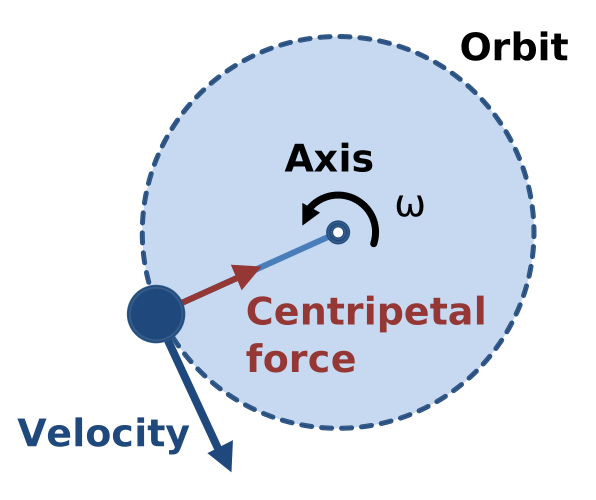
Uniform circular motion. Velocity is tangent to the circle at every point. Acceleration (centripetal) always points toward the center. Credit: Wikimedia Commons, CC BY-SA
Centripetal Force
By Newton’s second law, every acceleration needs a net force (F=ma). Centripetal acceleration needs a net force pointing inward — that net force is the centripetal force.
Important: “centripetal force” is not a new kind of force. It’s just a label for “whatever real force happens to be pointing toward the center.” Depending on the situation, that real force might be tension, friction, gravity, normal force, or something else — but it’s always one of the standard forces you already know.
| Scenario | What real force provides the centripetal force? |
|----------|--------------------------------|
| Ball on a string | Tension in the string |
| Car rounding a curve | Static friction between tires and road |
| Satellite in orbit | Gravity |
| Roller-coaster loop (top) | Normal force + gravity, both pointing down/inward |
| Roller-coaster loop (bottom) | Normal force minus gravity (normal points up/inward, gravity pulls down/outward) |
| Electron orbiting nucleus | Electrostatic (Coulomb) force |
There Is No Centrifugal Force
In an inertial reference frame, there is no outward force on an object in circular motion. The “outward push” feeling is your body’s inertia resisting the inward turn — Newton’s first law in action. If the inward force vanished, you wouldn’t fly outward; you’d continue in a straight line tangent to where you were the moment the force disappeared.
“Centrifugal force” only shows up when you do physics in a rotating (non-inertial) reference frame, where it’s a fictitious force used to make Newton’s laws bookkeep correctly inside the spinning frame. The MCAT treats centrifugal force as fictitious — never include it on a free-body diagram.
Period, Frequency, and Speed
For an object going around a complete circle:
Brief Note on Rotational Quantities
The MCAT occasionally references angular quantities. You don’t need to do detailed rotational dynamics, but recognize the parallels:
Centripetal acceleration can also be written ac=ω2r (substitute v=rω into v2/r). Either form is fine — pick whichever the problem makes easier.
A 2 kg ball moves at 3 m/s in a circle of radius 1.5 m. What is the centripetal acceleration and centripetal force?
Click to reveal answer
ac=6 m/s², Fc=12 N.ac=v2/r=9/1.5=6 m/s². Fc=mac=2×6=12 N, directed toward the center of the circle.
A car rounds a curve at constant speed. What force provides the centripetal force? If the road is icy and friction decreases, what happens?
Click to reveal answer
Static friction provides the centripetal force. If friction drops (icy road), there isn’t enough inward force to keep the car on the curved path. The car doesn’t fly “outward” — it continues in a straight line tangent to the curve, which takes it off the road to the outside of the turn. The driver must slow down (reducing required centripetal force = mv2/r) to stay on the road.
A car traveling at 30 m/s rounds a curve of radius 90 m. What is the centripetal acceleration? If the speed doubles to 60 m/s on the same curve, what’s the new centripetal acceleration?
Click to reveal answer
10 m/s² at 30 m/s; 40 m/s² at 60 m/s.ac=v2/r=900/90=10 m/s². At double speed: ac=3600/90=40 m/s² — four times larger because v is squared. This is why high-speed curves require either banking (to provide extra inward force from the normal force) or much wider radii.
Newton’s leap was realizing that the same force pulling the phone to the floor also keeps the Moon in orbit around the Earth, and the Earth in orbit around the Sun, and every other planet, comet, and star in motion. Gravity isn’t just a local “things-fall-down” effect near Earth’s surface — it’s a universal force acting between every pair of masses in the universe. The equation describing it is one of the most consequential in physics.
Newton’s Law of Universal Gravitation
Four key features:
Gravity is always attractive. There’s no gravitational repulsion. This makes it different from the electric force, which can attract or repel.
It follows an inverse square law. Double the distance and the force drops to 41. Triple it and the force drops to 91. (Same pattern as Coulomb’s law for electric charges.)
It acts between every pair of masses, no matter how small. Two coffee cups on a table actually attract each other gravitationally — but the force is mind-bogglingly weak (gravity is the weakest of the four fundamental forces by many orders of magnitude).
The "r" is the center-to-center distance, not the surface-to-surface distance. For the Earth and a falling object, r is the Earth’s radius (~6400 km), not the few meters between the object and the ground.
Gravitational Field Strength (g)
Near any planet or star, we can define a gravitational field strength — the gravitational force per unit mass:
Crucially: g decreases with altitude. An astronaut at twice Earth’s radius from the center (r=2R) experiences g=GM/(2R)2=gsurface/4. They weigh ¼ as much, but their mass hasn’t changed.
Location
Approximate g
Earth’s surface
9.8 m/s²
Top of Mt. Everest
9.77 m/s² (barely smaller)
Low Earth orbit (~400 km)
8.7 m/s²
Moon’s surface
1.6 m/s²
Mars’s surface
3.7 m/s²
Sun’s surface
~274 m/s²
Notice that Mt. Everest barely changes g — Earth’s radius is so big that another 9 km up is a tiny fractional change. But the Moon, with much less mass, has g about ⅙ that of Earth’s. That’s why astronauts could leap several feet on the lunar surface.
Weightlessness = Free Fall
Astronauts on the International Space Station float around as if there’s no gravity. But gravity at 400 km altitude is still about 89% of the gravity at sea level. They’re not “above” gravity — they’re in free fall.
Here’s the trick: the ISS and everything inside it are falling toward Earth at the same rate. Astronaut, spacecraft, lab equipment — all accelerating at the same g together. Since nothing is accelerating relative to anything else, there’s no normal force between the astronauts and the floor. No normal force = no felt weight. They float.
This is the same physics as the brief weightless feeling you get at the top of a roller-coaster drop, or in a plummeting elevator, or on those “vomit comet” parabolic-flight planes that NASA uses to train astronauts. All of them are in free fall — and all of them feel weightless during it, regardless of how strong gravity actually is.
Orbits as Continuous Free Fall
An orbit is just the right combination of forward speed and gravitational pull so that the object continuously falls toward the planet but always misses it. The curvature of the fall matches the curvature of the planet — falling and missing forever.
Orbital speed depends only on the central body’s mass and the orbital radius, not on the orbiting object. That’s why all satellites at the same altitude move at the same speed.
Higher orbits → slower orbital speed. Counter-intuitive but real: a satellite far from Earth moves slower than one close in. (And it has a longer orbital period, by Kepler’s third law below.)
Kepler’s Laws (Brief Overview)
The MCAT occasionally references Kepler’s three laws of planetary motion:
Law of Ellipses: Planets orbit in ellipses with the Sun at one focus. (Circular orbit is a special case where the ellipse is a perfect circle.)
Law of Equal Areas: A planet sweeps out equal areas in equal times. Practically: it moves faster when closer to the Sun and slower when farther.
Law of Periods:T2 is proportional to r3. Bigger orbits → longer years.
If the distance between two objects doubles, what happens to the gravitational force between them?
Click to reveal answer
The force drops to 41 of its original value. Gravity follows an inverse-square law: F=Gm1m2/r2. If r doubles, r2 quadruples, so F becomes F/4. Triple the distance → 91. Halve the distance → 4× force.
An astronaut orbiting Earth reports feeling "weightless." Is gravity acting on them? Explain.
Click to reveal answer
Yes — gravity is absolutely acting on them. Gravity is what keeps them in orbit (it's the centripetal force). They feel weightless because they're in free fall — both the astronaut and the spacecraft accelerate toward Earth at the same rate, so there's no normal force between them. No contact force = no sensation of weight, even though gravitational force is still very much present.
A 60 kg astronaut moves to a planet where g=4 m/s². What is their mass and weight on the new planet?
Click to reveal answer
Mass: 60 kg. Weight: 240 N. Mass doesn't change — it's the same 60 kg of matter regardless of location. Weight does change because W=mg: W=60×4=240 N. (On Earth at g=10, the same astronaut weighs 600 N.)
Balance a ruler on your fingertip. The balance point sits right in the middle — the 15 cm mark of a 30 cm ruler. Now tape a quarter to one end and try again. The balance point shifts toward the quarter.
That balance point is the center of mass — the single point where you can think of the entire mass of an object (or system) as concentrated. It’s the point that obeys Newton’s laws as if all the external forces were applied right there.
The MCAT uses this concept in problems ranging from simple balance to multi-object collisions to “where does the system actually move?” questions. Once you can calculate it (it’s just a weighted average), the rest is bookkeeping.
Definition and Calculation
For a system of discrete masses in one dimension:
For two dimensions, calculate xcm and ycm separately using the same formula with the appropriate coordinates.
Example. Two masses on a number line: m1=3 kg at x=0 m, and m2=1 kg at x=4 m.
xcm=3+13×0+1×4=44=1 m
The center of mass is at x=1 m — much closer to the 3 kg mass than to the 1 kg mass. That makes sense: the heavier mass “pulls” the center of mass toward itself.
Symmetric Objects
For a uniform, symmetric object, the center of mass is exactly at the geometric center — no calculation needed:
Uniform rod → middle of the rod.
Uniform sphere → center of the sphere.
Uniform rectangular plate → intersection of the diagonals.
Uniform ring → center of the ring (even though there’s no material there).
Uniform donut → center of the donut hole.
Center of Mass and Motion
Newton’s second law applies to the center of mass of a system:
Fnet,external=Mtotal⋅acm
This has a few important consequences:
External forces (gravity, applied pushes, friction with the outside world) determine how the center of mass accelerates.
Internal forces (forces between parts of the same system) don’t affect the center of mass at all. The Earth pulls on you and you pull on the Earth — but those forces are internal to the Earth-you system, so they can’t move the system’s center of mass.
If no external force acts, the center of mass moves at constant velocity (or stays at rest). Doesn’t matter what the parts do internally.
Center of Mass vs. Center of Gravity
For nearly all MCAT purposes, center of mass and center of gravity are the same point. They differ only when the gravitational field changes appreciably across the object — like an extremely tall building where g at the top is measurably weaker than at the bottom. On the MCAT, treat them as identical.
Why It Matters for Equilibrium
An object is in stable equilibrium when its center of mass is as low as possible. Nudge a marble in a bowl and it rolls back to the bottom. The bowl shape forces the center of mass to rise when displaced, and gravity pulls it back down to the lowest point.
An object is in unstable equilibrium when its center of mass is as high as possible — like a marble balanced on top of an upside-down bowl. The slightest nudge sends the center of mass downhill, and the marble rolls away.
For a standing object to remain upright, the vertical line through its center of mass must fall inside the base of support (the area enclosed by the object’s contact points with the ground). Lean too far and the line passes outside the base — gravity now creates a torque that tips you over.
This is why:
A wide stance is more stable than a narrow one (bigger base).
People with their arms out feel more stable on a balance beam (low CoM, plus arms help keep the line over the beam).
The Leaning Tower of Pisa is still standing — barely. Its center of mass is just over its base. If it leans much more, it falls.
A 4 kg mass is at x=2 m and a 6 kg mass is at x=7 m. Where is the center of mass?
Click to reveal answer
xcm=5 m.xcm=(4×2+6×7)/(4+6)=(8+42)/10=5 m. Closer to the heavier (6 kg) mass at x=7, as expected.
A uniform ring has mass M and radius R. Where is its center of mass?
Click to reveal answer
At the geometric center of the ring. Because the ring is uniform and symmetric, its center of mass sits at the center — even though there's no material at that point. The center of mass is a mathematical location, not necessarily a physical one.
A 70 kg person stands on a frictionless 30 kg cart, 1 m from one end. The cart is initially at rest. The person walks 2 m along the cart. How far does the cart move? Which way?
Click to reveal answer
The cart moves about 1.4 m in the opposite direction. No external horizontal forces act, so the center of mass of the (person + cart) system doesn't move. If the person moves +2 m relative to the ground, the cart must move −d m such that 70(2)−30(d)=0 → d=140/30≈4.7 m relative to the person, but only ≈1.4 m relative to the ground (the relative displacement adds to 2 m). Internal forces (foot pushing on cart, cart pushing on foot) can't shift the system's center of mass.
Try this thought experiment: catch a raw egg by pulling your hands backward as it lands. The egg survives. Now catch the same egg with stiff hands, palms facing forward. The egg shatters.
In both cases, the egg’s momentum changes by the same amount (it goes from “falling” to “stopped”). What changed is the time over which that change happened. The soft, backwards-pulling catch took longer, so the force on the egg was smaller. The stiff catch was abrupt — same momentum change packed into a tiny time, which means a huge force, which means a broken egg.
That trade-off — same change in momentum, different force depending on how long the change takes — is the impulse-momentum theorem, and it shows up everywhere on the MCAT: car crashes, airbags, padded helmets, bending your knees when you land from a jump, rocket propulsion. Master it once and you’ve explained half of safety engineering.
Linear Momentum
Momentum is sometimes called “inertia in motion.” It’s a measure of how hard it is to stop something that’s already moving. A slow-moving freight train can have the same momentum as a fast-moving car, because the train’s huge mass makes up for its low speed. A stationary object (v=0) has zero momentum no matter how massive it is.
Conservation of Momentum
In an isolated system (no net external force), the total momentum before any event equals the total momentum after:
What counts as “isolated”? External forces (friction with the ground, gravity, etc.) must be negligible during the interaction. Most collision problems treat the collision as so brief that external forces have no time to change momentum significantly — even if those forces are present at other times. Two billiard balls on a felt table aren’t a perfectly isolated system (friction is there), but during the millisecond of the actual collision, friction’s effect is tiny, so we treat the collision as if it were isolated.
Impulse
Impulse (J) is the change in momentum, and it equals the average net force multiplied by the time the force acts:
The whole punch of this equation is the trade-off between F and Δt. For a fixed momentum change (Δp, set by the situation), making Δt bigger makes F smaller. That’s the entire principle behind every safety device ever invented.
Impulse on a Force-Time Graph
Impulse equals the area under a force-time graph. If the force is constant, the area is just a rectangle (F×Δt). If the force varies (most real impacts), the impulse is the area under whatever curve the force traces. The peak force can be much larger than the average force — and it’s the peak that breaks bones, not the average.
Real-World Applications
Safety feature
How it works (impulse-momentum theorem)
Airbag
Inflates and slowly deflates → extends deceleration time → reduces peak force on body
Car crumple zone
Front of car collapses progressively → extends collision time
Helmets (motorcycle, bike)
Foam liner crushes on impact → extends time the head decelerates
Bending knees on landing
Joints flex over a longer time → reduces force on bones
Boxing gloves
Padding extends the impact time vs. bare fists
Catching mitts
Mitts compress to extend catch time, reducing sting
Solving Momentum Problems
Same recipe every time:
Define the system. Which objects are included?
Check for isolation. Are net external forces negligible during the interaction?
Draw “before” and “after” diagrams with velocity vectors.
Pick a positive direction (and stick with it).
Apply conservation of momentum: total p before = total p after.
Solve for the unknown.
Worked example. A 5 kg cart moving at 4 m/s right collides with a stationary 3 kg cart. After the collision, the 5 kg cart moves at 1 m/s right. What is the velocity of the 3 kg cart?
Before:ptotal=5(4)+3(0)=20 kg·m/s.
After:20=5(1)+3v2⇒15=3v2⇒v2=5 m/s (to the right).
So the smaller cart now moves at 5 m/s right — faster than the original cart was moving. That’s allowed because momentum, not speed, is conserved. The smaller cart has less mass, so it can carry the missing momentum at a higher speed.
A 1200 kg car traveling at 20 m/s crashes into a wall and stops in 0.5 seconds. What is the average force on the car?
Click to reveal answer
48,000 N (about 4 tons of force).J=Δp=m(vf−vi)=1200(0−20)=−24,000 kg·m/s. Favg=J/Δt=−24,000/0.5=−48,000 N. The negative sign means it points opposite to the car's motion. This is why crumple zones matter — extending Δt from 0.5 s to even 1 s would halve the average force.
Why do airbags reduce injuries in a car crash? Explain using the impulse-momentum theorem.
Click to reveal answer
Airbags increase the time over which the passenger decelerates. The change in momentum is the same with or without the airbag — the passenger still goes from "moving" to "stopped." But J=F⋅Δt, so a longer stopping time (the airbag inflates and absorbs the impact gradually) means a smaller average force on the body. Lower force = less risk of injury.
A 0.15 kg baseball traveling at 40 m/s is hit by a bat and rebounds at 60 m/s in the opposite direction. What was the impulse delivered by the bat?
Click to reveal answer
15 kg·m/s (or 15 N·s) in the direction the ball rebounds. Pick "rebound direction" as positive. Initial velocity: −40 m/s. Final velocity: +60 m/s. Δv=100 m/s. J=mΔv=0.15×100=15 kg·m/s. Notice the impulse is bigger than mv in either direction alone — that's because the bat had to first stop the ball *and then* send it back the other way.
Two billiard balls collide on a pool table and bounce off each other with a sharp click. Almost no energy is lost — the balls keep moving with nearly the same total speed they had before.
A car rear-ends another car at a red light. The two crumple together and slide forward as one mangled unit. A huge fraction of the original kinetic energy is gone — converted to heat, twisted metal, and the sound of breaking glass.
Both events conserve momentum (the universe insists on this, always, in any isolated system). But only the billiard collision conserves kinetic energy. The difference between these two types of collisions — and a third in-between type — is one of the most heavily tested topics in MCAT physics.
Three Types of Collisions
| Type | Momentum conserved? | Kinetic energy conserved? | Objects after collision |
|------|---------------------|--------------------------|----------------------|
| Elastic | Yes | Yes | Bounce apart |
| Inelastic | Yes | No (some KE lost) | Bounce apart (with deformation) |
| Perfectly inelastic | Yes | No (maximum KE lost) | Stick together as one |
🎯 Predict First
A moving billiard ball hits an identical stationary ball head-on in a perfectly elastic collision. What happens?
Test your prediction below. Set both masses to 4 kg, keep the mode on Elastic, and press Run; then switch to Perfectly inelastic and run it again. Watch the bar chart on the right: the momentum bars always match, but after an inelastic collision the kinetic energy bar comes up short.
That’s two equations with two unknowns (v1f,v2f). Solvable, but the algebra is annoying. There’s a much cleaner shortcut:
Special cases worth memorizing for elastic collisions:
| Scenario | Result |
|----------|--------|
| Equal masses, target at rest | Moving object stops dead; target moves off with the original velocity |
| Heavy hits light (at rest) | Heavy object barely slows; light object flies off at ~2× the heavy object’s speed |
| Light hits heavy (at rest) | Light object bounces back at nearly the same speed; heavy object barely budges |
The “equal masses, target at rest” result is the entire physics behind a Newton’s cradle — when the first ball hits, it stops, and only the last ball flies off. Each pair of adjacent balls is doing the equal-mass elastic exchange, all at once.
Elastic collision between equal masses. The moving ball stops completely and transfers all its velocity to the target. This is the classic Newton’s cradle effect. Credit: Wikimedia Commons, CC BY-SA
Perfectly Inelastic Collisions
In a perfectly inelastic collision, the objects stick together and move as one combined unit. This is actually the simplest collision to calculate — there’s only one final velocity to solve for.
Worked example. A 4 kg block moving at 6 m/s right collides with and sticks to a 2 kg block at rest.
vf=(4×6+2×0)/(4+2)=24/6=4 m/s right.
How much kinetic energy was lost?
KEbefore=21(4)(62)=72 J.
KEafter=21(6)(42)=48 J.
KE lost = 72−48=24 J — converted to heat, sound, and deformation.
Calculating Kinetic Energy Lost
For a perfectly inelastic collision where the target starts at rest, there’s a clean shortcut for the fraction of KE lost:
Fraction of KE lost=m1+m2m2
where m1 is the moving object and m2 is the stationary target. If the masses are equal, exactly half the kinetic energy is lost. If the target is much heavier than the projectile, almost all the KE is lost (think: bullet embedding in a wall — the wall barely moves and almost all the bullet’s energy goes into heat and damage).
2D Collisions (Brief Note)
On the MCAT, most collision problems are 1D. If a 2D collision shows up, apply conservation of momentum separately in the x- and y-directions — same approach as any vector problem (§1.3). Each direction is its own independent equation.
Summary Table
| Property | Elastic | Inelastic | Perfectly Inelastic |
|----------|---------|-----------|-------------------|
| Momentum conserved | Yes | Yes | Yes |
| KE conserved | Yes | No | No (maximum loss) |
| Objects after | Separate | Separate | Stuck together |
| KE after | Same as before | Less than before | Minimum possible |
| Real-world example | Billiard balls, atomic collisions | Most everyday collisions | Bullet in block, car pile-up |
A 3 kg ball moving at 8 m/s collides with and sticks to a 5 kg ball at rest. What is the final velocity? How much kinetic energy is lost?
Click to reveal answer
vf=3 m/s. KE lost = 60 J.vf=(3×8+5×0)/(3+5)=3 m/s. KEbefore=21(3)(64)=96 J. KEafter=21(8)(9)=36 J. KE lost = 96−36=60 J. (Or use the shortcut: fraction lost = 5/(3+5)=5/8, and 5/8×96=60 J.)
In which type(s) of collision is momentum conserved? In which type(s) is kinetic energy conserved?
Click to reveal answer
Momentum is conserved in ALL types (elastic, inelastic, perfectly inelastic) as long as the system is isolated. Kinetic energy is conserved ONLY in elastic collisions. In inelastic collisions, some KE is converted to other forms (heat, sound, deformation).
A 2 kg cart moving at 6 m/s right elastically collides with an identical 2 kg cart at rest. What are the velocities after the collision?
Click to reveal answer
The first cart stops; the second cart moves at 6 m/s right. This is the special “equal masses, target at rest, elastic” case — the moving object hands off all its velocity to the target. It’s exactly what happens in a Newton’s cradle: the first ball stops dead and only the last one flies off.