
Newton's Second Law
A nurse pushes two hospital beds down the same hallway with the same effort. The empty bed glides easily; the bed carrying a 200 kg patient barely budges. Same push. Different result. Why?
That’s Newton’s second law in one sentence: the same force produces less acceleration on more mass. Push harder, you go faster. Push the same thing that’s heavier, you go slower. It’s the rule that connects “what you do” (force) to “what happens” (acceleration), and it’s the single most-used equation on MCAT physics.
The Law
In plain English, this equation says three things:
- Push harder, accelerate faster. Twice the force on the same object → twice the acceleration.
- Heavier things are harder to speed up. Twice the mass with the same force → half the acceleration.
- Acceleration points where the net force points. Not where the object is going — where the forces are pulling it.
That third point is the one MCAT loves to trick you on. A car braking to a stop is still moving forward, but it’s accelerating backward (because the brake force is backward). Direction of motion ≠ direction of acceleration.
The Newton (the Unit)
One newton (N) is the force needed to accelerate a 1 kg mass at 1 m/s². So 1 N = 1 kg·m/s².
To get a feel for the size: an apple weighs about 1 N. A liter of water weighs about 10 N. A 70 kg adult weighs about 700 N. If you’re ever lost on whether your answer is “way too big” or “way too small,” anchor to these.
Weight vs. Mass
These two words are not interchangeable on the MCAT.
- Mass (m) is how much stuff is in an object. Scalar. Measured in kilograms. Doesn’t change if you move to the moon, the bottom of the ocean, or the back of an ambulance.
- Weight (W) is the gravitational force pulling that mass downward. Vector. Measured in newtons. Changes everywhere gravity changes.
Everyday version: when your bathroom scale says “150 lb,” that’s actually telling you the gravitational force on your body, not your mass. The MCAT holds you to the physics definitions strictly — if a question gives you “70 kg,” that’s mass; the corresponding weight is about 700 N.
Free-Body Diagrams
A free-body diagram (FBD) is a sketch showing every force acting on one specific object. It’s the most important problem-solving tool in dynamics — and skipping it is the #1 reason students miss force questions. Every MCAT force problem should start with a quick FBD.
How to draw one in 30 seconds:
- Draw the object as a box or dot. Ignore everything else in the scene.
- Draw an arrow for every force acting on the object, starting from the center.
- Label each arrow (weight, normal, friction, tension, push, etc.).
- Do NOT draw forces the object exerts on other things. Those go on the other object’s diagram.
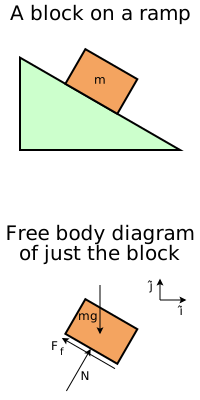
Common forces on FBDs:
| Force | Symbol | Direction | Notes |
|---|---|---|---|
| Weight | W or mg | Downward | Always present near Earth’s surface |
| Normal force | N or | Perpendicular to surface | Surface pushes back on whatever’s touching it |
| Friction | f | Parallel to surface, opposing motion | Static or kinetic |
| Tension | T | Along the rope/string | Pulls, never pushes |
| Applied force | Direction of push/pull | Given in the problem |
Applying Newton’s Second Law
Once your FBD is drawn, the math is mechanical. Pick a coordinate system (usually x = horizontal, y = vertical), then add up the forces in each direction separately:
- x-direction: sum of all x-forces =
- y-direction: sum of all y-forces =
If the object isn’t accelerating in a direction (e.g., a box sitting on a table isn’t accelerating vertically — it’s just sitting there), then the net force in that direction is zero. That fact alone often unlocks the normal force or tension.
Worked example. You push a 30 kg suitcase across an airport floor with a 60 N horizontal force. Friction opposes the motion at 30 N. What’s the suitcase’s acceleration?
- FBD has 4 forces: weight down, normal up (these cancel — no vertical motion), push (60 N forward), friction (30 N backward).
- Net horizontal force = 60 − 30 = 30 N forward.
- m/s² forward.
That’s it. Three lines of work because we drew the diagram first.
Elevator Problems (Apparent Weight)
The MCAT loves elevator problems because they hide a really clean physics insight inside an everyday experience.
You’ve felt it: when an elevator starts going up, you feel briefly heavier. When it slows down at the top, you feel briefly lighter. Your actual weight (mg) hasn’t changed — but the floor (and the scale, if you’re standing on one) is pushing on you with a different force.
That force is the normal force, and the scale reads exactly that. We call it your apparent weight.
In an elevator accelerating upward, the floor has to do two jobs: hold you up and speed you up. So it pushes harder than usual. In an elevator accelerating downward, the floor still holds you up but doesn’t have to push as hard, because gravity is doing some of the work.
| Elevator motion | Acceleration | Normal force (scale reading) | You feel… |
|---|---|---|---|
| Accelerating up | Upward | N = m(g + a) > mg | Heavier |
| Constant velocity (up or down) | 0 | N = mg | Normal |
| Accelerating down | Downward | N = m(g - a) < mg | Lighter |
| Free fall | g downward | N = 0 | Weightless |
Notice that constant velocity feels normal — even at the top of a fast-moving elevator, if it’s cruising at steady speed, you feel just like standing on the ground. The “heavy” and “light” sensations only happen during the acceleration phases (start and stop).