
Circular Motion
You’re a passenger in a car taking a sharp left turn. You feel pulled to the right — toward the outside of the curve. A ball on a string swings in a circle and flies away the moment you let go. Spin a bucket of water over your head and the water stays in the bucket, like something is pinning it outward.
You whirl a ball on a string in a horizontal circle and the string suddenly snaps. Which way does the ball go?
Lock in your prediction, then test it below. Press “Cut the string” and watch the path the ball actually takes against the faint circle it used to follow. Try a few speeds and radii and check whether the departure direction ever changes.
Every one of these feelings seems to say there’s a force pushing you outward. But there isn’t. What’s actually happening is the opposite: something must constantly pull you inward to keep you moving in a circle, and the moment that inward pull disappears, you fly off in a straight line tangent to the curve — not outward.
Your body’s “outward push” sensation is just inertia (Newton’s first law) trying to keep you moving in a straight line while the car curves around you. There’s no outward force. There’s only the absence of an inward one.
Uniform Circular Motion
An object moving in a circle at constant speed is in uniform circular motion. The speed is constant — but the direction is changing every instant. Since velocity is a vector (magnitude + direction), a constantly changing direction means a constantly changing velocity, which means there’s acceleration — even though the speedometer never moves.
This was the punchline of §1.4 (“speed vs. velocity”). Now we put a number on it.
Centripetal Acceleration
The acceleration in uniform circular motion always points toward the center of the circle. It’s called centripetal — Latin for “center-seeking.”
Notice in the numerator. Doubling your speed quadruples the centripetal acceleration needed to stay in the same circle. That’s why it’s so much harder to control a car at 60 mph through a curve than at 30 mph — not twice as hard, four times as hard.
The velocity is always tangent to the circle (along the path of motion). The acceleration is always perpendicular to the velocity (pointing inward). So velocity and acceleration are at 90° to each other at every moment — which is why the speed (magnitude of velocity) doesn’t change, only the direction does.
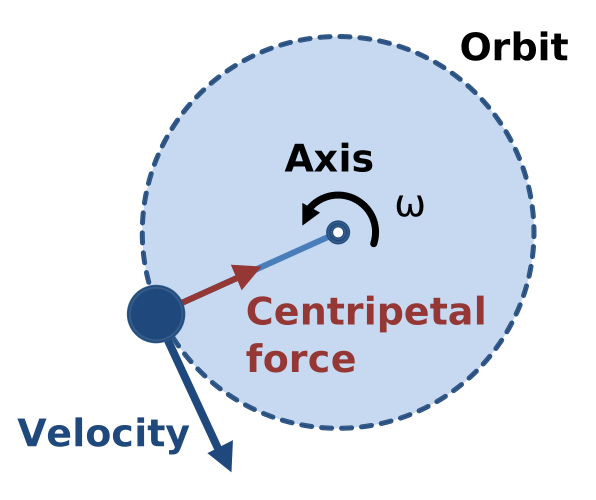
Centripetal Force
By Newton’s second law, every acceleration needs a net force (). Centripetal acceleration needs a net force pointing inward — that net force is the centripetal force.
Important: “centripetal force” is not a new kind of force. It’s just a label for “whatever real force happens to be pointing toward the center.” Depending on the situation, that real force might be tension, friction, gravity, normal force, or something else — but it’s always one of the standard forces you already know.
| Scenario | What real force provides the centripetal force? |
|----------|--------------------------------|
| Ball on a string | Tension in the string |
| Car rounding a curve | Static friction between tires and road |
| Satellite in orbit | Gravity |
| Roller-coaster loop (top) | Normal force + gravity, both pointing down/inward |
| Roller-coaster loop (bottom) | Normal force minus gravity (normal points up/inward, gravity pulls down/outward) |
| Electron orbiting nucleus | Electrostatic (Coulomb) force |
There Is No Centrifugal Force
In an inertial reference frame, there is no outward force on an object in circular motion. The “outward push” feeling is your body’s inertia resisting the inward turn — Newton’s first law in action. If the inward force vanished, you wouldn’t fly outward; you’d continue in a straight line tangent to where you were the moment the force disappeared.
“Centrifugal force” only shows up when you do physics in a rotating (non-inertial) reference frame, where it’s a fictitious force used to make Newton’s laws bookkeep correctly inside the spinning frame. The MCAT treats centrifugal force as fictitious — never include it on a free-body diagram.
Period, Frequency, and Speed
For an object going around a complete circle:
Brief Note on Rotational Quantities
The MCAT occasionally references angular quantities. You don’t need to do detailed rotational dynamics, but recognize the parallels:
| Linear quantity | Angular equivalent | Relationship |
|----------------|-------------------|-------------|
| Displacement () | Angular displacement () | |
| Velocity () | Angular velocity () | |
| Acceleration () | Angular acceleration () | |
Centripetal acceleration can also be written (substitute into ). Either form is fine — pick whichever the problem makes easier.
m/s², N. m/s². N, directed toward the center of the circle.
Static friction provides the centripetal force. If friction drops (icy road), there isn’t enough inward force to keep the car on the curved path. The car doesn’t fly “outward” — it continues in a straight line tangent to the curve, which takes it off the road to the outside of the turn. The driver must slow down (reducing required centripetal force = ) to stay on the road.
10 m/s² at 30 m/s; 40 m/s² at 60 m/s. m/s². At double speed: m/s² — four times larger because is squared. This is why high-speed curves require either banking (to provide extra inward force from the normal force) or much wider radii.