Place a marble on a flat table. It just sits there. Tilt the table even slightly and the marble starts rolling. Tilt it more — it rolls faster.
Gravity hasn’t changed. It still pulls straight down with the same force. What changed is how that downward pull gets split between two jobs: pulling the marble along the slope (making it slide) and pressing the marble into the slope (making it stay in contact).
Inclined-plane problems show up on nearly every MCAT, and they all reduce to one move: split the weight vector (mg) into a piece along the ramp and a piece perpendicular to the ramp. Master that one move and every incline problem becomes plug-and-chug.
🎯 Predict First
A 2 kg block sits on the verge of slipping on a ramp tilted at 30 degrees. You swap it for a 20 kg block of the same material. What happens?
Test your prediction below. Raise the angle until the block lets go, then drag the mass slider up and down: every force arrow grows and shrinks with the mass, but the slip point never moves.
Static: friction holds (tan θ = 0.47, μs = 0.50). Slips when tan θ > μs (mass does not matter).
The trick to inclines is to tilt your coordinate axes so one axis runs along the slope and the other runs perpendicular to it. This is unusual — every other problem uses x = horizontal, y = vertical — but here it pays off massively. Why? Because the object only moves along the slope. If your axes are aligned with the slope, “motion direction” and “x-axis” are the same thing, and the math collapses to one dimension.
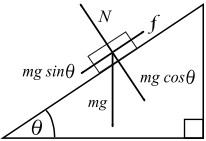
Once you tilt the axes, gravity is the one force that no longer points along an axis. Gravity always pulls straight down, regardless of which way you’ve drawn your axes. So you have to split gravity into two components:
Force decomposition on an incline. Gravity (mg) splits into a component along the ramp (mgsinθ) and a component into the ramp (mgcosθ). The normal force balances the perpendicular component. Credit: Wikimedia Commons, CC BY-SA
The Normal Force on an Incline
On a flat surface, the normal force equals the full weight: N=mg. On an incline, the surface only has to balance the perpendicular component:
N=mgcosθ
This means the normal force is always less than mg on an incline. The steeper the slope (bigger θ), the smaller cosθ, the smaller N. At θ=90° (a vertical wall), N=mgcos90°=0 — a vertical wall provides no support to an object that isn’t held against it.
Frictionless Incline
On a frictionless incline, the only force along the slope is mgsinθ. Apply Newton’s second law along that direction:
ma=mgsinθ
The mass cancels out: a=gsinθ.
Sanity checks (these are great for confirming you wrote the formula right):
At θ=0 (flat surface): a=gsin0°=0. No acceleration on a flat floor. ✓
At θ=90° (vertical drop): a=gsin90°=g. Free fall. ✓
Anywhere in between: a is between 0 and g. ✓
Incline With Friction
When friction is in play, it acts along the slope, opposite to the direction of motion (or attempted motion).
Object sliding down the ramp. Gravity pulls it down the slope; friction pushes it up the slope:
Net=mgsinθ−fk=mgsinθ−μk(mgcosθ)
a=g(sinθ−μkcosθ)
Object pushed up the ramp. Both gravity and friction now point down the slope (friction always opposes motion):
a=g(sinθ+μkcosθ) (this is a deceleration as the object slows on the way up)
When Does an Object Stay Put?
An object on a ramp doesn’t slide as long as static friction can balance the down-slope pull of gravity:
μsN≥mgsinθ
Substitute N=mgcosθ:
μsmgcosθ≥mgsinθ⇒μs≥tanθ
Mass cancels. The object slips at the critical angle where tanθ=μs. Below that angle, friction can hold it. Above it, friction can’t keep up and the object starts sliding.
Worked Example
A 10 kg box sits on a 30° ramp. The coefficient of kinetic friction is 0.2. What is the box’s acceleration down the ramp? (Use g=10 m/s²; sin30°=0.5; cos30°=0.87.)
Compare to a frictionless 30° ramp: a=gsin30°=5 m/s². Adding friction shaved off about 1.7 m/s² of acceleration. As a sanity check: the answer is positive, so the box does slide down (friction wasn’t strong enough to hold it). If you’d gotten a negative number, friction would be strong enough to keep the box stationary, and the actual acceleration would be zero.
A 10 kg box sits on a 30° frictionless ramp. What is the acceleration down the ramp and what is the normal force? (Use g = 10 m/s²)
Click to reveal answer
Acceleration: 5 m/s². Normal force: 87 N.a=gsin30°=10×0.5=5 m/s². N=mgcos30°=10×10×0.87=87 N. Note that acceleration doesn’t depend on mass, but normal force does.
On an incline, what happens to the normal force and friction as the angle increases?
Click to reveal answer
Both decrease. Normal force N=mgcosθ shrinks as θ grows because cosθ shrinks. Since friction depends on N (via f=μN), friction shrinks too. Meanwhile, the down-slope component of gravity (mgsinθ) grows. Steeper ramp = less friction holding you back AND more gravity pulling you down. That’s the double whammy that makes steep slopes so prone to sliding.
A block sits on a ramp whose angle is slowly increased. The block starts to slide when the ramp reaches 25°. What is the coefficient of static friction between the block and the ramp?
Click to reveal answer
μs=tan25°≈0.47. The block starts sliding at the critical angle where tanθ=μs. So μs=tan25°≈0.47. This is a clean experimental method for measuring μs — tilt until it slides, read the angle, take the tangent.