
Vector Math
You walk 3 blocks east, then 4 blocks north. How far are you from where you started?
Your first instinct says “7 blocks” — but that’s only the total ground you covered. The straight-line distance from start to finish is 5 blocks, and to find it you have to add the two walks as vectors, not as plain numbers.
That’s the whole game with vectors: 3 + 4 doesn’t always equal 7, because direction matters. A 3 N force pulling right and a 3 N force pulling left don’t combine to 6 N — they cancel to zero.
Almost every MCAT motion problem and force problem comes down to vector addition or subtraction. There are two ways to do it, and you should be comfortable with both.
Graphical Method: Tip-to-Tail
The simplest way to add two vectors: draw them tip-to-tail. The first arrow ends where the second begins. The straight line from the start of the first to the end of the second is your answer (the resultant).
The three-step picture:
- Draw the first vector as an arrow.
- Place the tail of the second vector at the tip of the first.
- Draw the resultant from the tail of the first to the tip of the last.
For the 3-east, 4-north example: 5 blocks, at an angle of north of east. Recognize this — it’s the classic 3-4-5 right triangle.
Component Method: The Workhorse
The graphical method is great for two vectors. Once you have three or more — or you need a precise number rather than an estimate from a sketch — switch to the component method. This is what you’ll use most often on the MCAT.
The idea: every vector can be split into x and y pieces (from §1.2). Once everything is in x and y, addition becomes ordinary arithmetic — just add all the x’s together, then all the y’s together, then rebuild the result.
Three steps:
- Resolve each vector into x- and y-components.
- Add all the x-components to get . Add all the y-components to get .
- Recombine using the Pythagorean theorem and arctangent.
Example. Add vector A (5 N at 30° above the x-axis) and vector B (8 N along the x-axis).
| Vector | x-component | y-component |
|---|---|---|
| A | N | N |
| B | N | N |
| Resultant | 12.35 N | 2.5 N |
12.6 N, pointing 11.5° above the x-axis.
Vector Subtraction
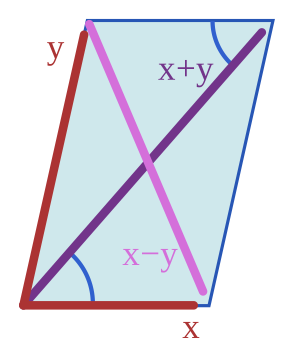
Subtracting vector B from vector A is the same as adding the opposite of B:
The negative of a vector has the same magnitude but points the opposite way. Graphically: flip B around 180°, then add it tip-to-tail with A. With components: just subtract each component (x from x, y from y).
Why this matters: vector subtraction is how you find changes. Change in velocity, , is what gives you acceleration. Change in position, , is displacement. Whenever the MCAT asks “what’s the change in…?” you’re doing vector subtraction.
Worked example. A car moving 30 m/s east turns a corner and ends up moving 30 m/s north. What’s the change in velocity?
- .
- In x: m/s.
- In y: m/s.
- Magnitude: m/s.
- Direction: northwest (45° above the −x axis).
The car’s speed never changed — but its velocity did, and the magnitude of that change is 42.4 m/s. That’s why the car had to accelerate to make the turn.
Special Cases
A few situations show up so often they’re worth memorizing as shortcuts.
Same direction → magnitudes add. Two 5 N forces both pulling right give 10 N right.
Opposite directions → magnitudes subtract. 5 N right plus 3 N left gives 2 N right.
Perpendicular (90° apart) → Pythagorean theorem. 3 N right plus 4 N up gives 5 N.
Equilibrium → vectors sum to zero. If everything cancels out, the object has no net force on it. By Newton’s first law, that means no acceleration — the object either sits still or coasts at constant velocity. Equilibrium is the entire premise of “free body in balance” problems and inclined-plane setups where things slide at constant speed.