You’re a passenger in a car going 60 km/h and you toss a ball straight up. To you, the ball goes straight up and comes straight back down into your hand. To someone standing on the sidewalk watching you go by, the ball traces a beautiful arc through the air — a parabola.
Both observers are right. The ball is doing two motions at once: a horizontal one (the car’s speed, which the ball still has) and a vertical one (your toss + gravity). Those two motions don’t interfere with each other. They just happen at the same time.
That single idea — horizontal and vertical motion are independent — is the master key to every projectile problem on the MCAT. Master it and the rest is just bookkeeping.
🎯 Predict First
A ball is launched at an angle and reaches the very top of its arc. At that instant, which statement is true?
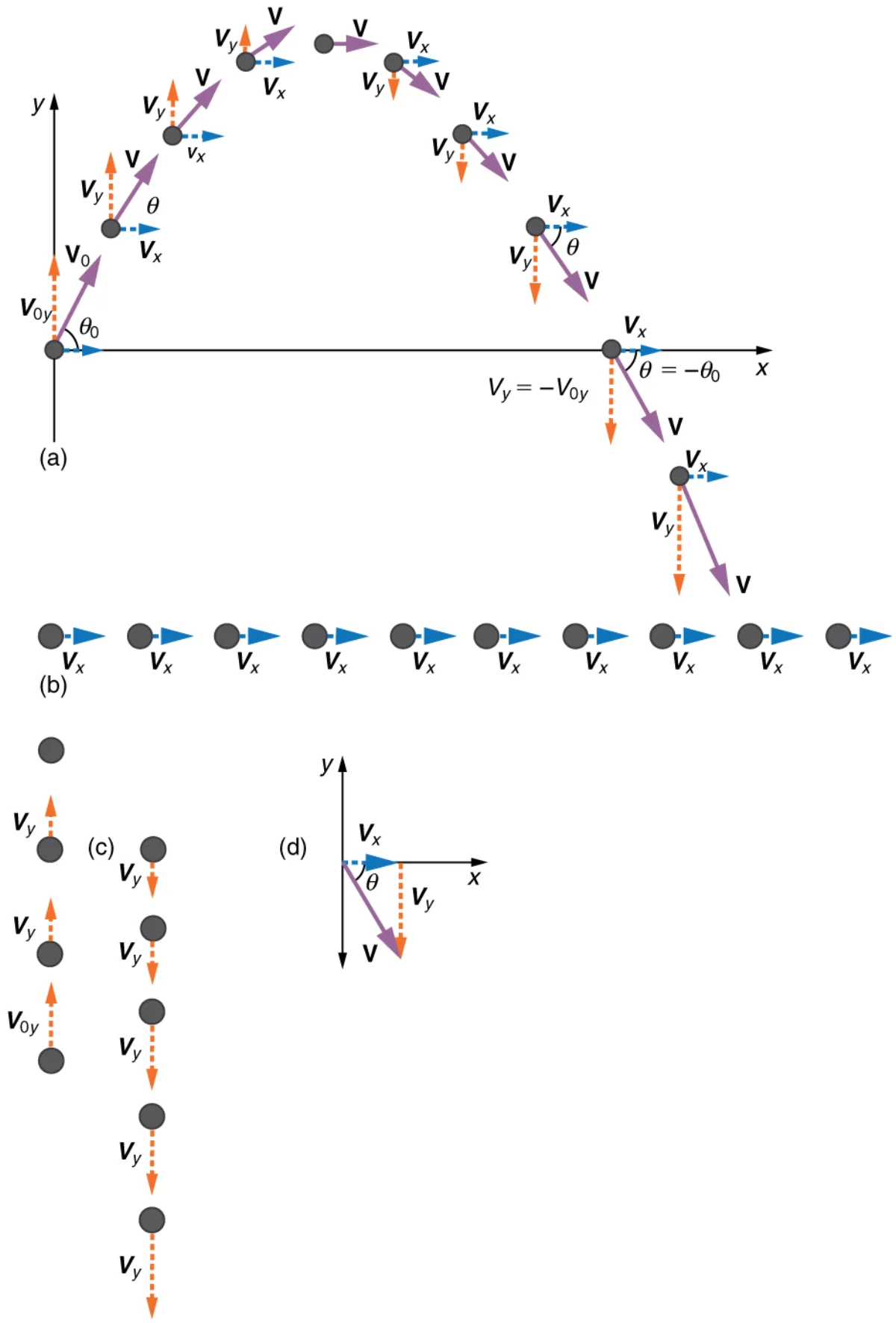
Use the simulation below to explore how launch angle and initial speed change the trajectory. Watch the horizontal velocity (blue) stay rock-steady while the vertical velocity (red) shrinks, hits zero, then grows in the other direction.
The horizontal direction has no acceleration (no force pushes the ball sideways once it’s left your hand), so the horizontal velocity never changes. The vertical direction has constant downward acceleration g — exactly the free fall problem from §1.5.
Solving Projectile Problems: Step by Step
Resolve the initial velocity into horizontal (v0cosθ) and vertical (v0sinθ) components.
Use the vertical equations to find time of flight, max height, or vertical position.
Plug that time into the horizontal equation to find range or horizontal position.
That’s it. Two motions, one shared variable (time), three steps.
Key Projectile Relationships
For a projectile launched from and landing at the same height (level ground):
Trajectory of a projectile on level ground. Horizontal velocity stays constant throughout. Vertical velocity decreases on the way up, hits zero at the peak, then increases on the way down. Credit: OpenStax, CC BY 4.0
Launch Angle Effects
The launch angle dramatically changes the trajectory. Soccer players, kickers, and quarterbacks all unconsciously do this math:
| Angle | Range | Height | Notes |
|-------|-------|--------|-------|
| 45° | Maximum | Moderate | Optimizes range because sin(2×45°)=sin90°=1 |
| 30° | Same as 60° | Lower than 60° | Complementary angles share range |
| 60° | Same as 30° | Higher than 30° | Complementary angles share range |
| 0° | — | 0 | Horizontal launch (rolled off a table) |
| 90° | 0 | Maximum | Straight up and down |
Special Case: Horizontal Launch
When something rolls off a table or flies off a cliff horizontally, the initial vertical velocity is zero. The object then falls like any dropped object vertically, while keeping its horizontal speed.
Time to hit the ground depends only on the height: h=21gt2, so t=2h/g.
Horizontal distance = (horizontal speed) × (time). Faster sideways speed → lands farther away. But the fall time itself doesn’t change — it’s set entirely by the height.
Famous demo: shoot a bullet horizontally and drop a second bullet from the same height at the same instant. They both hit the ground at the same time. The shot bullet just lands much farther away.
Trajectories at different launch angles. Complementary angles (like 30° and 60°) hit the same range. A 45° launch maximizes range. Credit: Wikimedia Commons, CC BY-SA
A ball is launched horizontally at 15 m/s from a 20 m high cliff. How long does it take to hit the ground? (Use g = 10 m/s²)
Click to reveal answer
2 seconds. Horizontal speed doesn’t affect time to fall. Using h=21gt2: 20=5t2, so t=2 s. The ball lands 15×2=30 m from the base of the cliff.
Two projectiles are launched at the same speed, one at 25° and one at 65°. Which has a longer range? Which reaches a greater height?
Click to reveal answer
They have the same range (25° + 65° = 90°, so they’re complementary angles). The 65° projectile reaches a greater height — a steeper angle directs more of the initial velocity vertically, producing a higher peak and a longer time in the air.
A soccer ball is kicked at 20 m/s at 30° above the horizontal. What is its range on level ground? (Use g = 10 m/s², sin 60° ≈ 0.87)
Click to reveal answer
About 35 m.R=gv02sin(2θ)=10202⋅sin60°=10400⋅0.87≈35 m. (For reference, that’s about a third of a soccer field — realistic for a hard kick.)