
Friction
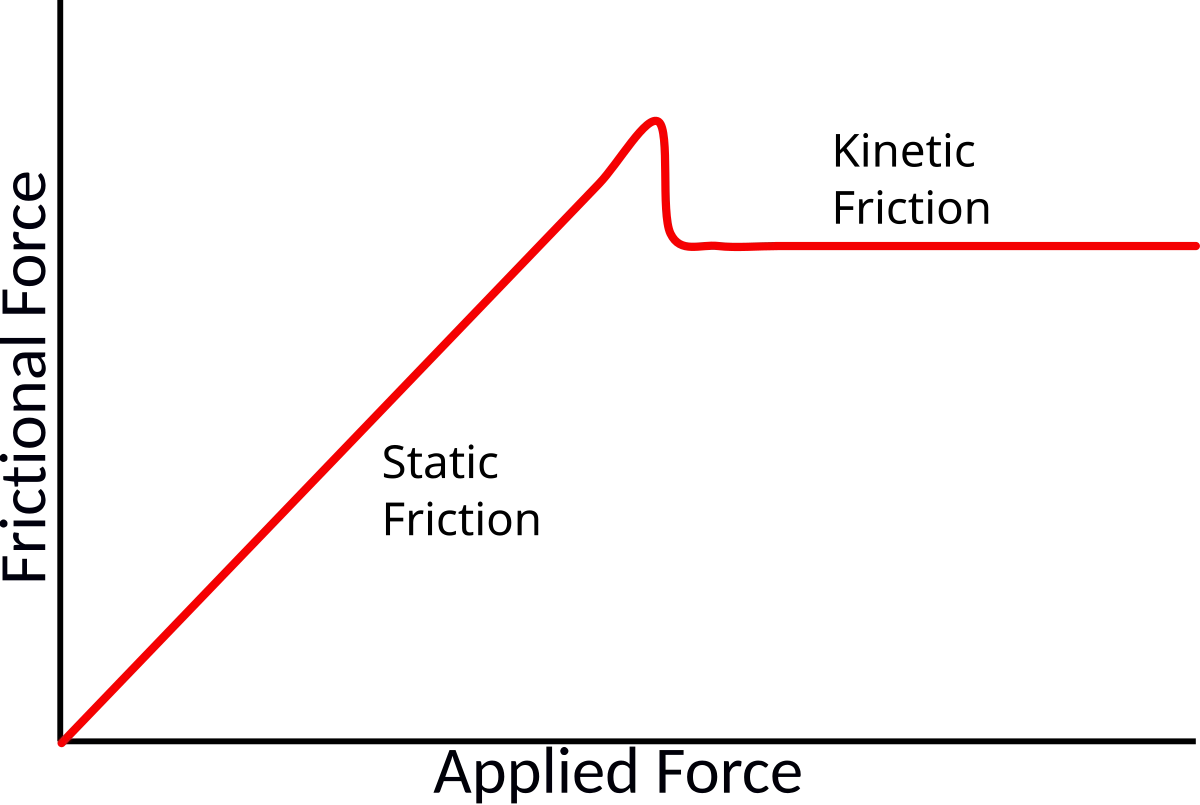
Try shoving a heavy bookcase across a carpeted floor. You push harder, and harder, and nothing happens. Then suddenly — pop — it breaks free and starts sliding. And once it’s moving, it feels noticeably easier to keep it going than it was to get it started.
That moment of “breaking free,” and the drop in effort right after, is the difference between static friction (the force resisting motion before the object slides) and kinetic friction (the force resisting motion during sliding). The MCAT tests this distinction constantly — directly in mechanics, and indirectly in fluid flow, in circuits as resistance, and in biological systems like blood viscosity.
What Is Friction?
Friction is a contact force that opposes the relative motion (or attempted motion) between two surfaces. It always acts parallel to the surfaces — never perpendicular — and points opposite to whichever direction the object is sliding (or would slide if friction got out of the way).
Static Friction
Static friction () acts on objects that are not yet sliding. It actively prevents motion.
The key word here is ”≤” not ”=”. Static friction is not always equal to . It’s only equal to at the very instant the object is about to slip. Before that, static friction self-adjusts to match exactly whatever push you apply.
- Push with 10 N → static friction pushes back with 10 N (object doesn’t move).
- Push with 50 N → static friction pushes back with 50 N (still doesn’t move).
- Push with 80 N where N → static friction can’t keep up, object slips and starts sliding.
This self-adjusting behavior is why, on a flat floor, a heavy box can sit perfectly still while you push gently — the floor’s friction is matching your push exactly, even though that floor is capable of pushing back much harder.
Kinetic Friction
Kinetic friction () acts on objects that are already sliding. Unlike static friction, it’s a fixed value.
Static vs. Kinetic: Side by Side
| Property | Static Friction | Kinetic Friction |
|---|---|---|
| When it acts | Object is not yet sliding | Object is sliding |
| Magnitude | Variable (0 up to ) | Constant () |
| Coefficient | (larger) | (smaller) |
| Self-adjusting? | Yes — matches applied force | No — always |
What Friction Depends On (and Doesn’t)
Friction depends on exactly two things:
- The coefficient of friction () — a dimensionless number set by what the two surfaces are made of.
- The normal force () — how hard the surfaces are squeezed together.
Friction does not depend on:
- Contact area. A brick on its side has the same friction as the same brick on its end (assuming same surface, same weight). Doubling the area cuts the pressure but doubles the contact patch — they cancel.
- Speed of sliding. Kinetic friction is the same at 1 m/s and 100 m/s.
This is one of those facts that genuinely surprises students because it doesn’t match intuition. Wider tires feel like they should grip more — but in the simple physics-class model of friction, they don’t. (In reality, tire grip involves rubber deformation, which is not simple Coulomb friction; the MCAT uses the simple model.)
Applications of Friction
Walking. Your foot pushes backward on the ground; static friction pushes forward on your foot (the same swap-and-flip from §1.9). Without friction, you couldn’t walk — try it on a wet bathroom floor or a sheet of ice.
Braking. When you brake hard, you want the tires to not slide — you want static friction between the tire and road, not kinetic. Static friction is bigger, so the stopping distance is shorter. If the wheels lock and skid, friction drops to kinetic and the car takes longer to stop. That’s why cars have anti-lock braking systems (ABS): they prevent the wheels from locking, keeping you in the high-friction static regime.
Climbing stairs / running. Same as walking — your shoe pushes back, friction pushes you forward.
Holding a pencil. Static friction between your fingers and the pencil keeps it from sliding out of your grip. Squeeze harder ( increases) and the maximum friction increases proportionally.
Worked Example
A 20 kg box sits on a floor with and . Use m/s².
- Normal force: N.
- Maximum static friction: N. So you must push harder than 100 N to get the box moving.
- Kinetic friction (once sliding): N.
- Force needed for constant velocity: exactly 60 N (just enough to cancel kinetic friction).
- If you push at 100 N once it’s already sliding: net force = N → m/s² forward.
Notice: the force to start moving (101 N) is much bigger than the force to keep moving steadily (60 N). That’s the static-vs-kinetic gap in action.