
Coulomb's Law
Hold two magnets in your hands. Push two north poles toward each other and you feel resistance that gets dramatically stronger as they get close. Flip one magnet around and they snap together so hard they pinch your fingers. Now imagine the same thing for electric charges instead of magnets — same intuition, but charges can be positive or negative, and the force between them follows a precise mathematical rule discovered by Charles-Augustin de Coulomb in 1785.
That rule is Coulomb’s law, and it governs almost every electrostatic problem you’ll see on the MCAT. The structure of the equation looks almost identical to Newton’s law of gravitation — which is a useful coincidence to remember, because if you know one, the other is mostly mechanical.
The Equation
The force is attractive when the charges have opposite signs (one +, one −) and repulsive when they have the same sign (both + or both −). The sign of the product tells you which: negative product → attraction; positive → repulsion.
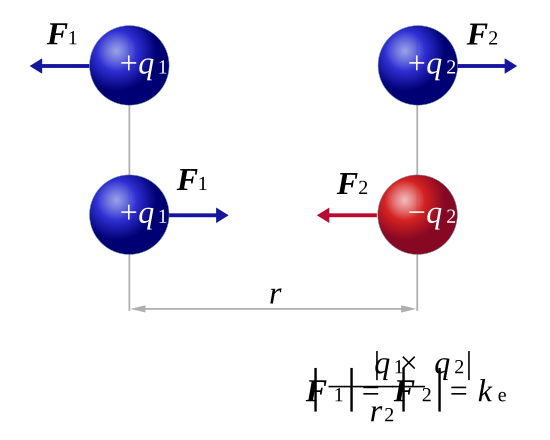
The Inverse-Square Law
The single most important feature of Coulomb’s law is the in the denominator. Force drops off fast with distance:
- Double the distance → force drops to .
- Triple the distance → force drops to .
- Halve the distance → force quadruples.
Coulomb’s Law vs. Newton’s Law of Gravitation
Coulomb’s law looks almost identical to gravity:
| Feature | Coulomb’s law | Gravity |
|---|---|---|
| Formula | ||
| Constant | ||
| Property | Charge | Mass |
| Direction | Attract OR repel | Always attract |
| Relative strength | Vastly stronger | Vastly weaker |
The electric force is much stronger than gravity. The electrostatic force between a proton and electron in a hydrogen atom is about (a 1 followed by 39 zeros) times stronger than the gravitational force between them. Gravity only dominates on cosmic scales (planets, stars, galaxies) because most macroscopic objects are electrically neutral — positive and negative charges cancel out, so the residual electric force across the room is tiny. Mass never cancels — gravity always adds up.
Superposition of Forces
When more than two charges are present, the net force on any one charge is the vector sum of all the individual Coulomb forces acting on it. Calculate the force from each other charge separately, then add the force vectors. This is the principle of superposition — and it’s what lets you handle multi-charge problems with the same simple two-body equation.
For the MCAT, superposition problems usually involve only two or three charges arranged symmetrically. Use symmetry to simplify: if two charges exert equal forces at right angles, the net force is along the diagonal with magnitude . Review vector addition if perpendicular force combinations feel rusty.
Common MCAT Problem Types
- Distance-change problems: “If the distance is halved, what happens to the force?” Apply inverse-square: × 4.
- Charge-change problems: “If both charges double, what happens to the force?” , so doubling both → × 4.
- Three-charge equilibrium: “Where should a third charge be placed so the net force on it is zero?” Find the point where forces from the two fixed charges are equal and opposite.