
Social Reproduction and Disparities
The final section covers how inequality persists across generations, the specific patterns of healthcare disparities, and a few tools for thinking about sociological research.
Social Reproduction
Social reproduction is how class, culture, and inequality get passed from one generation to the next. It’s why children of professionals usually become professionals and children of the poor often stay poor.
Mechanisms:
- Economic inheritance - wealth transfers, home ownership, support for education.
- Human capital - parental investment in children’s education and skills.
- Social networks - whom you know opens which doors.
- Cultural knowledge - tacit understanding of how elite institutions work.
Bourdieu’s Capital

Pierre Bourdieu expanded the concept of capital beyond money to include:
- Economic capital. Money and material assets.
- Cultural capital. Knowledge, tastes, credentials that signal belonging to a class. Fluent in “highbrow” art, understanding unspoken norms of academia, comfort with professional manners.
- Social capital. The value of your social networks and connections.
- Symbolic capital. Prestige, reputation, honor.
Each type of capital can be converted into the others (though conversion is rarely perfect). A doctor’s credential (cultural capital) enables high income (economic capital) and professional networks (social capital).
Habitus
Habitus is Bourdieu’s concept for internalized dispositions - a person’s taken-for-granted ways of acting, thinking, and evaluating. Habitus develops through socialization in one’s class environment. Upper-class habitus includes confidence in elite institutions, taste for “high” culture, comfort in formal settings. Working-class habitus includes different tastes, comfort zones, and styles.
Habitus makes inequality feel natural. The upper-class person’s comfort in a Michelin-starred restaurant feels like personal refinement; the working-class person’s discomfort feels like personal lack. Both are products of different social environments, but they are experienced as individual traits.
Healthcare Disparities in the U.S.
Healthcare outcomes vary along multiple axes:
By Income
- Lower income → higher mortality rates, worse outcomes for chronic disease, higher infant mortality.
- The gap in U.S. life expectancy between rich and poor widened substantially between 2001 and 2014.
By Race
- Black Americans have higher maternal mortality (~3× that of white women), higher rates of cardiovascular disease, stroke, diabetes, and many cancers.
- Native Americans experience specific burdens around diabetes, alcohol-related illness, and suicide.
- Hispanic Americans often show better health on some measures despite lower income - the “Hispanic paradox” - though with significant variation.
By Geography
- Rural Americans face hospital closures, longer transport times, fewer specialists.
- “Deaths of despair” (opioids, suicide, alcohol-related deaths) hit rural white Americans especially hard.
By Insurance Status
- Uninsured Americans delay care, skip medications, and have worse outcomes across virtually every condition.
- Medicaid expansion reduced mortality in states that adopted it.
Intersectionality and Health Disparities

Intersectionality (Crenshaw, Chapter 11) helps explain why single-axis analyses miss critical patterns. Black women’s maternal mortality is not just “race plus gender” - it’s an intersection that produces unique disparities. A white gay man in rural poverty faces intersecting burdens of class and sexuality not captured by either alone.
Modern health equity research leans heavily on intersectional frameworks.
Social Determinants of Health
The conditions in which people are born, grow, live, work, and age that shape health. The WHO framework includes:
- Economic stability. Employment, income, expenses.
- Education. Access, quality, literacy.
- Social and community context. Discrimination, support, civic participation.
- Health and healthcare. Access, quality, coverage.
- Neighborhood and built environment. Housing, transportation, air quality, food access.
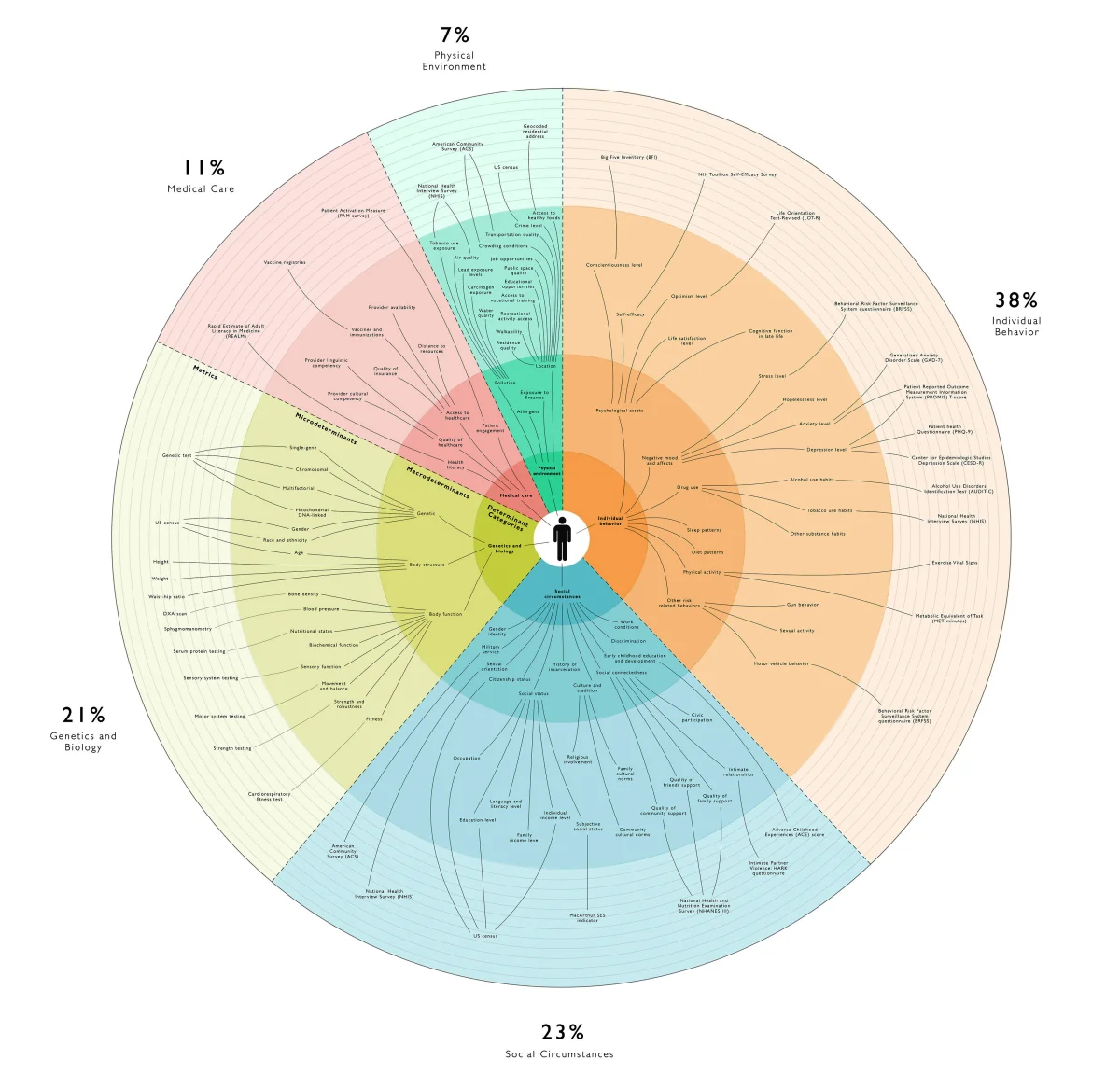
Medical care itself contributes only a modest share (~20%) to population health outcomes. Behaviors, environment, and social factors together contribute the majority.
Residential Segregation
Residential segregation is the physical separation of groups (by race, ethnicity, or income) into different neighborhoods. It is one of the most consequential drivers of inequality in the United States, because where you live governs what schools, jobs, grocery stores, hospitals, and air quality you have access to.
Three Measurable Forms
- Evenness (segregation proper). How unevenly two groups are distributed across neighborhoods. Measured by the index of dissimilarity - a number from 0 to 100. An index of 0 means perfectly even distribution; 100 means total segregation. It literally reads as the percentage of one group that would have to move for distribution to be even. U.S. Black/white dissimilarity in many metros sits around 60–70.
- Concentration. Clustering of one group into a small land area. A neighborhood with 90% of its population from one group is highly concentrated.
- Centralization. Concentration specifically in the urban core. A group is centralized when it is packed into the inner city while others spread out to suburbs.
Why Residential Segregation Drives Health and Life Outcomes
- Political isolation. Segregated communities have less overlap with other neighborhoods’ political interests. Their votes get diluted at the municipal level, and their representatives often have little power to demand resources for them. Result: fewer clinics, worse snow removal, underfunded schools.
- Linguistic isolation. Communities kept apart can develop or retain distinct languages or dialects. That limits the job market they can access, even within the same city.
- Educational underfunding. U.S. public schools are funded largely by local property taxes. Segregation by income produces segregation in school quality automatically - no one has to write a discriminatory law for it to happen.
- Spatial mismatch. Jobs for low-income workers exist, but often in suburbs disconnected from the urban neighborhoods where those workers live. Without a car, a two-hour bus commute each way is unworkable. The jobs are there; access is not.
- Environmental burden. Highways, factories, waste-processing sites, and polluting industries are disproportionately placed in segregated, low-income, minority neighborhoods - a pattern called environmental injustice. Asthma rates in these neighborhoods can be multiples of those in wealthier areas a few miles away.
- Healthcare access. Fewer hospitals, longer ambulance response times, closed maternity wards, fewer specialists.
Segregation vs. Social Isolation
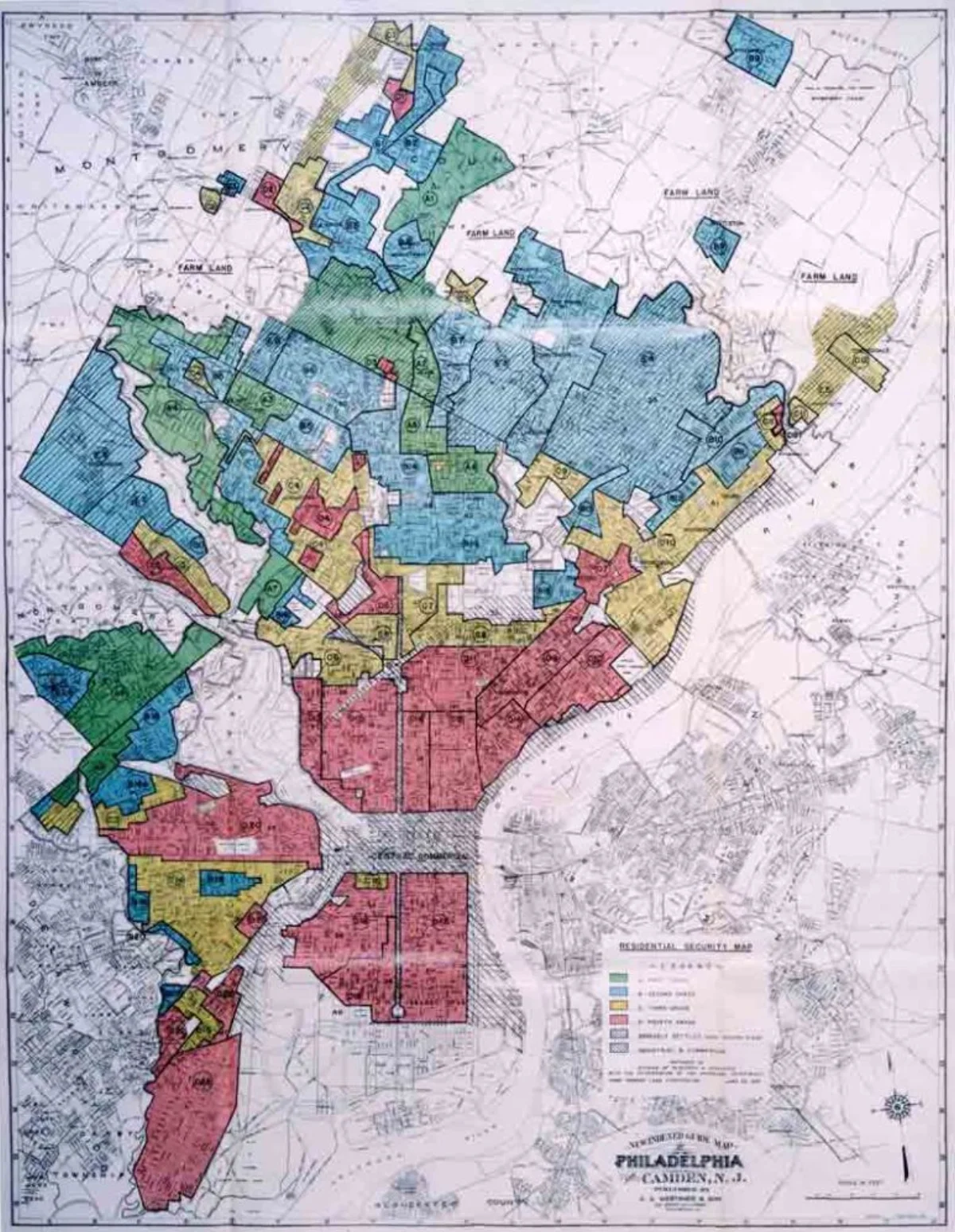
Segregation is usually externally imposed - by redlining, discriminatory lending, restrictive covenants, or exclusionary zoning. Social isolation is when a community voluntarily separates itself from the mainstream based on religion, culture, or lifestyle (e.g., the Amish). Same end result - separate populations - but very different mechanisms and moral valences.

”Separate but Equal” Is Rarely Equal
When groups are segregated, the segregated group consistently receives worse resources. The 1954 Brown v. Board of Education decision rested on exactly this finding: even when legally “equal,” segregated facilities were materially unequal in practice. The same holds today across housing, schools, and healthcare.
Research Study Types
Cross-Sectional Studies
Collect data from a population at a single point in time. Useful for prevalence estimates. Limited for inferring causation.
Longitudinal Studies
Follow the same group over time. Useful for tracking changes, identifying risk factors, and establishing temporal ordering.
- Cohort studies - follow a defined group forward in time, comparing those with and without an exposure.
- Case-control studies - compare people with a disease (cases) to people without (controls), looking backward for differential exposures.
Randomized Controlled Trials (RCTs)
Random assignment to intervention vs. control. The gold standard for causal inference but sometimes infeasible or unethical.
Qualitative Research
Interviews, ethnography, textual analysis. Provides depth and meaning at the cost of statistical generalizability.
Generalizability
Generalizability (external validity) is the extent to which findings from a study apply beyond the specific sample studied.
Requirements for generalizability:
- Representative sample. The sample should reflect the target population.
- Adequate sample size. Large enough to detect effects reliably.
- Valid measurements. Tools that accurately capture the concept of interest.
- Context similarity. The conditions of study should resemble the real-world settings where findings would apply.
Studies of college sophomores often don’t generalize to adults. Studies of Western populations often don’t generalize to non-Western populations. The term “WEIRD” populations (Western, Educated, Industrialized, Rich, Democratic) captures the overrepresentation of these populations in psychology research - most of what we “know” about human behavior comes from WEIRD samples that may not represent humanity.