Four Theories of Emotion

Four Theories of Emotion

6 min read Updated Apr 19, 2026

You see a bear on a hiking trail. Your heart races, your muscles tense, and you feel terrified. What happened in what order? The four theories of emotion disagree about the sequence, and the MCAT loves asking you to classify a scenario by theory.

Shared vocabulary: every emotion involves an event, a physiological response (PR), and a cognitive label/emotion. The theories differ on which comes first.
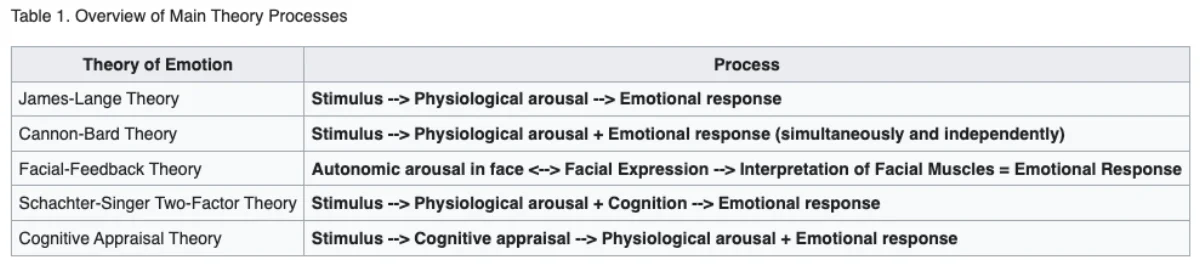
Two-column table titled 'Overview of Main Theory Processes' listing five theories of emotion and their arrow sequences. James-Lange: stimulus, then physiological arousal, then emotional response. Cannon-Bard: stimulus, then physiological arousal and emotional response simultaneously and independently. Facial-Feedback: autonomic arousal in the face and facial expression, then interpretation of the facial muscles as the emotional response. Schachter-Singer two-factor: stimulus, then physiological arousal plus cognition, then emotional response. Cognitive appraisal: stimulus, then cognitive appraisal, then physiological arousal and emotional response together
A summary table of the theories of emotion written as arrow sequences. Notice that each disagrees only about which step comes first: the same building blocks (stimulus, physiology, cognition, emotion) are rearranged. The MCAT routinely tests which theory predicts a given sequence. The table lists a fifth entry, facial-feedback, which this chapter does not cover; the four you need are James-Lange, Cannon-Bard, Schachter-Singer, and cognitive appraisal (Lazarus). Credit: D.mandziy via Wikimedia Commons (CC BY-SA 4.0).

James-Lange Theory

Event → Physiological Response → Emotion
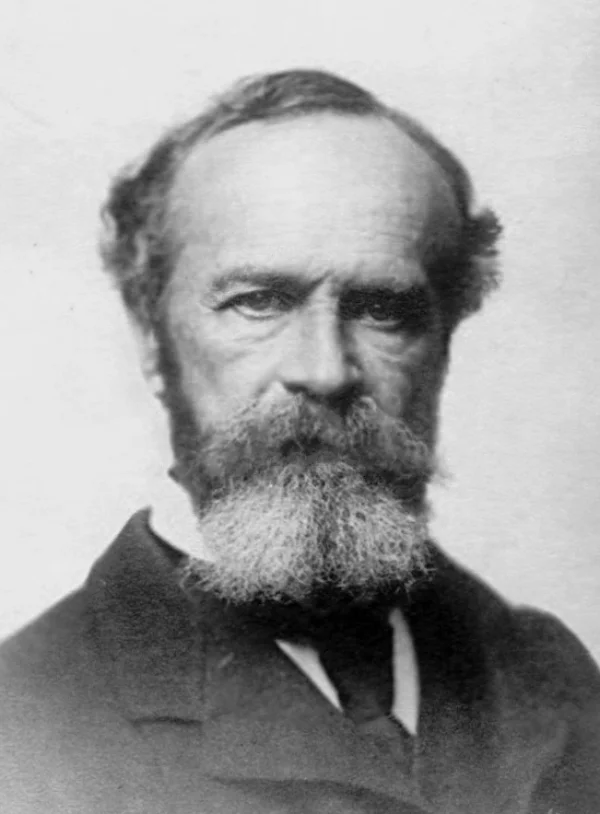
Black-and-white portrait of William James, a bearded 19th-century American philosopher and psychologist, looking at the camera with a serious expression
William James (1842-1910), the American philosopher-psychologist who, with Carl Lange, proposed that emotions arise from the conscious perception of bodily changes. Credit: Anonymous, c. 1890s (Public Domain) via Wikimedia Commons.

William James and Carl Lange proposed that your conscious emotion is a consequence of your physiological response. You don’t cry because you’re sad; you’re sad because you cry. The bear triggers a racing heart and tense muscles; you notice those bodily changes; your brain interprets them as fear.

Key prediction: if you could artificially produce a physiological pattern, you should feel the corresponding emotion.

Evidence: Botox that paralyzes frown muscles actually reduces subjective ratings of negative emotion. Smiling produces small increases in reported happiness. Both findings align with James-Lange.

Cannon-Bard Theory

Event → Physiological Response + Emotion (simultaneously)
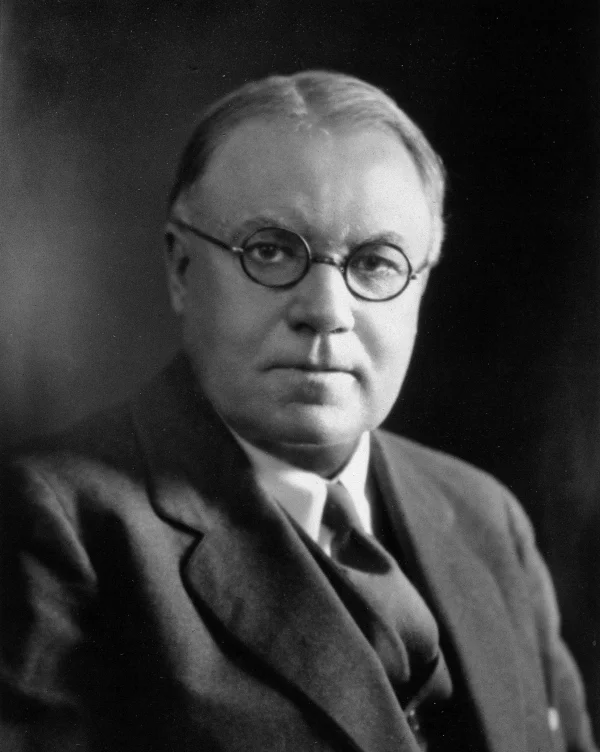
Black-and-white studio portrait of Walter Bradford Cannon in 1934, a middle-aged man with round wire-rim glasses wearing a three-piece suit
Walter Bradford Cannon (1871-1945), Harvard physiologist who coined "fight or flight" and, with student Philip Bard, formulated the simultaneous-arousal critique of James-Lange. Credit: Bachrach studio, 1934, Wellcome Collection via Wikimedia Commons (CC BY 4.0).

Walter Cannon and Philip Bard pushed back against James-Lange. They argued that the physiological response and the emotion occur simultaneously and independently, both triggered by the event. You see the bear, and at the same time your heart races AND you feel afraid. Neither causes the other.

Their objections to James-Lange:

  • Different emotions can produce the same physiological pattern. A racing heart accompanies fear, anger, and excitement. If the physiology caused the emotion, how would you know which one you were feeling?
  • Physiological responses are too slow. Emotions hit almost instantly, but heart rate changes take seconds.
  • You can have physiological arousal without emotion. Sprinting up stairs produces a racing heart without fear.

Mnemonic: C and B are adjacent in the alphabet - physiological response and emotion happen together.

Schachter-Singer Two-Factor Theory

Event → Physiological Response + Cognitive Label → Emotion

Stanley Schachter and Jerome Singer’s 1962 compromise: both physiological arousal AND cognitive interpretation are required for an emotion. You feel your heart racing. Then you look around and ask “why?” The answer determines the emotion. Heart racing + bear = fear. Heart racing + attractive date = attraction. Heart racing + just ran up the stairs = exertion.

Their classic experiment: subjects were injected with adrenaline (producing physiological arousal) and placed in either a euphoric or an angry confederate’s company. Those with the euphoric confederate reported feeling happy; those with the angry confederate reported feeling irritated. Same physiology, different emotions - determined by context and labeling.

This is why the “suspension bridge effect” works: people interviewed on a shaky bridge misattribute their fear arousal as attraction to the interviewer.

Lazarus Cognitive Appraisal Theory

Event → Cognitive Appraisal → Emotion + Physiological Response

Richard Lazarus argued that cognitive appraisal comes first. You must first evaluate the situation (is it a threat? a challenge? irrelevant?). The appraisal determines both the emotion you feel AND the physiological response.

This makes emotion very culturally and individually variable. Skydiving is terrifying to one person and exhilarating to another - the event is identical, but the appraisal differs. Same with holding a snake, speaking in public, or meeting a new roommate.

Mnemonic: Lazarus = LAbel first, emotion follows.

Yerkes-Dodson Law

An important related principle: performance on most tasks follows an inverted U relationship to arousal.

  • Too little arousal → bored, unmotivated, poor performance.
  • Moderate arousal → peak performance.
  • Too much arousal → anxiety, panic, poor performance.
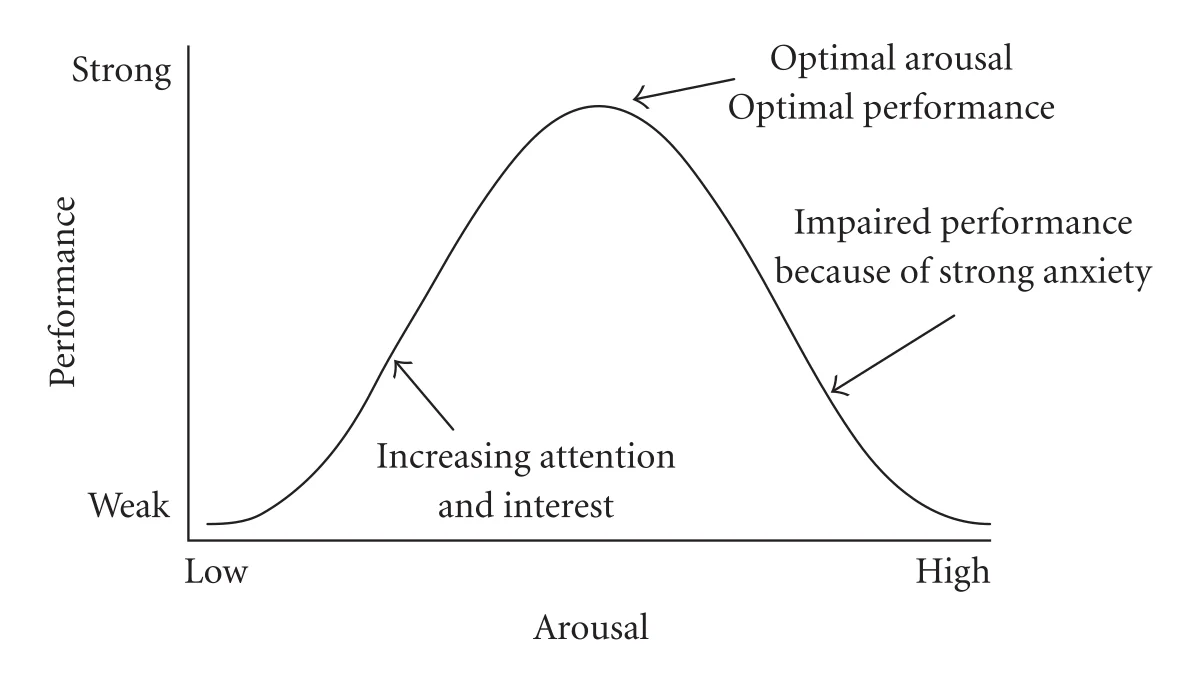
A single inverted-U curve with arousal on the x-axis (low to high) and performance on the y-axis (weak to strong). Labels mark increasing attention and interest on the rising limb, optimal arousal and optimal performance at the peak, and performance impaired by strong anxiety on the falling limb
The classic single-curve form of Yerkes-Dodson, annotated with the mechanism at each stage: attention and interest build on the way up, performance peaks at optimal arousal, and strong anxiety pulls it back down. The curve drawn here is one task at one difficulty; where its peak sits is what shifts between the simple and difficult curves in the figure below. This is why coaches pump up a sprinter but a surgeon needs calm. Credit: Diamond et al. 2007, after Yerkes and Dodson 1908, via Wikimedia Commons (CC0).

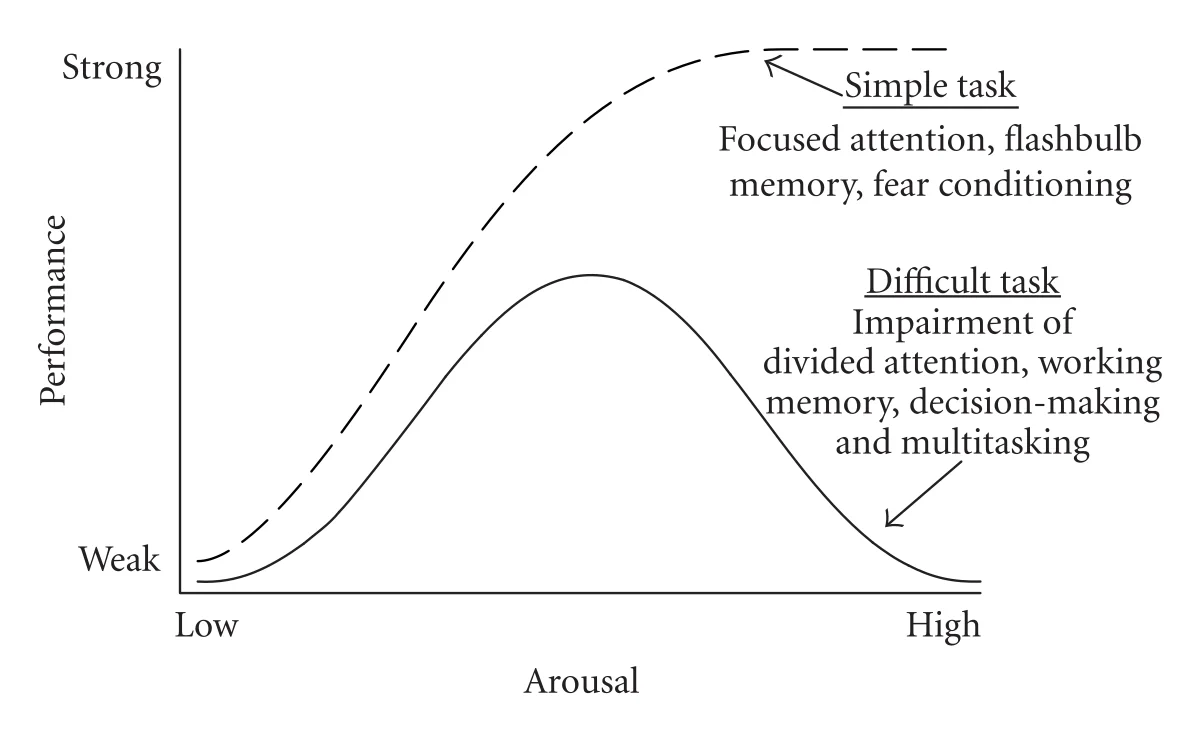
The specific peak shifts with task difficulty:

  • Simple tasks benefit from higher arousal.
  • Complex tasks peak at lower arousal.
Graph with arousal on the x-axis (low to high) and performance on the y-axis (weak to strong), carrying two curves. A dashed curve labelled 'Simple task' rises and plateaus near the top. A solid curve labelled 'Difficult task' peaks at moderate arousal and falls back to weak at high arousal
The Yerkes-Dodson law drawn for two tasks at once. The solid difficult-task curve is the inverted U described above: too little arousal and you are under-engaged, too much and anxiety degrades performance. The dashed simple-task curve keeps climbing and then plateaus, so a well-rehearsed task tolerates arousal that would wreck a demanding one. Credit: Diamond et al. 2007, via Wikimedia Commons (CC0).

This is why test anxiety is worst when you care most about the exam, and why easy tasks are done better when you’re charged up while intricate surgery requires calm.

Match the theory to the sequence: "event → physiology → emotion."
Click to reveal answer
James-Lange theory. Emotion is the interpretation of physiological changes. "We don't run because we're afraid; we're afraid because we run."
What is the Schachter-Singer two-factor theory?
Click to reveal answer
Emotions require two factors: physiological arousal + a cognitive label. The same arousal can be labeled differently depending on context. Classic adrenaline experiment showed subjects reported fear or euphoria based on the social context.
What does the Yerkes-Dodson law describe?
Click to reveal answer
An inverted-U relationship between arousal and performance: moderate arousal maximizes performance. Simple tasks benefit from higher arousal; complex tasks from lower arousal.