
Side Chains
The 20 standard amino acids are grouped by side chain character. The R group determines the amino acid’s role in proteins: hydrophobic side chains pack the protein interior, polar side chains face the surface, and ionizable side chains participate in H-bonding, salt bridges, and catalysis.
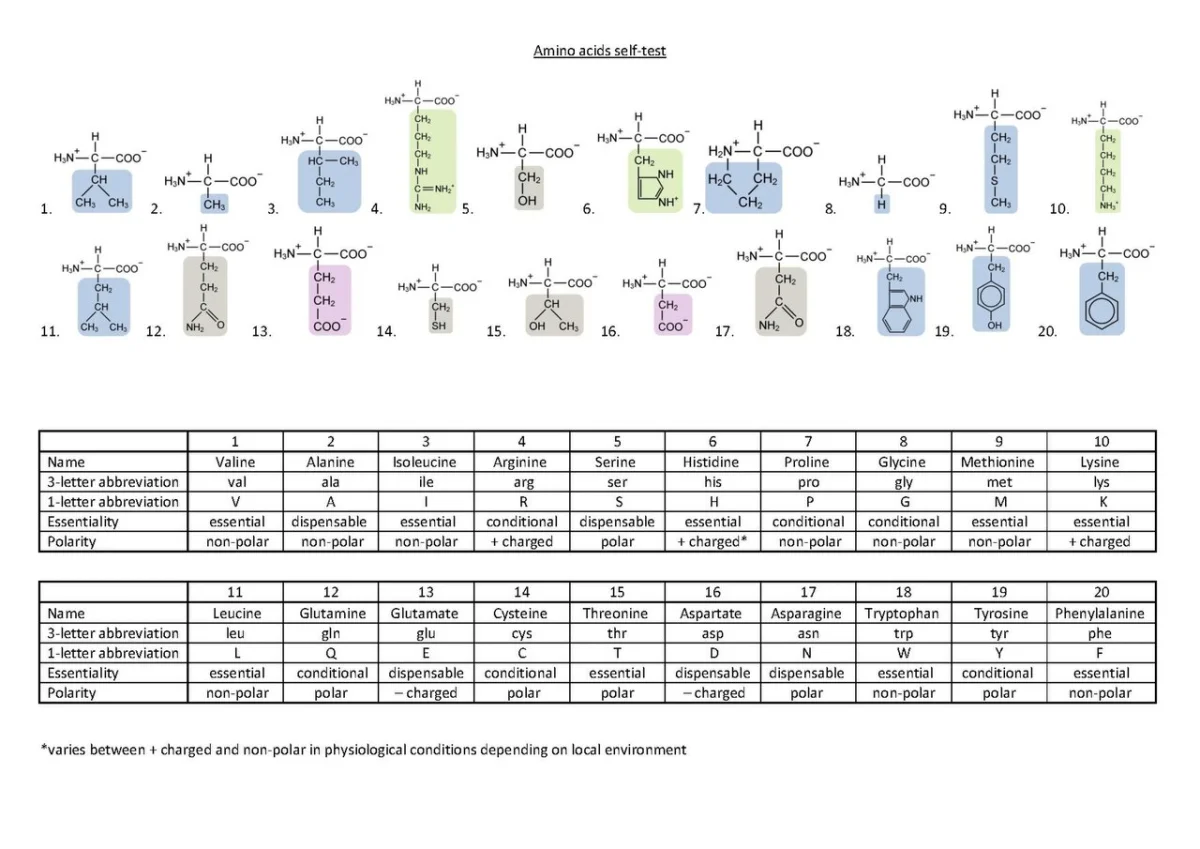
Nonpolar (Hydrophobic) Side Chains
These have hydrocarbon side chains - no heteroatoms or charges. They cluster together in protein cores to avoid water.
| Amino acid | 3-letter | 1-letter | Side chain |
|---|---|---|---|
| Glycine | Gly | G | -H |
| Alanine | Ala | A | -CH₃ |
| Valine | Val | V | -CH(CH₃)₂ |
| Leucine | Leu | L | -CH₂CH(CH₃)₂ |
| Isoleucine | Ile | I | -CH(CH₃)CH₂CH₃ |
| Methionine | Met | M | -CH₂CH₂SCH₃ |
| Proline | Pro | P | (cyclic) |
| Phenylalanine | Phe | F | -CH₂C₆H₅ |
| Tryptophan | Trp | W | indole ring |
Polar Uncharged Side Chains
These have heteroatoms (O, N, S) but no net charge at physiological pH. They H-bond with water and are found at protein surfaces.
| Amino acid | 3-letter | 1-letter | Side chain |
|---|---|---|---|
| Serine | Ser | S | -CH₂OH |
| Threonine | Thr | T | -CH(OH)CH₃ |
| Cysteine | Cys | C | -CH₂SH (sulfhydryl) |
| Asparagine | Asn | N | -CH₂CONH₂ (amide) |
| Glutamine | Gln | Q | -CH₂CH₂CONH₂ |
| Tyrosine | Tyr | Y | -CH₂-C₆H₄-OH (phenolic) |
Acidic (Negatively Charged at pH 7)
Side chain carboxylic acid with pKa below 5. At pH 7, it is deprotonated (COO⁻).
| Amino acid | 3-letter | 1-letter | Side chain pKa |
|---|---|---|---|
| Aspartate | Asp | D | -CH₂COOH (pKa ~3.9) |
| Glutamate | Glu | E | -CH₂CH₂COOH (pKa ~4.1) |
Basic (Positively Charged at pH 7)
Side chain amine or guanidinium with pKa above 7. At pH 7, it is protonated (NH₃⁺ or guanidinium+).
| Amino acid | 3-letter | 1-letter | Side chain pKa |
|---|---|---|---|
| Lysine | Lys | K | -(CH₂)₄NH₃⁺ (pKa ~10.8) |
| Arginine | Arg | R | -(CH₂)₃-NH-C(NH)NH₂ (pKa ~12.5) |
| Histidine | His | H | -CH₂-imidazole (pKa ~6.0) |
Note: histidine’s pKa of ~6 is close to physiological pH, which is why it acts as both acid and base in enzyme active sites. At pH 7, histidine is mostly deprotonated but has a significant fraction protonated. This responsiveness to small pH changes is why histidine is so common in enzyme mechanisms.
Calculating pI with Ionizable Side Chains
For amino acids with ionizable side chains, pI is the average of the two pKa values BRACKETING the zwitterionic form (net zero charge).
- Aspartate (3 pKa values: 2.0, 3.9, 9.8). Zwitterion is bracketed by pKa₁ (alpha-COOH, 2.0) and pKa₂ (side chain COOH, 3.9). pI = (2.0 + 3.9)/2 = 2.95.
- Lysine (3 pKa values: 2.2, 9.0, 10.8). Zwitterion is bracketed by pKa₂ (alpha-NH₃⁺, 9.0) and pKa₃ (side chain NH₃⁺, 10.8). pI = (9.0 + 10.8)/2 = 9.9.
- Histidine (3 pKa values: 1.8, 6.0, 9.2). Zwitterion is bracketed by pKa₂ (side chain imidazolium, 6.0) and pKa₃ (alpha-NH₃⁺, 9.2). pI = (6.0 + 9.2)/2 = 7.6.
Special Amino Acids
- Glycine (Gly, G): smallest, most flexible. Found in tight turns of proteins (Ramachandran plot shows allowed regions unique to glycine).
- Proline (Pro, P): side chain cyclizes back to the alpha-N, creating a rigid ring. Does not fit alpha-helix well - found at helix breaks and in turns.
- Cysteine (Cys, C): thiol side chain can form disulfide bonds (S-S bridges) between two cysteines, stabilizing protein tertiary structure.
- Tryptophan (Trp, W): the largest amino acid; has an indole ring and intense UV absorbance (used to quantify protein concentration).