A peptide bond looks like a single C-N bond. It isn’t. Two electron resonance structures share the electrons between a C-N and a C=N form. The result is partial double bond character, which has three consequences you need to know cold:
The peptide bond is planar (all six atoms in the amide group lie in a flat plane).
It is rigid (no rotation around the peptide bond itself).
The substituents on either side adopt the trans configuration in almost every case.
Everything about how proteins fold starts from these three facts.
Why the Peptide Bond is Planar
The nitrogen in an amide has a lone pair. That lone pair delocalizes into the neighboring carbonyl C=O. The resonance structure puts a double bond between C and N and a negative charge on the oxygen. In the real molecule, this is an average: the C-N bond has about 40 percent double-bond character.
Double bonds cannot rotate. Therefore the peptide bond cannot rotate. All six atoms involved - the alpha carbon of residue i, the carbonyl C and O, the amide N and H, and the alpha carbon of residue i+1 - lie in a single plane.
Why Trans is Preferred
When two alpha carbons are bonded through a planar peptide bond, the R groups can either be on the same side of the plane (cis) or opposite sides (trans). Trans is strongly preferred because it keeps the bulky R groups away from each other. Cis peptide bonds cause steric clashes.
About 99.9 percent of peptide bonds in folded proteins are trans. The rare exception: proline. Because proline’s side chain loops back to the amide nitrogen, the cis and trans forms are closer in energy, and about 5 to 10 percent of X-Pro peptide bonds (peptide bond immediately before proline) are cis.
Where the Backbone Can Rotate: Phi and Psi
If the peptide bond itself is frozen, where does the flexibility come from? The two bonds on either side of each alpha carbon. These are called phi (Φ) and psi (Ψ):
Phi (Φ): the rotation around the N-Cα bond.
Psi (Ψ): the rotation around the Cα-C(=O) bond.
Every residue in a polypeptide has its own Φ and Ψ. Together, these two angles for every residue define the entire backbone geometry of the protein.
The Ramachandran Plot
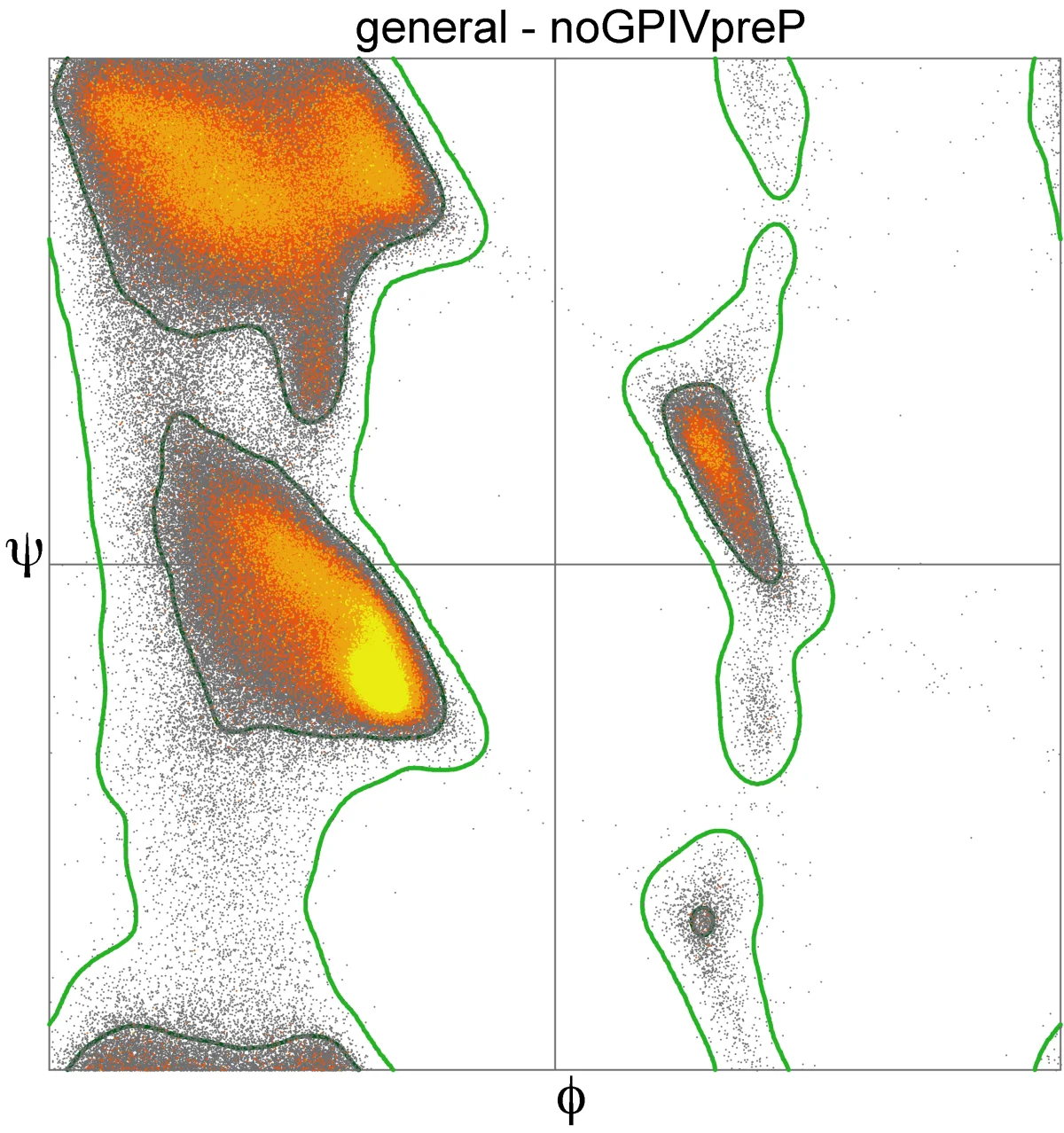
Because of steric clashes between the R group and the backbone, not every combination of Φ and Ψ is physically possible. Plotting Φ vs. Ψ for all residues in known protein structures gives the Ramachandran plot. Only a few clusters of allowed angles appear:
The alpha helix region (around Φ = -60°, Ψ = -45°)
The beta sheet region (around Φ = -120°, Ψ = +120°)
A small left-handed helix region (mostly occupied by glycine)
Ramachandran plot of allowed backbone angles. The upper-left cluster is the beta sheet region; the middle-left cluster is the alpha helix region. Steric clashes forbid most other combinations, which is why proteins repeatedly adopt the same secondary structures. Credit: Wikimedia Commons, CC BY 3.0 (D. Richardson via Dcrjsr)
Why is a peptide bond planar and rigid?
Click to reveal answer
The nitrogen lone pair delocalizes into the carbonyl C=O via resonance, giving the C-N bond about 40 percent double-bond character. Double bonds do not rotate. As a result, the six atoms of the peptide bond (Cα-C(=O)-N(H)-Cα) all lie in a single plane and cannot rotate around the C-N bond.
What are phi (Φ) and psi (Ψ) angles?
Click to reveal answer
They are the two rotatable backbone dihedral angles on either side of an alpha carbon. Phi is the rotation around the N-Cα bond; psi is the rotation around the Cα-C(=O) bond. The peptide bond itself (C-N) cannot rotate, so phi and psi define all the backbone flexibility of a polypeptide.
Why is trans preferred over cis for peptide bonds?
Click to reveal answer
Trans keeps the bulky R groups on opposite sides of the planar peptide bond, minimizing steric clashes. Cis puts them on the same side, which is energetically unfavorable. The exception is X-Pro bonds, where proline's cyclic side chain partially relieves the steric penalty and cis occurs about 5-10 percent of the time.