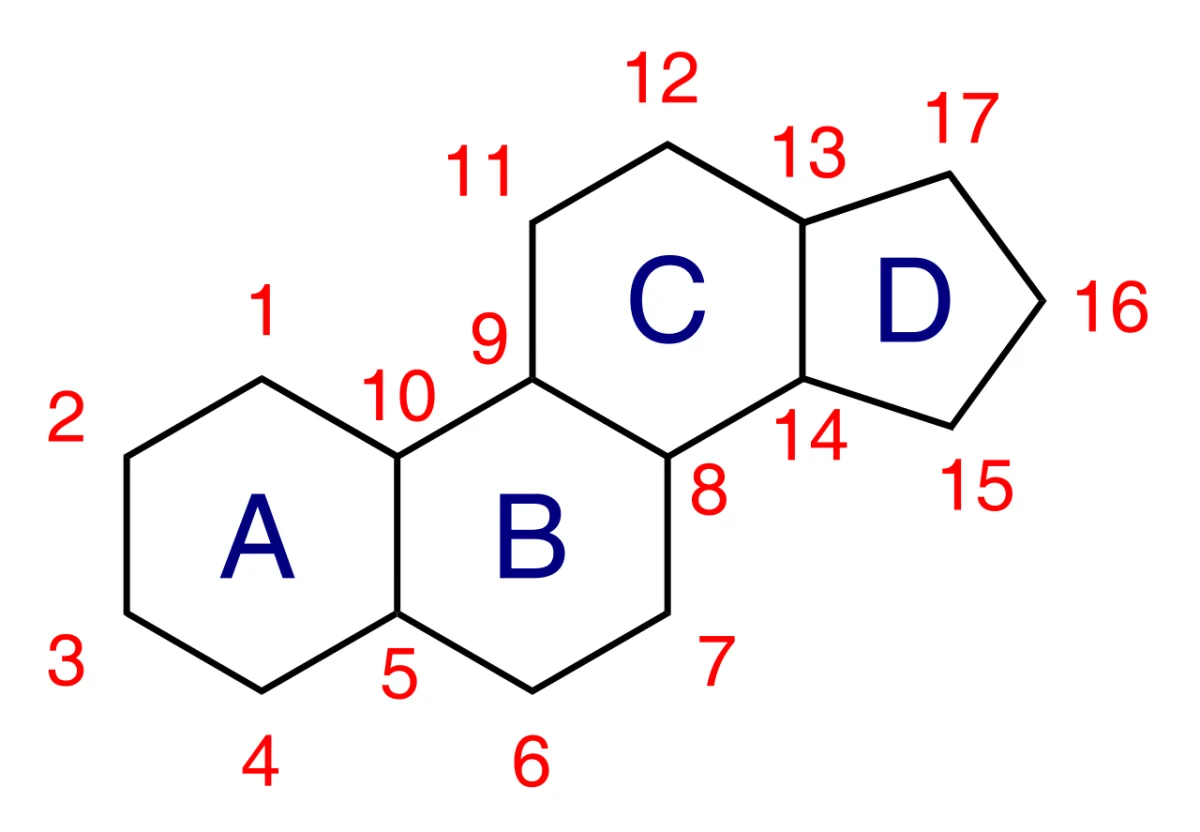
Cholesterol is the starting material for every steroid hormone, bile acids, and vitamin D. It is also a major component of cell membranes. All steroids share the same four-ring nucleus.
The Four-Ring Skeleton
The steroid nucleus: three six-membered rings (A, B, C) fused to one five-membered ring (D). Carbons are numbered 1-17. Every steroid in your body is built on this scaffold. Credit: Wikimedia Commons, CC BY-SA
Three six-membered rings (A, B, C).
One five-membered ring (D).
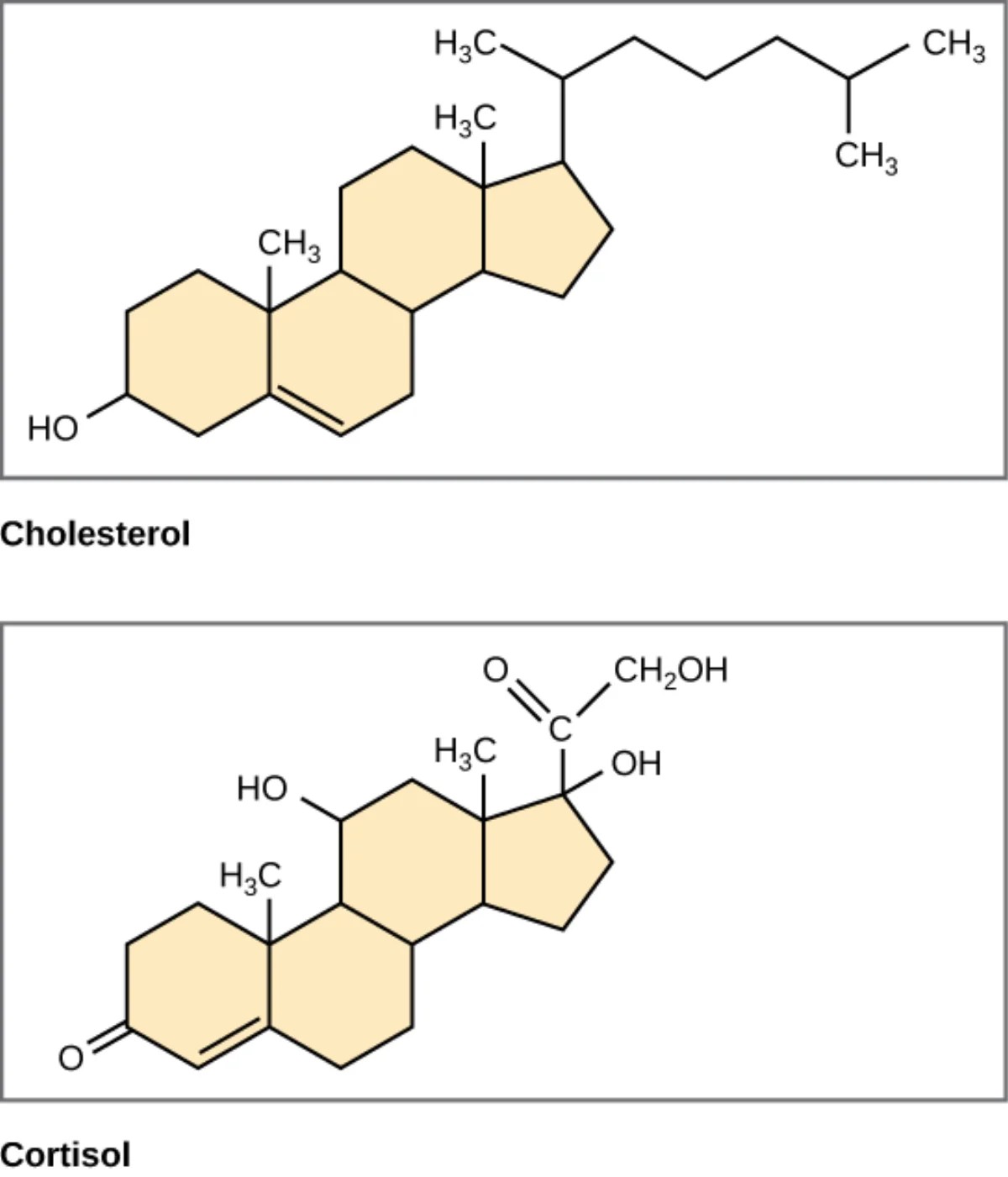
Various modifications (side chains, double bonds, -OH groups) on this core give each specific steroid.
Cholesterol
Cholesterol: steroid nucleus + hydroxyl at C3 + double bond between C5 and C6 + branched side chain at C17. Credit: Wikimedia Commons, CC BY-SA
Cholesterol inserts into the phospholipid bilayer with its -OH near the phosphate heads and its ring system parallel to the fatty acid tails. It acts as a bidirectional stabilizer of membrane fluidity:
At high temperature, cholesterol reduces fluidity by restricting motion of nearby fatty acid tails.
At low temperature, cholesterol prevents the bilayer from becoming too rigid by disrupting tight packing.
Most cells can make cholesterol themselves; the liver makes most of the body’s supply. HMG-CoA reductase is the rate-limiting enzyme of cholesterol synthesis. Statins inhibit HMG-CoA reductase.
The Major Steroid Hormones
All steroid hormones are synthesized from cholesterol in the adrenal cortex, gonads, or placenta. The five MCAT-relevant classes:
Cholesterol (left) and cortisol (right) share the same four-ring steroid scaffold. Every steroid hormone is a modification of cholesterol. Credit: OpenStax Biology 2e, CC BY 4.0
Cholesterol is oxidized in the liver to bile acids (cholic acid, chenodeoxycholic acid). Bile acids are amphipathic - they emulsify dietary fats in the small intestine, increasing the surface area accessible to pancreatic lipase. Without bile acids, fat absorption is poor (which is why patients with bile duct obstruction develop fatty stools, steatorrhea).
Vitamin D
Vitamin D is a “steroid hormone” technically, despite being called a vitamin. UV light on skin converts 7-dehydrocholesterol to cholecalciferol (vitamin D3). Two hydroxylations (one in liver, one in kidney) make active 1,25-dihydroxyvitamin D, which regulates calcium absorption and bone mineralization.
What four-ring structure is shared by all steroids?
Click to reveal answer
Three six-membered rings fused to one five-membered ring (labeled A, B, C, D). This steroid nucleus is the backbone of cholesterol, cortisol, testosterone, estradiol, aldosterone, bile acids, and vitamin D. Every steroid differs only in which functional groups decorate this core.
How does cholesterol affect membrane fluidity at high vs. low temperature?
Click to reveal answer
Cholesterol is a bidirectional stabilizer. At high temperature, it reduces fluidity by restricting fatty acid tail motion. At low temperature, it prevents the membrane from packing into a rigid gel by disrupting tight tail-tail interactions. Either way, cholesterol keeps membrane fluidity closer to a middle range.
How do steroid hormones produce their cellular effects, and how is this different from peptide hormones?
Click to reveal answer
Steroid hormones are lipid-soluble, so they diffuse across the plasma membrane freely. They bind intracellular (often nuclear) receptors that directly regulate gene transcription. Effects are slow (hours to days) but long-lasting. Peptide hormones bind surface receptors and trigger rapid second-messenger cascades - fast, short-lived effects.