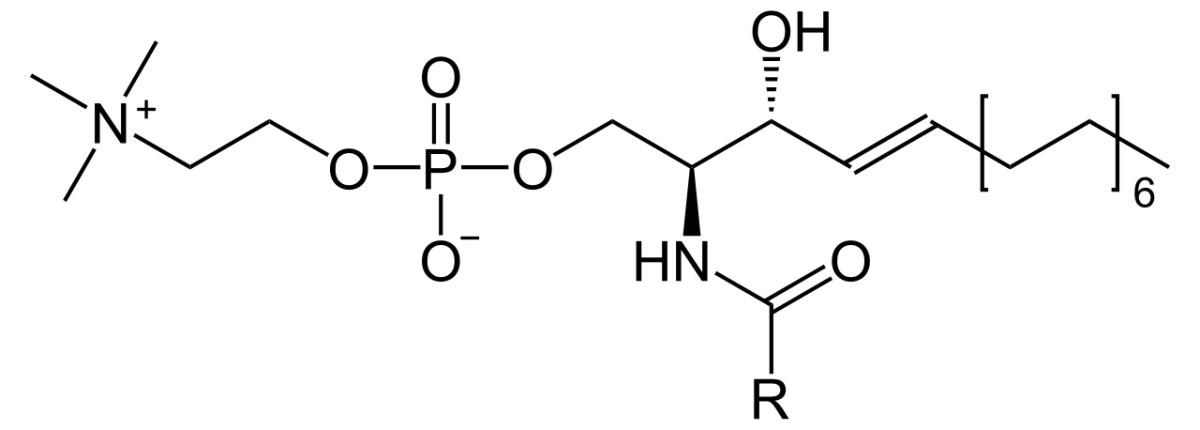
Sphingolipids are the second major class of membrane lipids (after glycerophospholipids). They are built on a sphingosine backbone rather than glycerol. They are especially abundant in nervous tissue - myelin is up to 30 percent sphingolipid.
The Building Blocks
Sphingosine: an 18-carbon amino alcohol with a trans double bond. Not a glycerol.
Ceramide: sphingosine plus a fatty acid attached via an amide bond to the C2 amine. Ceramide is the parent compound for all sphingolipids.
Sphingomyelin: ceramide + phosphocholine head group. A phospholipid of the sphingosine family.
Cerebrosides: ceramide + one sugar (glucose or galactose).
Sphingomyelin: sphingosine + fatty acid (amide-linked) + phosphocholine head. It is the main sphingolipid of the myelin sheath. Credit: Wikimedia Commons, CC BY-SA
Sphingolipids in Myelin and Signaling
Myelin wraps axons to speed electrical conduction. It is built of concentrated lipid layers with a high sphingolipid content, including sphingomyelin and glycosphingolipids. Damage to myelin (demyelination) slows nerve conduction - the clinical hallmark of multiple sclerosis.
Sphingolipids are also bioactive signaling molecules. Ceramide, sphingosine, and sphingosine-1-phosphate (S1P) regulate apoptosis, cell proliferation, and immune cell trafficking. S1P is the target of an approved multiple sclerosis drug class (S1P receptor modulators).
Lysosomal Storage Diseases
Sphingolipids are degraded in lysosomes by a chain of enzymes. A defect in any single enzyme causes the specific sphingolipid upstream to accumulate and damage the cell. These sphingolipidoses are classic genetic lysosomal storage diseases.
Disease
Enzyme deficient
Accumulated lipid
Notes
Tay-Sachs
Hexosaminidase A
GM2 ganglioside
Cherry-red macula, neurodegeneration in infancy
Gaucher
Glucocerebrosidase
Glucocerebroside
Most common; can be mild or severe
Niemann-Pick
Sphingomyelinase
Sphingomyelin
Severe neurological form in infants
Krabbe
Galactocerebrosidase
Galactocerebroside
Demyelinating
Fabry
Alpha-galactosidase A
Ceramide trihexoside
X-linked; angiokeratomas, kidney disease
What is the backbone of a sphingolipid, and how does it differ from a glycerophospholipid?
Click to reveal answer
Sphingolipids are built on sphingosine, an 18-carbon amino alcohol with a trans double bond. Glycerophospholipids are built on glycerol. Sphingosine has only one free hydroxyl available for a head group (plus its own built-in hydrocarbon tail), so sphingolipids pack slightly differently than glycerophospholipids but serve similar membrane roles.
Why are sphingolipids especially abundant in myelin?
Click to reveal answer
Myelin is an insulating wrap around axons, made of concentrated lipid bilayers with very few embedded proteins. Sphingolipids, particularly sphingomyelin and glycosphingolipids, stack into this dense electrical insulator. Demyelinating diseases like multiple sclerosis disrupt this sphingolipid-rich architecture.
What is the unifying mechanism behind sphingolipidoses like Tay-Sachs, Gaucher, and Niemann-Pick?
Click to reveal answer
Each is caused by a defect in a single lysosomal hydrolase in the sphingolipid degradation pathway. The specific sphingolipid upstream of the broken step accumulates inside lysosomes, eventually damaging the cell. The specific accumulated lipid and clinical picture depend on which enzyme is missing. Tay-Sachs: hexosaminidase A → GM2 ganglioside. Gaucher: glucocerebrosidase → glucocerebroside. Niemann-Pick: sphingomyelinase → sphingomyelin.