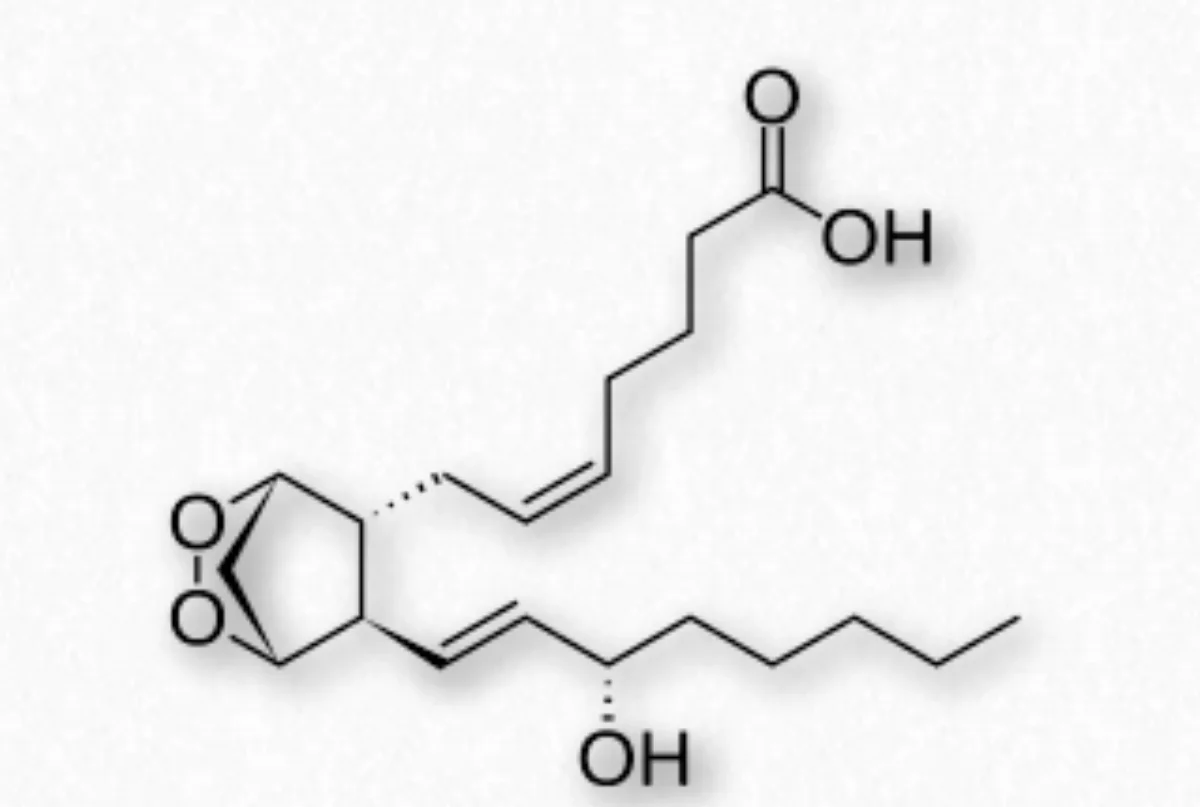
Eicosanoids are lipid signaling molecules made from arachidonic acid, a 20-carbon omega-6 polyunsaturated fatty acid. They do not travel far - they act locally on nearby cells and are rapidly degraded. Three main classes: prostaglandins, thromboxanes, and leukotrienes.
Prostaglandin H2, the precursor to all series-2 prostaglandins and thromboxanes. It contains the characteristic five-membered ring derived from arachidonic acid cyclization. Credit: Wikimedia Commons, CC BY-SA
The Arachidonic Acid Branch Point
Phospholipase A2 cleaves arachidonic acid from membrane phospholipids in response to cell damage or hormonal stimulation. Arachidonic acid then goes down one of two pathways:
COX pathway (cyclooxygenase): produces prostaglandins and thromboxanes.
Inhibits platelet aggregation, vasodilation (made by endothelium)
Thromboxane A2 (TXA2)
Promotes platelet aggregation, vasoconstriction (made by platelets)
Leukotriene B4
Neutrophil chemotaxis
Leukotriene C4, D4, E4
Bronchoconstriction, increased vascular permeability (role in asthma)
Prostacyclin and thromboxane are opposites - this balance determines whether a blood vessel clots or stays open.
Why NSAIDs Matter
NSAIDs (nonsteroidal anti-inflammatory drugs) block COX. No COX activity means no prostaglandin/thromboxane production, so:
Less PGE2 → less pain, less fever, less inflammation (therapeutic).
Less TXA2 → less platelet aggregation (why low-dose aspirin is used to prevent heart attack and stroke).
Less gastric PGE2 → less mucus protecting the stomach → NSAIDs can cause ulcers.
Examples: ibuprofen, naproxen, aspirin. Aspirin irreversibly acetylates COX; most others are reversible inhibitors.
Corticosteroids (like prednisone) inhibit phospholipase A2 indirectly (via lipocortin/annexin-1), so they block BOTH the COX and LOX pathways. That is why corticosteroids have broader anti-inflammatory effects than NSAIDs, but also more side effects.
What fatty acid is the precursor to most eicosanoids, and from where is it released?
Click to reveal answer
Arachidonic acid, a 20-carbon omega-6 polyunsaturated fatty acid. It is released from membrane phospholipids by phospholipase A2. Two enzymes branching from arachidonic acid - cyclooxygenase (COX) and lipoxygenase (LOX) - produce prostaglandins/thromboxanes and leukotrienes respectively.
How do NSAIDs reduce pain, fever, and inflammation?
Click to reveal answer
NSAIDs inhibit cyclooxygenase (COX), blocking the production of prostaglandins and thromboxanes. Less PGE2 means less activation of pain receptors and the hypothalamic fever response. Less TXA2 means less platelet activation. Aspirin specifically acetylates COX irreversibly; most other NSAIDs are reversible inhibitors.
Why do corticosteroids have broader anti-inflammatory effects than NSAIDs?
Click to reveal answer
NSAIDs inhibit only COX, so they reduce prostaglandins and thromboxanes while leaving leukotrienes unaffected. Corticosteroids indirectly inhibit phospholipase A2 (the enzyme that releases arachidonic acid in the first place), which shuts down BOTH COX and LOX pathways. That makes corticosteroids more comprehensive but also more prone to systemic side effects.