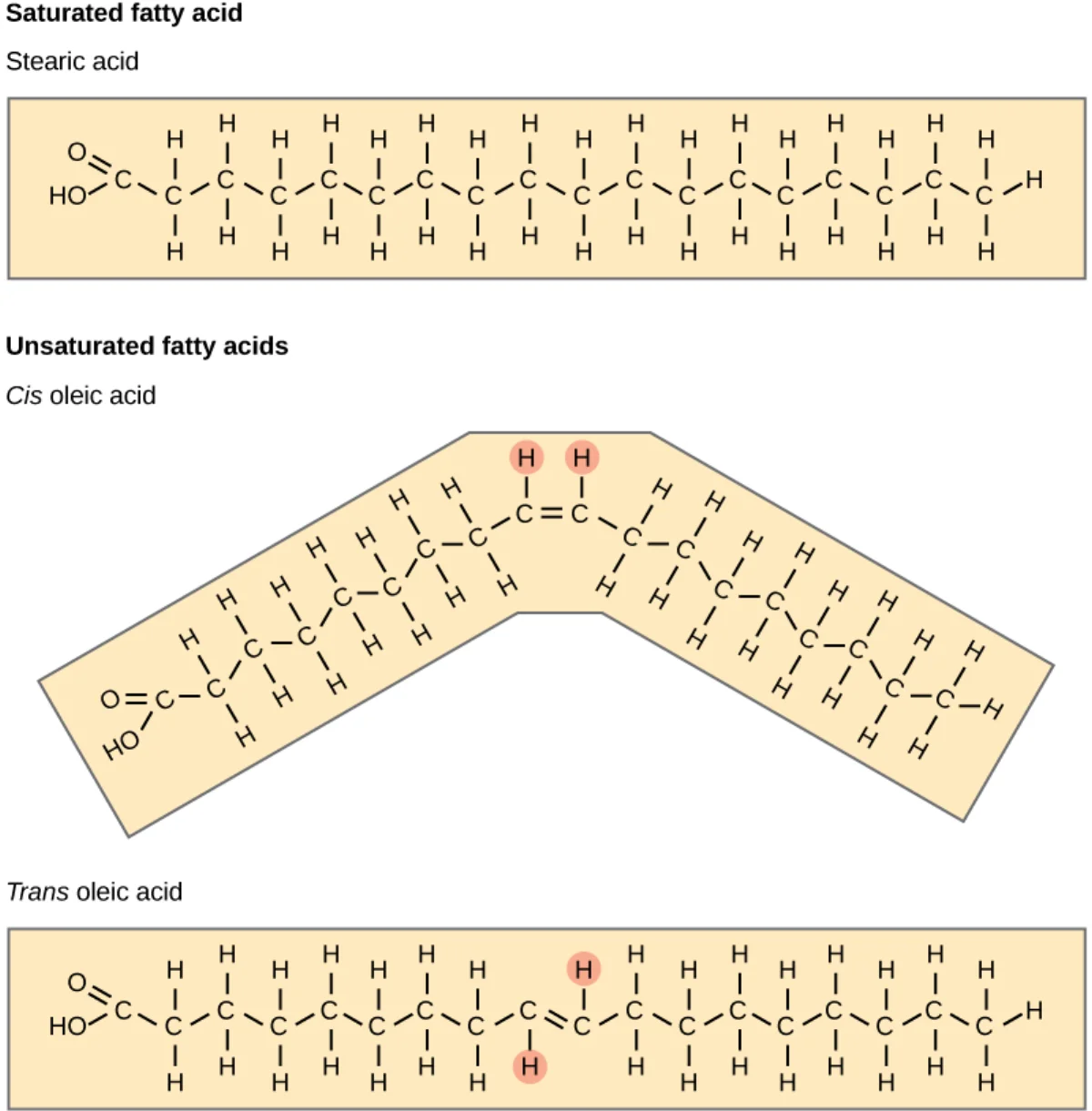
A fatty acid is a long hydrocarbon chain with a carboxylic acid group at one end. Most natural fatty acids have an even number of carbons (typically 14-24) because they are built two carbons at a time during fatty acid synthesis.
Saturated vs. Unsaturated
Saturated fatty acid: no carbon-carbon double bonds. The chain is a straight rod. Packs tightly → solid at room temperature (butter, lard, tropical oils).
Unsaturated fatty acid: one or more C=C double bonds. Each cis double bond puts a kink in the chain. Kinked chains cannot pack tightly → liquid at room temperature (olive oil, canola oil, fish oil).
Saturated fatty acids (top) pack tightly into solids. Unsaturated fatty acids (bottom) have kinks from cis double bonds and remain liquid. Credit: OpenStax Biology 2e, CC BY 4.0
Cis vs. Trans
Naturally occurring unsaturated fatty acids are almost always cis, which puts a sharp bend in the chain.
Trans fats are mostly industrial - produced by partial hydrogenation of vegetable oils. The trans double bond does NOT kink the chain, so trans fats behave more like saturated fats (solid, pack tightly). This is why trans fats raise LDL and lower HDL, contributing to cardiovascular disease. Most developed countries now restrict artificial trans fats.
Omega Numbering and Essential Fatty Acids
Fatty acids can be numbered two ways:
Delta numbering starts from the carboxyl (C1). A delta-9 double bond is between C9 and C10.
Omega numbering starts from the methyl end. Omega-3 means the first double bond is 3 carbons from the omega (methyl) end.
Alpha-linolenic acid (ALA), an 18-carbon omega-3 fatty acid. Blue numbers count carbons from the carboxyl end (delta numbering); red numbers count from the methyl (omega) end. The first double bond sits three carbons from the omega end - that is what "omega-3" means. An omega-6 fatty acid (like linoleic acid) would instead have its first double bond six carbons from the omega end. Credit: Wikimedia Commons, CC BY-SA
Humans cannot introduce double bonds past C9 from the carboxyl end, so we cannot synthesize omega-3 or omega-6 fatty acids. These are essential fatty acids and must come from the diet. Omega-3s (like alpha-linolenic acid, EPA, DHA) are found in fish and flaxseed. Omega-6s (like linoleic acid) are in most vegetable oils.
Why is butter solid at room temperature but olive oil liquid?
Click to reveal answer
Butter is rich in saturated fatty acids with straight, rod-like chains that pack tightly into a solid. Olive oil is rich in cis-unsaturated fatty acids (mainly oleic acid) whose cis double bond introduces a kink. Kinked chains cannot pack tightly, so the lipid is liquid at room temperature.
What does "omega-3 fatty acid" mean?
Click to reveal answer
The first double bond is 3 carbons from the methyl (omega) end of the fatty acid chain. Omega-3s include alpha-linolenic acid, EPA, and DHA. They are essential because humans cannot introduce double bonds past C9 from the carboxyl end and thus cannot synthesize them.
Why are trans fats considered unhealthy compared to cis unsaturated fats?
Click to reveal answer
A trans double bond keeps the chain straight, so trans unsaturated fatty acids pack tightly and behave like saturated fats. Dietarily, they raise LDL cholesterol and lower HDL, worsening cardiovascular risk. Cis double bonds kink the chain and prevent tight packing, preserving fluidity and the healthier metabolic profile of unsaturated fats.