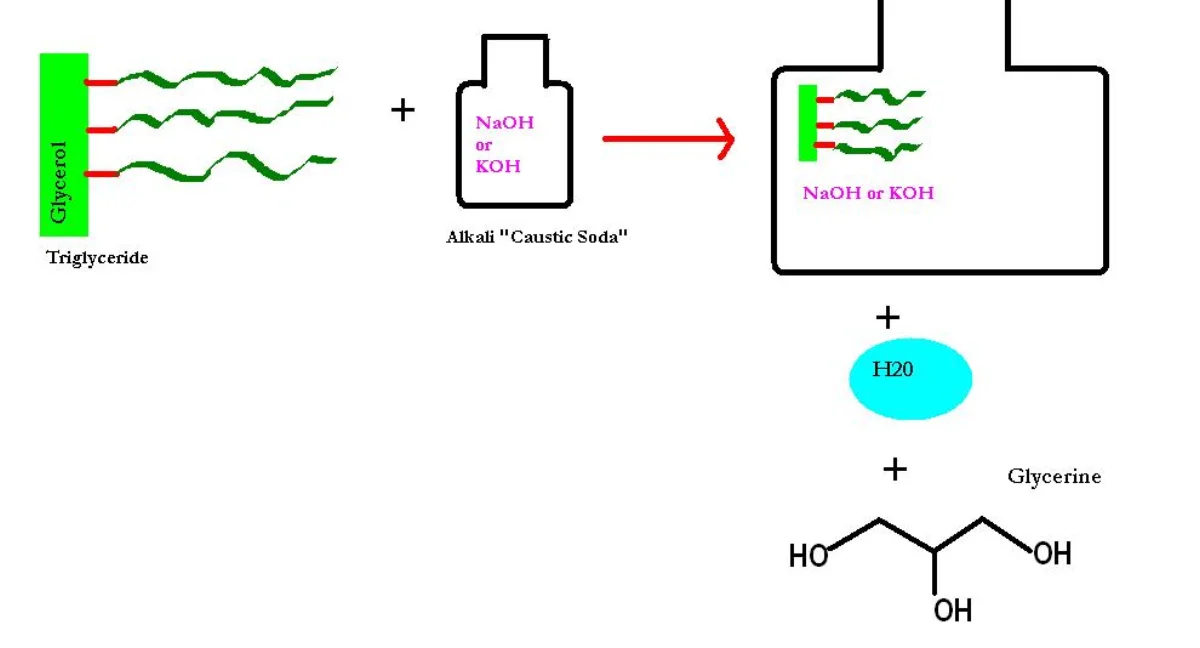
Saponification is the base-catalyzed hydrolysis of a triglyceride (or any ester) into its alcohol and the salt of its carboxylic acid. For a triacylglycerol, the products are glycerol and three fatty acid salts. The fatty acid salts are soap.
The lipid family tree
Lipid structure
1
Scroll sideways to see the whole map.
Saponifiable: contains an ester Non-saponifiable: no ester to cut The property they all share Amphipathic, so it builds membranes
What saponification actually isBase hydrolysis of an ester. Add NaOH to a triacylglycerol and you get glycerol plus three fatty acid salts, which are soap. Only lipids with an ester bond can do this, which is exactly why the tree splits there.
Why fat stores more energyFatty acids are almost entirely reduced carbon and hydrogen, so there is a great deal of oxidation left to do. They are also stored anhydrous, while glycogen drags about twice its own weight in water. Roughly 9 kcal per gram against 4.
The one definition that covers all of themA lipid is not defined by a structure, it is defined by a property: insoluble in water, soluble in organic solvent. That is why this family contains molecules as different as a soap, a hormone, and a vitamin.
Every lipid is here because of what it will not dissolve in, not because of what it is made of. The first split, saponifiable or not, is the only structural question worth asking, and it predicts whether a molecule stores energy or carries a message.Saponification. Triglyceride + NaOH (or KOH) → glycerol + 3 fatty acid salts. The salts are soap: amphipathic molecules with hydrophobic tails and ionic hydrophilic heads. Credit: Wikimedia Commons, CC BY-SA
Strong base (usually NaOH for hard soaps, KOH for soft soaps) attacks each ester carbonyl, cleaving the ester and leaving the carboxylate anion. Sodium (or potassium) counterions form the salt.
Why Soap Cleans
A soap molecule is amphipathic. One end is ionic (the carboxylate COO-), which loves water. The other end is a long hydrocarbon tail, which loves grease. When soap is added to water containing oil, the molecules arrange into micelles - little spheres with hydrophobic tails pointing inward (trapping oil) and hydrophilic heads facing out (in water). The oil is now suspended in water and can be rinsed away.
Saponification vs. Hydrolysis
Ester hydrolysis can happen in acidic or basic conditions. In the body, lipases (hydrolases) break ester bonds without base - they use water and acid/base catalysis within the active site. The pure-chemistry saponification reaction uses excess strong base. Both give the same products.
What products form when a triglyceride is saponified?
Click to reveal answer
Glycerol and three fatty acid salts (soap). The base (usually NaOH or KOH) hydrolyzes each ester bond on the glycerol backbone, producing glycerol and three free fatty acid anions that pair with the sodium or potassium counterion.
Why does soap remove oily dirt from a surface?
Click to reveal answer
Soap molecules are amphipathic: the carboxylate head is hydrophilic and the long hydrocarbon tail is hydrophobic. In water, soap molecules surround oil droplets with their hydrophobic tails pointing into the oil and their hydrophilic heads facing outward. The resulting micelle is water-soluble and can be rinsed away with the oil trapped inside.
Why does saponification go essentially to completion under strong base?
Click to reveal answer
The carboxylic acid product is deprotonated to the carboxylate anion under strong base. Carboxylate is stabilized (delocalized negative charge over both oxygens) and very unlikely to revert to the starting ester. The irreversible deprotonation pulls the equilibrium all the way toward products, making the reaction effectively one-way.