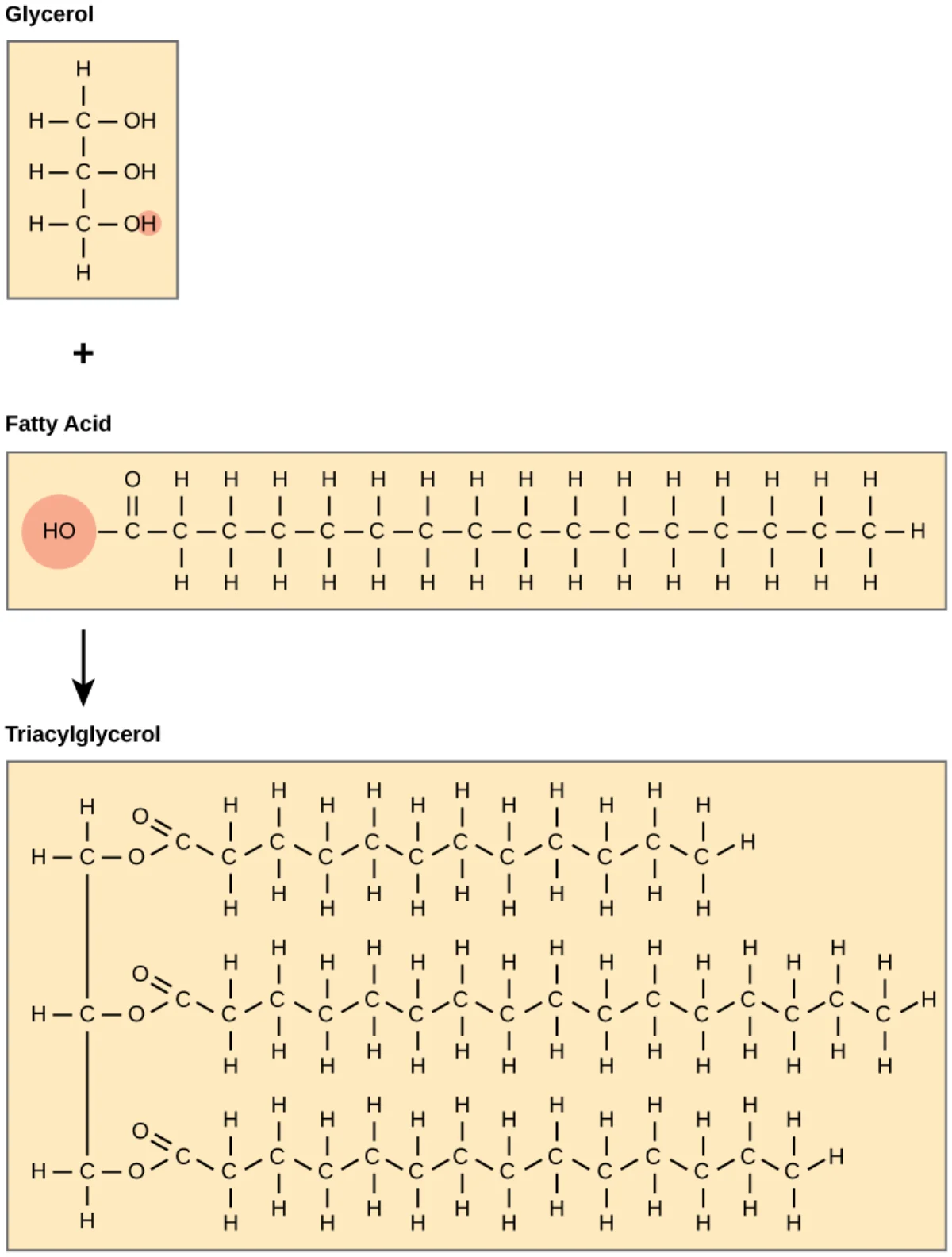
A triacylglycerol (triglyceride, TAG) is glycerol with three fatty acids attached by ester bonds. This is the body’s main form of stored energy.
Triacylglycerol. Glycerol (left) plus three fatty acids linked by ester bonds. The three fatty acids can be the same (simple TAG) or different (mixed TAG). Credit: OpenStax Biology 2e, CC BY 4.0
Why Fat is Energy-Dense
Fat yields about 9 kcal per gram.
Carbohydrate and protein yield about 4 kcal per gram.
Fat stores more than twice the energy per gram because its carbons are more reduced. Fatty acid chains are long stretches of C-H bonds with few oxygens. Each C-H bond is a high-energy electron waiting to enter the electron transport chain. Carbohydrates are already partially oxidized (lots of C-O bonds), so they have fewer electrons per gram to donate.
Fat is also stored without water. Glycogen is stored bound to water (about 2 g water per gram glycogen). A gram of fat stores pure energy with no extra water weight.
Storage and Release
Triglycerides are stored in adipocytes (fat cells) as a single large droplet. Mobilization happens in response to low-energy signals:
Glucagon and epinephrine activate hormone-sensitive lipase (HSL) in adipose via cAMP and PKA. HSL hydrolyzes triglycerides into glycerol and free fatty acids, which are released into blood.
Insulin opposes this. In the fed state, insulin inhibits HSL and activates lipoprotein lipase at capillaries, promoting fat storage.
The liberated fatty acids travel bound to albumin to tissues that need fuel. Glycerol goes to the liver, where it enters glycolysis as dihydroxyacetone phosphate (via glycerol kinase).
Why does fat yield about 9 kcal/g while carbohydrate and protein yield only about 4 kcal/g?
Click to reveal answer
Fatty acid chains are highly reduced - they are long stretches of C-H bonds with few oxygens. More C-H bonds mean more electrons to feed the electron transport chain, producing more NADH/FADH2 and therefore more ATP per gram. Carbohydrates are already partially oxidized (C-O bonds), so they release less energy per gram.
Which hormone activates hormone-sensitive lipase to mobilize fat from adipose tissue?
Click to reveal answer
Glucagon and epinephrine both activate HSL via the cAMP/PKA pathway in adipocytes. Insulin opposes this action, dephosphorylating (inactivating) HSL in the fed state. The net result is that fasting and stress mobilize stored fat, while the fed state stores it.
How does glycerol released from triglyceride breakdown enter energy metabolism?
Click to reveal answer
Glycerol travels to the liver, is phosphorylated by glycerol kinase to glycerol-3-phosphate, and then oxidized to dihydroxyacetone phosphate (DHAP). DHAP is an intermediate in glycolysis, so it can enter glycolysis or gluconeogenesis. Only about 5% of the energy in a triglyceride molecule comes from the glycerol backbone - most comes from the three fatty acid tails via beta-oxidation.