
Antibody Classes
All antibodies share the same basic Y-shaped structure, but the constant region of the heavy chain comes in five varieties, creating five antibody classes (isotypes). Each class has a different shape, location, and job. The MCAT expects you to know all five.
The Five Antibody Classes
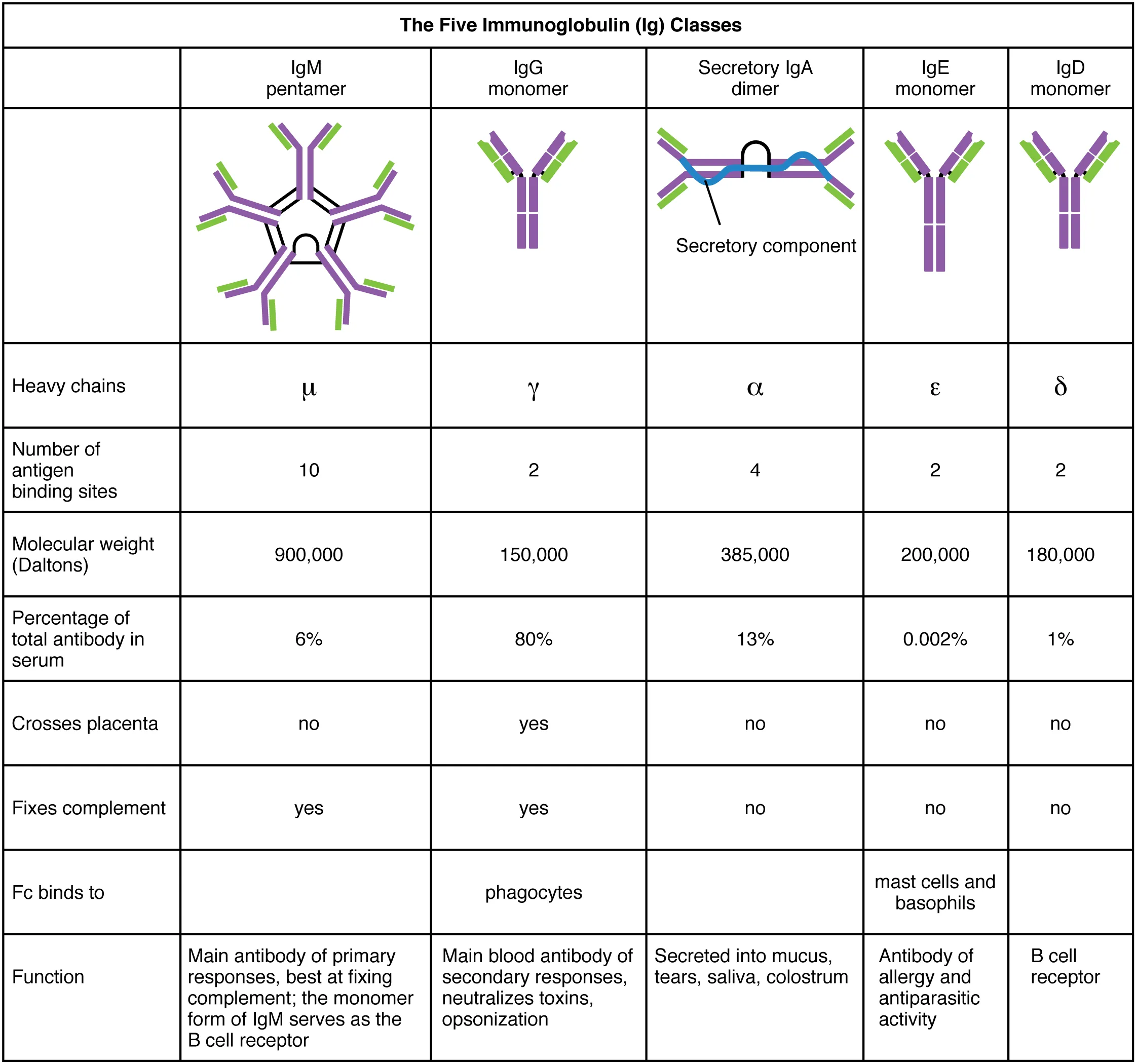
IgG - The All-Purpose Workhorse
IgG is the most abundant antibody in the blood (~75% of serum immunoglobulins). It is the primary antibody of the secondary immune response - when your body encounters a pathogen it has seen before, IgG levels surge.
Key features:
- Monomer (single Y-shape)
- Only antibody that crosses the placenta - provides passive immunity to the fetus
- Longest half-life of any antibody (~21 days)
- Effective at neutralization, opsonization, and complement activation
- Dominant antibody after class switching from IgM
IgA - The Secretory Guardian
IgA is found primarily in mucosal secretions - saliva, tears, mucus, breast milk, and the lining of the respiratory and GI tracts. It exists as a dimer (two Y-shapes joined by a J chain) in secretions.
Key features:
- Guards the mucosal surfaces that are the body’s main entry points for pathogens
- Found in breast milk - provides passive immunity to nursing infants through the GI tract
- Prevents pathogen attachment to epithelial surfaces (neutralization)
- Does not activate complement efficiently
IgM - The First Responder
IgM is the first antibody produced during a primary immune response. It exists as a pentamer (five Y-shapes joined by a J chain) in the blood, giving it 10 antigen-binding sites - making it excellent at agglutination.
Key features:
- First antibody made by naive B cells before class switching occurs
- Pentamer structure = 10 binding sites = powerful agglutination
- Very effective at complement activation (classical pathway)
- Also found as a monomer on the surface of naive B cells (part of the BCR)
- Short half-life (~5 days) - levels decline as IgG takes over
- Elevated IgM = sign of recent/current infection
IgE - The Allergy Antibody
IgE is present in very low concentrations in blood but plays an outsized role in allergic reactions and defense against parasites.
Key features:
- Monomer that binds to Fc receptors on mast cells and basophils
- When an allergen cross-links two IgE molecules on a mast cell, the mast cell degranulates, releasing histamine
- This is the mechanism behind Type I hypersensitivity (allergies, anaphylaxis)
- Also important in defense against parasitic worms (helminths) - eosinophils have Fc receptors for IgE
- Elevated IgE = allergies or parasitic infection
IgD - The Mystery Antibody
IgD is the least understood antibody class. It exists in tiny amounts in the blood and is found primarily on the surface of naive, mature B cells as part of the B cell receptor complex (along with IgM).
Key features:
- Monomer on B cell surface
- Signals B cell activation when antigen binds
- Not secreted in significant amounts
- No well-defined role in pathogen destruction
Master Comparison Table
| Class | Structure | Location | Key Function | High-Yield Fact |
|---|---|---|---|---|
| IgG | Monomer | Blood, tissue fluids | Opsonization, neutralization, complement | Crosses placenta; most abundant; secondary response |
| IgA | Dimer (secreted) | Mucous membranes, secretions, breast milk | Mucosal defense, neutralization | In All secretions; protects newborns via breast milk |
| IgM | Pentamer (secreted), Monomer (BCR) | Blood, B cell surface | Agglutination, complement activation | First responder; largest; indicates new infection |
| IgE | Monomer | Bound to mast cells/basophils | Allergic response, anti-parasite defense | Triggers histamine release; Type I hypersensitivity |
| IgD | Monomer | B cell surface | B cell activation signaling | Least understood; on naive B cells |
Isotype (Class) Switching
When a B cell is first activated, it produces IgM. But with help from cytokines released by helper T cells, the B cell can undergo class switching (isotype switching) - changing the constant region of its heavy chain to produce a different antibody class (IgG, IgA, or IgE).
Critical detail: class switching changes the Fc region (and therefore the effector function) but keeps the variable region identical. The antibody still targets the exact same antigen - it just communicates differently with the immune system.
Class switching requires helper T cell signals (cytokines) that direct the B cell to rearrange its heavy chain DNA, swapping out one constant region for another.