Before you can track energy in a chemical reaction, you need to define what you are tracking. In thermodynamics, we split the universe into two parts: the system (the specific reaction or process you are studying) and the surroundings (everything else). The boundary between them determines what can cross - energy, matter, or neither.
The Three System Types
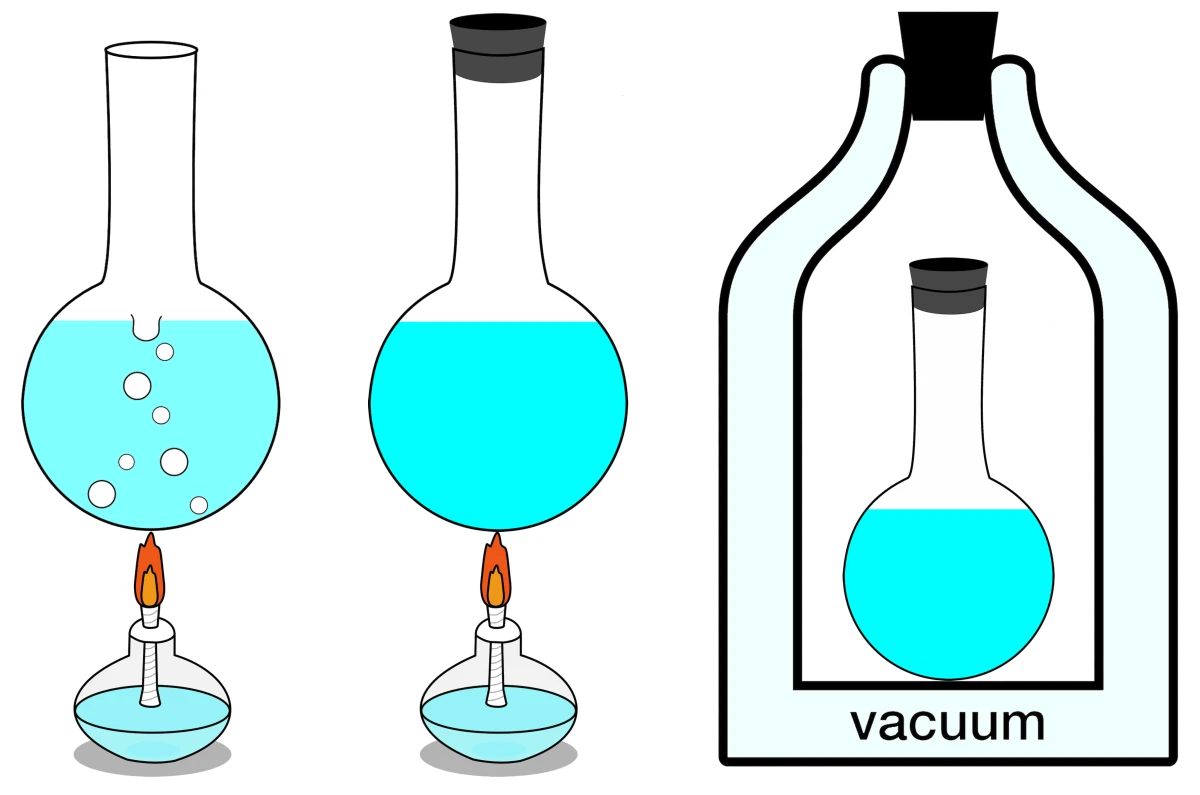
Open, closed, and isolated systems. An open system exchanges both energy and matter, a closed system exchanges only energy, and an isolated system exchanges neither. Credit: Wikimedia Commons, CC BY-SA 4.0
Open system: Both energy and matter can cross the boundary. A boiling pot of water without a lid is an open system. Heat enters from the stove (energy in), and steam escapes into the air (matter out). Most biological systems are open - your body constantly exchanges heat and chemicals with the environment.
Closed system: Energy can cross the boundary, but matter cannot. A sealed pressure cooker on a stove is a closed system. Heat flows in through the walls, but the water and steam stay trapped inside. Most chemical reactions studied on the MCAT take place in closed systems.
Isolated system: Neither energy nor matter can cross the boundary. A perfect thermos is the closest everyday example. In reality, truly isolated systems do not exist (every thermos eventually leaks heat), but the concept is useful for theoretical calculations. The entire universe is sometimes treated as an isolated system because there is nothing outside it to exchange with.
System Type
Energy Transfer?
Matter Transfer?
Example
Open
Yes
Yes
Boiling pot without a lid
Closed
Yes
No
Sealed pressure cooker on a stove
Isolated
No
No
Ideal thermos (approximation)
Why System Classification Matters
The type of system you are working with determines which thermodynamic quantities you measure. In a constant-pressure system (like a coffee cup calorimeter open to the atmosphere), the heat flow equals the enthalpy change (q = ΔH). In a constant-volume system (like a sealed bomb calorimeter), the heat flow equals the internal energy change (q = ΔU). You will see these distinctions again in Section 7.4 on calorimetry.
The First Law of Thermodynamics
The first law states that energy cannot be created or destroyed, only transferred or converted between forms. Mathematically:
Energy enters a system as heat (q) or work (w). If you add heat to a gas and it does not expand, all that energy increases the internal energy (temperature goes up). If the gas expands against external pressure, some energy goes into doing work, and the internal energy increases by less.
Sign Conventions
Getting signs right is critical on the MCAT. The convention used in most chemistry contexts:
Quantity
Positive means…
Negative means…
q (heat)
Heat flows INTO the system (endothermic)
Heat flows OUT of the system (exothermic)
w (work)
Work done ON the system (compression)
Work done BY the system (expansion)
ΔU
System gains internal energy
System loses internal energy
A gas in a sealed piston absorbs 150 J of heat and expands, doing 50 J of work on its surroundings. What is the change in internal energy?
Click to reveal answer
ΔU = +100 J. Using ΔU = q + w: q = +150 J (heat absorbed), w = -50 J (work done BY the system is negative in the chemistry convention). ΔU = 150 + (-50) = +100 J. The system gained 100 J of internal energy.
A sealed thermos of hot soup is placed in a room. Over time, the soup cools slightly. Is this thermos a truly isolated system? Why or why not?
Click to reveal answer
No. A truly isolated system cannot exchange energy or matter with its surroundings. If the soup cools, heat is leaking out through the walls - meaning energy is being transferred. The thermos is a good approximation of an isolated system, but it is not perfect. Only the universe as a whole is a truly isolated system.
Imagine you are hiking from a trailhead at 1,000 feet elevation to a summit at 5,000 feet. Your elevation change is always 4,000 feet, whether you take the steep direct trail or the winding scenic route. But the distance you walk and the energy you burn depend entirely on which path you choose.
State Functions: Only Start and Finish Matter
A state function depends only on the current state of the system - its temperature, pressure, volume, and composition - not on how it got there. The change in a state function is calculated as:
ΔX = X(final) - X(initial)
The key state functions you need for the MCAT:
State Function
Symbol
What It Measures
Internal energy
U
Total energy stored in the system
Enthalpy
H
Heat content at constant pressure
Entropy
S
Degree of disorder
Gibbs free energy
G
Energy available to do useful work
Temperature
T
Average kinetic energy of particles
Pressure
P
Force per unit area
Volume
V
Space occupied
Path Functions: The Route Matters
A path function depends on how the process is carried out. Heat (q) and work (w) are path functions. You can transfer different amounts of heat and work to get between the same two states, depending on the process.
Consider heating water from 25 C to 100 C. You could:
Heat it slowly at constant pressure (one amount of q and w)
Compress it first, then heat it, then expand it (different q and w)
In both cases, ΔH, ΔU, ΔS, and ΔG are identical because the initial and final states are the same. But q and w differ because the path was different.
Why This Matters for the MCAT
The state function concept is the foundation for Hess’s law (Section 7.5). Because enthalpy is a state function, you can break a complex reaction into simpler steps, calculate ΔH for each step, and add them up. The total ΔH is the same regardless of which steps you use. This is enormously powerful for calculations.
A PV diagram showing two paths between states a and b. While the work done (area under the curve) differs for each path, the change in state properties like internal energy is identical — this is the defining characteristic of a state function. Credit: Wikimedia Commons, CC BY-SA 4.0
Standard Conditions
When comparing thermodynamic values across different reactions, we need a common reference point. Standard conditions are defined as:
Temperature: 25 C (298 K)
Pressure: 1 atm (or 1 bar in newer conventions)
Concentration: 1 M for solutions
Values measured under these conditions get the degree symbol: ΔH°, ΔS°, ΔG°. Do not confuse standard conditions (25 C, 1 atm) with STP (0 C, 1 atm), which is used for gas law calculations. They are different reference points.
Is heat (q) a state function or a path function? Why?
Click to reveal answer
Path function. The amount of heat transferred between a system and its surroundings depends on how the process is carried out (constant pressure, constant volume, etc.), not just on the initial and final states. Two different processes connecting the same initial and final states can involve different amounts of heat transfer.
If ΔH for a reaction is -200 kJ via a one-step mechanism and the same overall reaction occurs via a three-step mechanism, what is ΔH for the three-step pathway?
Click to reveal answer
Still -200 kJ. Enthalpy is a state function, so ΔH depends only on the initial reactants and final products, not on the pathway or number of steps. This is the basis of Hess's law.
Every chemical reaction involves energy. Some reactions release energy and feel hot to the touch. Others absorb energy and feel cold. Enthalpy is the thermodynamic quantity that tracks this heat flow at constant pressure - which is how most reactions in your body and in the lab actually occur.
What Is Enthalpy?
Enthalpy (H) is defined as:
In practice, you almost never calculate H directly. Instead, you work with the change in enthalpy:
ΔHrxn = H(products) - H(reactants)
Exothermic vs. Endothermic
Property
Exothermic
Endothermic
ΔH sign
Negative (ΔH < 0)
Positive (ΔH > 0)
Energy flow
System releases heat to surroundings
System absorbs heat from surroundings
Surroundings feel
Warmer
Cooler
Products vs. reactants
Products at LOWER energy
Products at HIGHER energy
Example
Combustion of methane
Photosynthesis
Enthalpy Diagrams
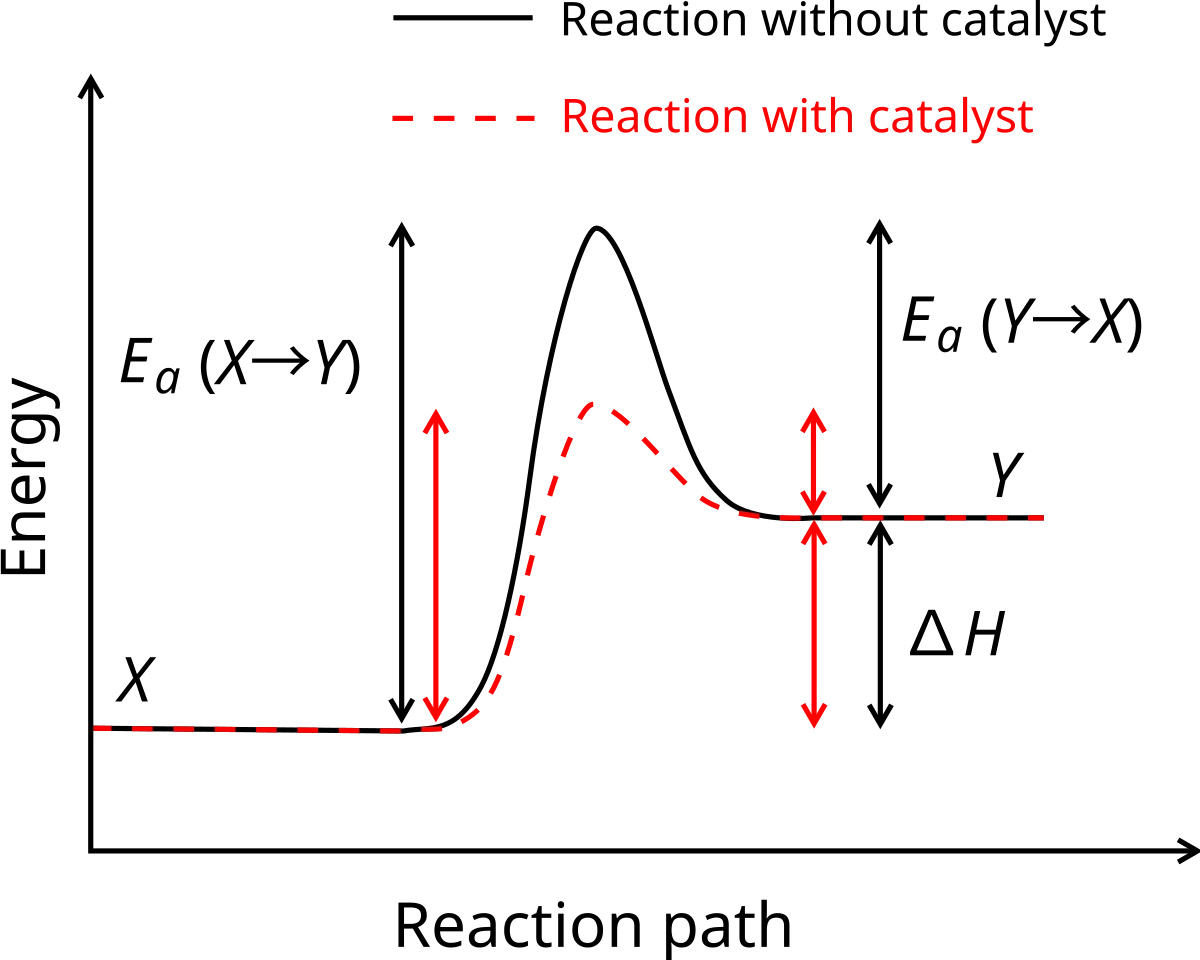
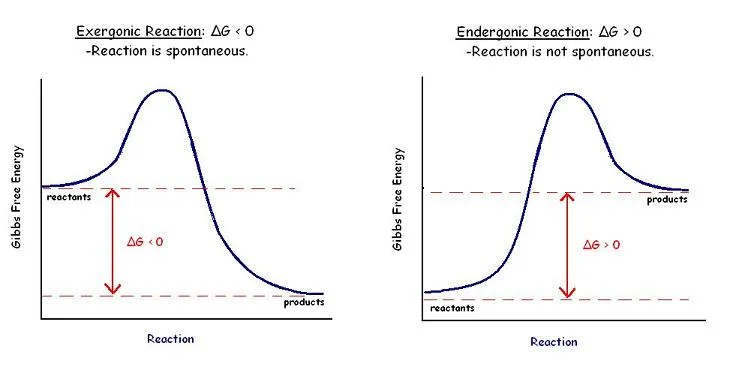
An enthalpy diagram places reactants and products on a vertical energy axis. For an exothermic reaction, the products sit lower than the reactants - energy was released going “downhill.” For an endothermic reaction, the products sit higher - energy was absorbed going “uphill.”
The vertical distance between reactants and products is |ΔH|. The direction tells you the sign.
An enthalpy (energy) diagram for an endothermic reaction. Reactants (X) sit lower than products (Y), and the difference is ΔH. The peak represents the activation energy (Ea). A catalyst (dashed red line) lowers Ea but does not change ΔH. Credit: Wikimedia Commons, CC BY-SA 3.0
Enthalpy and the PV Term
The full definition H = U + PV includes a pressure-volume term. For reactions involving only solids and liquids, volume changes are tiny, so ΔH is almost equal to ΔU. But for reactions involving gases, the PV term matters because gases expand or compress significantly.
For an ideal gas at constant temperature: PV = nRT
So ΔH = ΔU + Δ(nRT) = ΔU + ΔnRT
where Δn = moles of gaseous products - moles of gaseous reactants. If a reaction produces more moles of gas than it consumes (Δn > 0), ΔH > ΔU. If it produces fewer moles of gas (Δn < 0), ΔH < ΔU.
Reversibility of Enthalpy
Because enthalpy is a state function, the enthalpy change for the reverse reaction has the same magnitude but opposite sign:
If it costs 285.8 kJ to decompose water, then forming water releases exactly 285.8 kJ. This principle is essential for Hess’s law calculations.
Stoichiometry and Enthalpy
ΔH values are reported per mole of reaction as written. If you double all the coefficients, you double ΔH:
H₂(g) + 21 O₂(g) → H₂O(l), ΔH = -285.8 kJ
2 H₂(g) + O₂(g) → 2 H₂O(l), ΔH = -571.6 kJ
Always check the stoichiometry when using ΔH values in calculations.
If dissolving ammonium nitrate in water has ΔH = +25.7 kJ/mol, what happens to the temperature of the water?
Click to reveal answer
The water temperature decreases. A positive ΔH means the reaction is endothermic - it absorbs heat from the surroundings (the water). As heat is pulled from the water into the dissolving process, the water cools down. This is exactly how instant cold packs work.
For the reaction N₂(g) + 3 H₂(g) → 2 NH₃(g), ΔH = -92.4 kJ. What is ΔH for the decomposition of 1 mol of NH₃ into N₂ and H₂?
Click to reveal answer
ΔH = +46.2 kJ. The reverse reaction has the opposite sign: +92.4 kJ for decomposing 2 mol NH₃. Since we only want 1 mol, divide by 2: 92.4 / 2 = +46.2 kJ.
You know that mixing certain chemicals makes the solution hot or cold. But how do scientists actually measure the exact amount of heat released or absorbed? The answer is calorimetry - a technique that captures heat flow by measuring temperature changes in a known mass of water (or another substance).
Specific Heat and Heat Capacity
Before we can do calorimetry calculations, you need two definitions:
Specific heat (c): The amount of energy needed to raise the temperature of 1 gram of a substance by 1 C. Water’s specific heat is 4.18 J/(g·C) - one of the highest of any common substance. This is why water heats up and cools down slowly compared to metals.
Heat capacity (C): The total amount of energy needed to raise the temperature of a specific object by 1 C. Heat capacity = mass × specific heat (C = mc).
Coffee Cup Calorimeter (Constant Pressure)
The coffee cup calorimeter is simply an insulated cup (usually Styrofoam) with a thermometer. The reaction occurs in aqueous solution inside the cup, and since the cup is open to the atmosphere, the pressure is constant.
Key point: At constant pressure, q = ΔH. So the coffee cup calorimeter directly measures the enthalpy change of the reaction.
How it works:
Mix reactants in the calorimeter
Measure the temperature change of the solution
Calculate q using q = mcΔT (using the mass and specific heat of the solution)
The heat gained by the solution equals the heat released by the reaction (or vice versa): q(rxn) = -q(solution)
Bomb Calorimeter (Constant Volume)
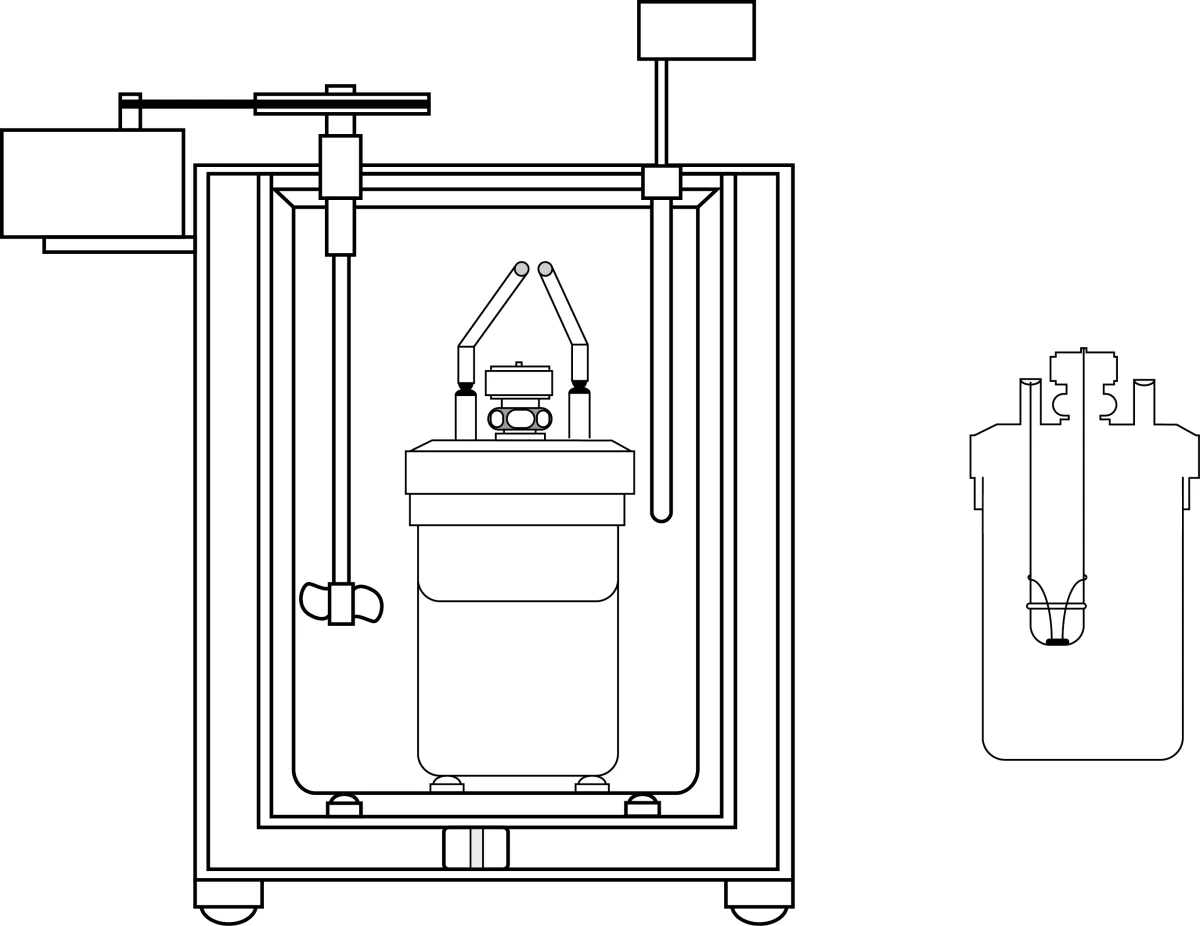
A bomb calorimeter: the reaction occurs inside the sealed steel "bomb" (center), surrounded by a known mass of water. Because the rigid container keeps volume constant, the measured heat equals ΔU. Credit: Wikimedia Commons, CC BY-SA 3.0
The bomb calorimeter is a sealed, rigid steel container (“the bomb”) immersed in a known mass of water. The sample is placed inside the bomb with excess oxygen and ignited electrically.
Key point: Because the volume cannot change, no PV work is done (w = 0). All energy goes into heat. At constant volume, q = ΔU (not ΔH).
The temperature of the surrounding water rises, and we calculate:
q = C(calorimeter) × ΔT
where C(calorimeter) is the total heat capacity of the calorimeter (including the water and the bomb itself), often given in the problem in units of kJ/C.
Coffee Cup vs. Bomb: Summary
Feature
Coffee Cup
Bomb
Held constant
Pressure (open to atmosphere)
Volume (sealed rigid container)
Measures
ΔH (enthalpy change)
ΔU (internal energy change)
Formula
q = mcΔT
q = C(cal) × ΔT
Best for
Acid-base reactions, dissolving
Combustion reactions
Precision
Lower (heat loss through cup)
Higher (well-insulated)
Assumptions in Calorimetry
For MCAT problems, you can usually assume:
The calorimeter is perfectly insulated (no heat loss to the room)
The solution has the density and specific heat of pure water [1 g/mL, 4.18 J/(g·C)]
All heat from the reaction is absorbed by the solution (coffee cup) or by the calorimeter (bomb)
Worked Example
A student dissolves 5.0 g of NaOH (molar mass 40 g/mol) in 100 mL of water in a coffee cup calorimeter. The temperature rises from 22.0 C to 28.5 C. What is the molar enthalpy of dissolution?
Why does a bomb calorimeter measure ΔU rather than ΔH?
Click to reveal answer
Because the volume is constant. In a sealed, rigid bomb, the volume cannot change, so no pressure-volume work is done (w = -PΔV = 0). By the first law, ΔU = q + w = q + 0 = q. The heat measured equals the internal energy change, not the enthalpy change. To get ΔH from bomb data, you would need to correct using ΔH = ΔU + ΔnRT.
In a coffee cup calorimetry experiment, the temperature of the solution drops. Is the reaction exothermic or endothermic?
Click to reveal answer
Endothermic (ΔH > 0). The solution cooled because the reaction absorbed heat FROM the solution. The solution is the surroundings - it lost heat, so its temperature dropped. The system (the reaction) gained that heat, making it endothermic.
Some reactions are impossible to measure directly. You cannot stick a thermometer into the formation of diamond from graphite because that reaction requires extreme pressure and takes geological time. But you CAN measure the combustion of graphite and the combustion of diamond separately. Hess’s law lets you combine those measurable reactions to calculate the enthalpy change for the unmeasurable one.
The Principle
The Three Manipulation Rules
When combining reactions to reach a target, you have three tools:
Rule 1 - Reverse: If you flip a reaction (swap products and reactants), change the sign of ΔH.
Forward: C(s) + O₂(g) → CO₂(g), ΔH = -393.5 kJ
Reverse: CO₂(g) → C(s) + O₂(g), ΔH = +393.5 kJ
Rule 2 - Multiply: If you multiply all coefficients by a factor n, multiply ΔH by the same factor.
Rule 3 - Add: Stack the manipulated reactions and add them. Species that appear on both sides cancel out (like algebra). Add the ΔH values.
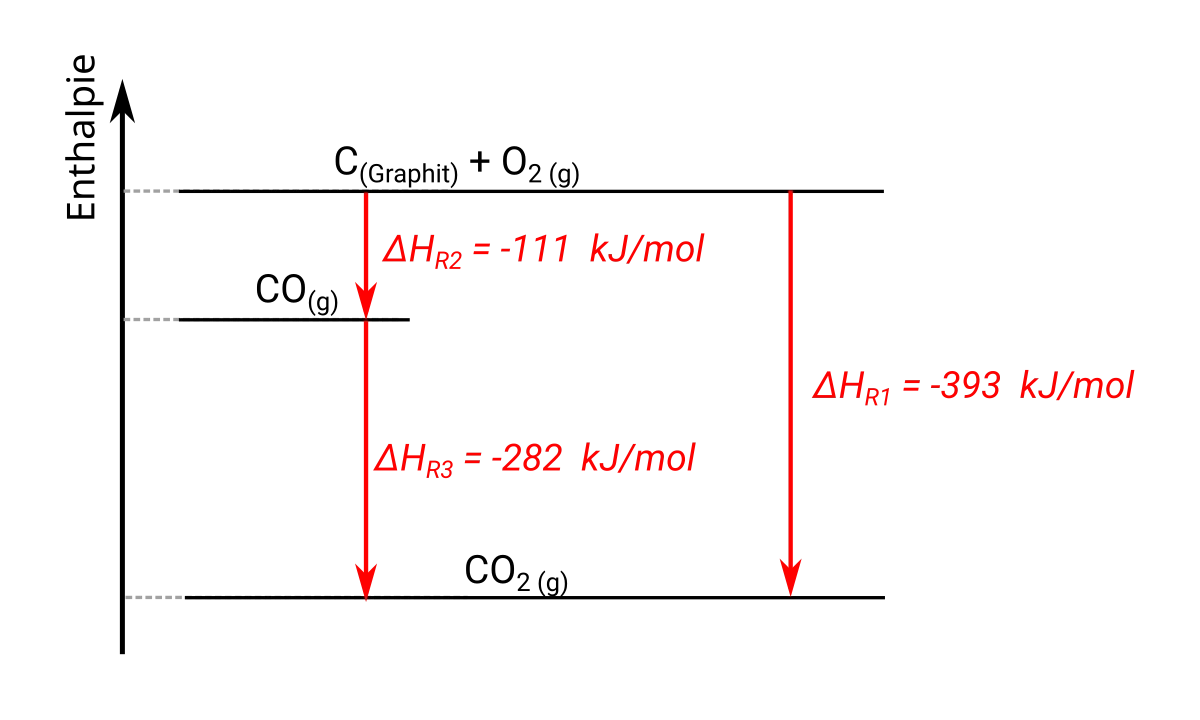
Hess's law illustrated with carbon combustion. Whether C goes directly to CO₂ (ΔH = -393 kJ/mol) or passes through CO as an intermediate (-111 + -282 = -393 kJ/mol), the total enthalpy change is identical. Credit: Wikimedia Commons, CC BY-SA 4.0
Worked Example
Target reaction: C(s) + O₂(g) → CO₂(g), ΔH = ?
Given:
C(s) + 21 O₂(g) → CO(g), ΔH₁ = -110.5 kJ
CO(g) + 21 O₂(g) → CO₂(g), ΔH₂ = -283.0 kJ
Solution: Both reactions are already in the correct direction. Add them:
Scan the given reactions - identify which ones contain your target reactants and products
Reverse or multiply reactions as needed so intermediates cancel
Add everything up, including the ΔH values
Verify: check that the final equation matches the target
If ΔH for a reaction is -150 kJ, what is ΔH for the same reaction run in reverse and with all coefficients tripled?
Click to reveal answer
ΔH = +450 kJ. Reversing the reaction flips the sign: +150 kJ. Tripling the coefficients multiplies ΔH by 3: 150 × 3 = +450 kJ. Apply both manipulations.
Why does Hess's law work? What underlying property of enthalpy makes it valid?
Click to reveal answer
Because enthalpy is a state function. State functions depend only on the initial and final states, not on the path taken. Therefore, the total enthalpy change is the same whether a reaction proceeds in one step or through multiple intermediate steps. You can add up any combination of steps that connect the same starting and ending points.
Hess’s law is powerful, but manipulating multiple reactions can be tedious. There is a shortcut: if you know the standard enthalpy of formation (ΔHf°) for every compound in a reaction, you can calculate ΔH° in a single step using a simple “products minus reactants” formula.
What Is a Formation Reaction?
A formation reaction produces exactly one mole of a compound from its elements in their standard states (the most stable form at 25 C and 1 atm).
The reaction is strongly exothermic, which makes sense - methane combustion powers your stove.
Standard Enthalpy of Combustion
The standard enthalpy of combustion (ΔH°comb) is the enthalpy change when one mole of a substance burns completely in oxygen under standard conditions. Combustion reactions are always exothermic (ΔH°comb < 0).
Common values:
Methane (CH₄): -890 kJ/mol
Glucose (C₆H₁₂O₆): -2,803 kJ/mol
Ethanol (C₂H₅OH): -1,367 kJ/mol
What is the standard enthalpy of formation of O₂(g)?
Click to reveal answer
Zero. O₂(g) is oxygen in its standard state (most stable form at 25 C and 1 atm). By definition, elements in their standard states have ΔHf° = 0.
Using the formula ΔH°rxn = ΣΔHf°(products) - ΣΔHf°(reactants), if all the products have very negative ΔHf° values and the reactants have ΔHf° near zero, is the reaction exothermic or endothermic?
Click to reveal answer
Exothermic. If products are very negative and reactants are near zero, then ΔH°rxn = (very negative) - (near zero) = very negative. A negative ΔH° means exothermic. The products are more stable (lower energy) than the reactants.
What if you do not have ΔHf° values for the compounds in your reaction? There is another way to estimate ΔH: use the energies of the individual bonds being broken and formed. This approach is less precise than using ΔHf° (because bond energies are averages), but it gives you a fast estimate - and the MCAT tests it regularly.
The Core Principle
Every chemical bond is a store of energy. Breaking a bond requires energy input (endothermic). Forming a bond releases energy (exothermic). The overall enthalpy change of a reaction depends on the balance between these two processes.
The Bond Energy Formula
Important: This formula uses the convention that bond dissociation energies (BDEs) are always positive numbers (the energy required to break). The subtraction handles the sign:
If you form stronger bonds than you break → ΔH < 0 (exothermic)
If you break stronger bonds than you form → ΔH > 0 (endothermic)
Common Bond Energies
You do not need to memorize these - the MCAT will provide them in a table. But knowing the trends helps:
Bond
Energy (kJ/mol)
Trend
C-H
413
Single bonds
C-C
348
Weaker than double/triple
C=C
614
Stronger than single
C≡C
839
Strongest carbon-carbon
O-H
463
Strong - explains water’s stability
O=O
498
Must break this in combustion
N≡N
941
Very strong - N₂ is hard to break
H-H
436
C=O
799
Strong bond in CO₂
N-H
391
Key trend: Triple bonds > double bonds > single bonds in energy. Stronger bonds = more stable molecules = more energy released when formed.
Worked Example
Estimate ΔH for the combustion of methane: CH₄ + 2 O₂ → CO₂ + 2 H₂O
Bonds broken (reactants):
4 × C-H = 4 × 413 = 1,652 kJ
2 × O=O = 2 × 498 = 996 kJ
Total broken = 2,648 kJ
Bonds formed (products):
2 × C=O (in CO₂) = 2 × 799 = 1,598 kJ
4 × O-H (in 2 H₂O) = 4 × 463 = 1,852 kJ
Total formed = 3,450 kJ
ΔH ≈ 2,648 - 3,450 = -802 kJ
The actual value is -890 kJ. The estimate is off by about 10% because bond energies are averages across many molecules. For the MCAT, this level of accuracy is expected and acceptable.
Why Combustion Is Always Exothermic
In combustion, you break relatively weak C-H, C-C, and O=O bonds and form very strong C=O and O-H bonds. The bonds formed are stronger than the bonds broken, so energy is released. This is why all combustion reactions are exothermic - the products (CO₂ and H₂O) contain some of the strongest bonds in chemistry.
Using bond energies, is breaking a triple bond (like N≡N, 941 kJ/mol) endothermic or exothermic?
Click to reveal answer
Endothermic. Breaking ANY bond requires energy input - it is always endothermic. The 941 kJ/mol is the energy you must put IN to break one mole of N≡N bonds. This is why N₂ is so unreactive - its triple bond is extremely difficult to break.
A reaction breaks bonds worth 500 kJ total and forms bonds worth 700 kJ total. Is the reaction exothermic or endothermic, and what is the approximate ΔH?
Click to reveal answer
Exothermic, ΔH ≈ -200 kJ. ΔH = bonds broken - bonds formed = 500 - 700 = -200 kJ. More energy was released forming bonds than was consumed breaking bonds, so the reaction is exothermic (negative ΔH).
Enthalpy tells you about heat flow, but it does not tell the whole story of whether a reaction will happen on its own. Some endothermic reactions DO happen spontaneously - ice melts at room temperature even though it absorbs heat. The missing piece of the puzzle is entropy.
What Is Entropy?
Entropy (S) is a measure of the disorder or randomness in a system. More precisely, it counts the number of microstates - the different ways particles can be arranged while still looking the same from the outside.
A neatly stacked deck of cards (one specific arrangement) has low entropy. A shuffled deck (one of trillions of possible arrangements) has high entropy. Nature overwhelmingly favors shuffled decks because there are so many more disordered arrangements than ordered ones.
The Second Law of Thermodynamics
The Third Law of Thermodynamics
The third law states that the entropy of a perfect crystal at absolute zero (0 K) is exactly zero. This provides an absolute reference point for entropy - unlike enthalpy, where we can only measure changes. This is why elements in their standard states do NOT have S° = 0 (unlike ΔHf° = 0). Every substance at temperatures above 0 K has some molecular motion and therefore some entropy.
Predicting Entropy Changes
You can often predict the sign of ΔS without any calculation by asking: “Did things become more or less disordered?”
ΔS > 0 (entropy increases) when:
Solids melt into liquids
Liquids vaporize into gases
A reaction produces more moles of gas
A solid dissolves in a solvent
Temperature increases
ΔS < 0 (entropy decreases) when:
Gases condense into liquids
Liquids freeze into solids
A reaction produces fewer moles of gas
Molecules combine into a larger molecule
A gas dissolves in a liquid
Entropy Ranking by Phase
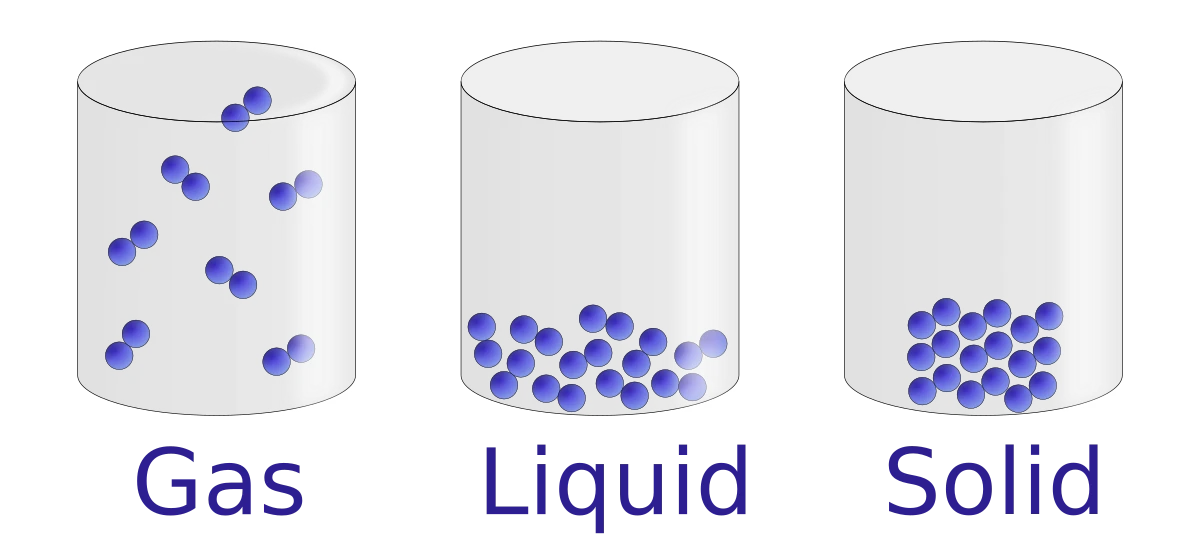
Particle arrangement in gas, liquid, and solid states. Gas molecules have the most freedom of motion (highest entropy), while solid molecules are locked in fixed positions (lowest entropy). Credit: Wikimedia Commons, CC BY-SA 4.0
S(gas) >> S(liquid) > S(solid)
A gas at any temperature has enormously more entropy than the same substance as a liquid, which has more entropy than the solid. Phase changes are the biggest drivers of entropy change.
Calculating ΔS° for a Reaction
Just like enthalpy, you can calculate the standard entropy change using tabulated values:
Entropy and Temperature
The relationship between entropy change and heat transfer at a given temperature is:
ΔS = q(rev) / T
where q(rev) is the heat transferred in a reversible process and T is the absolute temperature in Kelvin. This equation tells you two things:
Adding heat to a system increases its entropy (q > 0 → ΔS > 0)
The same amount of heat causes a LARGER entropy change at low temperatures than at high temperatures
Predict the sign of ΔS for: CaCO₃(s) → CaO(s) + CO₂(g)
Click to reveal answer
ΔS > 0 (positive). The reaction produces a gas (CO₂) from a solid. Going from 0 moles of gas on the left to 1 mole of gas on the right increases the disorder of the system significantly. More gas = more entropy.
Why is the standard entropy of O₂(g) not zero, even though O₂ is an element in its standard state?
Click to reveal answer
Because entropy has an absolute reference point (the third law). Unlike enthalpy of formation (ΔHf° = 0 for elements by convention), the third law sets entropy = 0 only for a perfect crystal at 0 K. At 298 K, O₂ molecules are moving and rotating, giving them significant entropy. The standard entropy of O₂(g) is about 205 J/(K·mol).
You now know two pieces of the puzzle: enthalpy (does the reaction release heat?) and entropy (does the reaction increase disorder?). The entropy concepts from physics thermodynamics apply directly here. But neither alone tells you whether a reaction will happen spontaneously. An exothermic reaction with a large entropy decrease might not be spontaneous. An endothermic reaction with a large entropy increase might be. You need one equation that combines both factors to give you the final answer.
The Master Equation
The Gibbs free energy relationship. A reaction is spontaneous when ΔG < 0, which can occur when enthalpy decreases (ΔH < 0), entropy increases (ΔS > 0), or the temperature is high enough that the TΔS term dominates. Credit: Wikimedia Commons, Public Domain
Unit Warning
Watch units carefully. ΔH is usually given in kJ/mol, but ΔS is usually given in J/(mol·K). Before plugging into ΔG = ΔH - TΔS, convert them to the same units. Either divide ΔS by 1,000 to get kJ/(mol·K), or multiply ΔH by 1,000 to get J/mol.
The Four Scenarios
This is one of the most tested concepts in MCAT thermochemistry. Depending on the signs of ΔH and ΔS, there are four possible combinations:
ΔH
ΔS
ΔG
Spontaneity
Example
-
+
Always negative
Spontaneous at ALL temperatures
Combustion, rust
+
-
Always positive
NEVER spontaneous
Reverse of combustion
-
-
Depends on T
Spontaneous at LOW T (enthalpy wins)
Freezing water below 0 C
+
+
Depends on T
Spontaneous at HIGH T (entropy wins)
Melting ice above 0 C
The Crossover Temperature
For the two “depends on T” cases, you can find the exact temperature where spontaneity switches by setting ΔG=0:
0=ΔH−TΔS→T=ΔSΔH
Below this temperature, one factor dominates; above it, the other does. This crossover temperature is the phase transition temperature for phase changes (0 C for water freezing/melting at 1 atm, 100 C for boiling/condensing).
Exergonic vs. Endergonic
Term
ΔG Sign
Meaning
Exergonic
ΔG < 0
Releases free energy; spontaneous
Endergonic
ΔG > 0
Requires free energy input; nonspontaneous
Do not confuse these with exothermic/endothermic. Exothermic/endothermic refer to ΔH (heat). Exergonic/endergonic refer to ΔG (free energy). A reaction can be exothermic but endergonic (if entropy decreases enough), or endothermic but exergonic (if entropy increases enough).
Spontaneity Does Not Mean Fast
A critical concept: ΔG tells you WHETHER a reaction is thermodynamically favorable, not HOW FAST it occurs. Diamond converting to graphite has ΔG < 0 (spontaneous), but it takes billions of years. The rate of a reaction depends on kinetics (activation energy, catalysts), not thermodynamics. ΔG says “will it?”; kinetics says “how fast?”
A reaction has ΔH = +50 kJ/mol and ΔS = +200 J/(mol·K). Above what temperature is this reaction spontaneous?
Click to reveal answer
Above 250 K (-23 C). Set ΔG = 0: T = ΔH/ΔS = 50,000 J / 200 J/K = 250 K. Above 250 K, the TΔS term overcomes the positive ΔH, making ΔG negative. Note the unit conversion: 50 kJ = 50,000 J.
A reaction is exothermic (ΔH < 0) and decreases entropy (ΔS < 0). At what temperatures is this reaction spontaneous?
Click to reveal answer
At low temperatures. ΔG = ΔH - TΔS. With ΔH < 0 and ΔS < 0, the -TΔS term is positive (subtracting a negative). At low T, TΔS is small, so ΔH dominates and ΔG is negative (spontaneous). At high T, TΔS becomes large and positive, overwhelming the negative ΔH, making ΔG positive (nonspontaneous). Example: freezing water is spontaneous below 0 C but not above.
In the previous section, you learned that ΔG determines spontaneity. But which ΔG? There is a critical distinction between ΔG° (standard free energy change) and ΔG (actual free energy change under real conditions). Confusing the two is one of the most common mistakes on the MCAT.
ΔG° and the Equilibrium Constant
Interpreting ΔG° and K
The sign of ΔG° tells you which side of the reaction is favored at equilibrium:
ΔG°
K
Meaning
Negative
K > 1
Products favored at equilibrium
Zero
K = 1
Neither side favored
Positive
K < 1
Reactants favored at equilibrium
ΔG Under Non-Standard Conditions
Real reactions rarely occur under standard conditions. The actual free energy change depends on the current concentrations via the reaction quotient Q:
How ΔG Changes as a Reaction Proceeds
When a reaction starts:
If Q < K: ΔG < 0 (reaction proceeds forward to make more products)
If Q > K: ΔG > 0 (reaction proceeds backward to make more reactants)
If Q = K: ΔG = 0 (equilibrium - no net change)
As the reaction approaches equilibrium, ΔG approaches zero. At equilibrium, Q = K and:
ΔG = ΔG° + RTlnK = 0
This is exactly where the equation ΔG° = -RTlnK comes from - it is the ΔG = 0 condition rearranged.
Connecting Everything
Here is how the three big thermodynamic equations fit together:
ΔG = ΔH - TΔS (relates free energy to enthalpy and entropy)
ΔG° = -RTlnK (relates standard free energy to equilibrium)
ΔG = ΔG° + RTlnQ (relates actual free energy to current conditions)
These three equations are the thermodynamic backbone of the MCAT. Know them cold.
Temperature and K
Because ΔG° depends on temperature (through the TΔS° term in ΔG° = ΔH° - TΔS°), and K depends on ΔG° (through ΔG° = -RTlnK), the equilibrium constant changes with temperature.
For an exothermic reaction (ΔH° < 0): increasing temperature makes ΔG° less negative (or more positive), which decreases K. Heat shifts equilibrium toward reactants.
For an endothermic reaction (ΔH° > 0): increasing temperature makes ΔG° more negative, which increases K. Heat shifts equilibrium toward products.
This connects directly to Le Chatelier’s principle from Chapter 6: heat acts as a reactant (endothermic) or product (exothermic).
At equilibrium, what is the value of ΔG?
Click to reveal answer
ΔG = 0. At equilibrium, the forward and reverse reactions are balanced, and there is no thermodynamic driving force in either direction. Note: ΔG° is NOT zero at equilibrium (unless K = 1). ΔG° is a fixed property of the reaction. ΔG is the quantity that equals zero at equilibrium.
A reaction has ΔG° = -30 kJ/mol. Is this reaction spontaneous under all conditions?
Click to reveal answer
Not necessarily. ΔG° = -30 kJ/mol means the reaction is spontaneous under STANDARD conditions (1 M, 1 atm) and that K > 1. But under non-standard conditions, ΔG = ΔG° + RTlnQ. If Q is very large (lots of products already present), RTlnQ could be positive enough to make ΔG > 0, meaning the reaction would actually go in reverse. ΔG° tells you about the equilibrium position; ΔG tells you about the current direction.
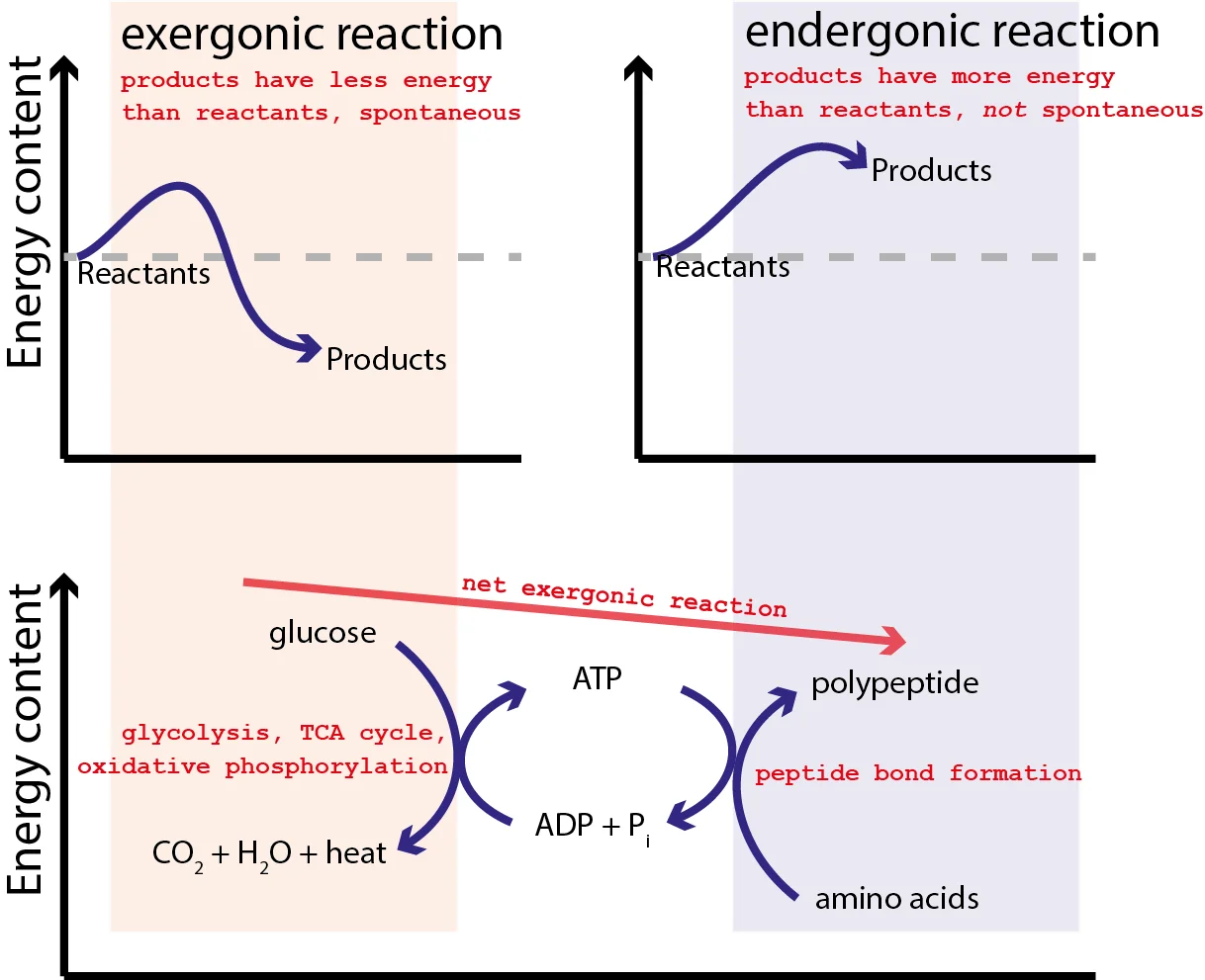
If a reaction has a positive ΔG (nonspontaneous), does that mean it can never happen? Not at all. Nature has an elegant solution: couple the nonspontaneous reaction with a highly spontaneous (exergonic) one. If the combined ΔG is negative, the overall process is spontaneous. This is how your body drives thousands of thermodynamically unfavorable reactions every second.
How Coupling Works
Two reactions can be coupled if they share a common intermediate and are catalyzed by the same enzyme (or occur in the same cellular pathway). The overall ΔG is simply the sum of the individual ΔG values:
ΔG(overall) = ΔG₁ + ΔG₂
If ΔG₁ is positive (nonspontaneous) and ΔG₂ is sufficiently negative (spontaneous), the sum can be negative, making the overall process spontaneous.
ATP: The Universal Energy Currency
The most common coupling partner in biology is ATP hydrolysis:
ATP + H₂O → ADP + Pi, ΔG° = -30.5 kJ/mol
This reaction is strongly exergonic because:
The products (ADP + Pi) have less electrostatic repulsion than ATP (which has four negative charges clustered on its phosphate groups)
The products are stabilized by resonance and hydration
Coupled reactions in biological systems. Exergonic processes (like glucose oxidation) generate ATP, which then provides the energy to drive endergonic processes (like protein synthesis). The overall ΔG must be negative for the coupled process to be spontaneous. Credit: Wikimedia Commons, CC BY-SA 3.0
Example: Glutamine Synthesis
The synthesis of glutamine from glutamate and ammonia is nonspontaneous:
The coupled reaction is spontaneous. The enzyme glutamine synthetase catalyzes this coupled reaction in a single active site.
Beyond ATP
Other high-energy molecules can serve as coupling partners:
Molecule
Hydrolysis ΔG° (kJ/mol)
Phosphoenolpyruvate (PEP)
-61.9
1,3-Bisphosphoglycerate
-49.4
Creatine phosphate
-43.1
ATP → ADP + Pi
-30.5
Glucose-6-phosphate
-13.8
Key Principles for the MCAT
You can add ΔG values for coupled reactions because ΔG is a state function
The coupled ΔG must be negative for the overall process to be spontaneous
Enzymes facilitate coupling by bringing both reactions together in one active site, but they do NOT change the thermodynamics
ATP hydrolysis provides about -30.5 kJ/mol under standard conditions (and even more under cellular conditions, roughly -50 to -54 kJ/mol)
A reaction has ΔG° = +25 kJ/mol. Can it be made spontaneous by coupling with ATP hydrolysis (ΔG° = -30.5 kJ/mol)?
Click to reveal answer
Yes. The overall ΔG° = +25 + (-30.5) = -5.5 kJ/mol, which is negative. The coupled reaction is spontaneous. ATP hydrolysis provides more than enough free energy to drive the unfavorable reaction.
Does coupling a nonspontaneous reaction with ATP hydrolysis change the equilibrium constant of the original reaction?
Click to reveal answer
No - but the COUPLED reaction has a different (larger) overall K. The individual equilibrium constants do not change. However, the overall equilibrium constant for the coupled reaction is the product of the two individual K values: K(overall) = K₁ × K₂. Since ATP hydrolysis has a very large K, the overall K is much larger than K₁ alone.
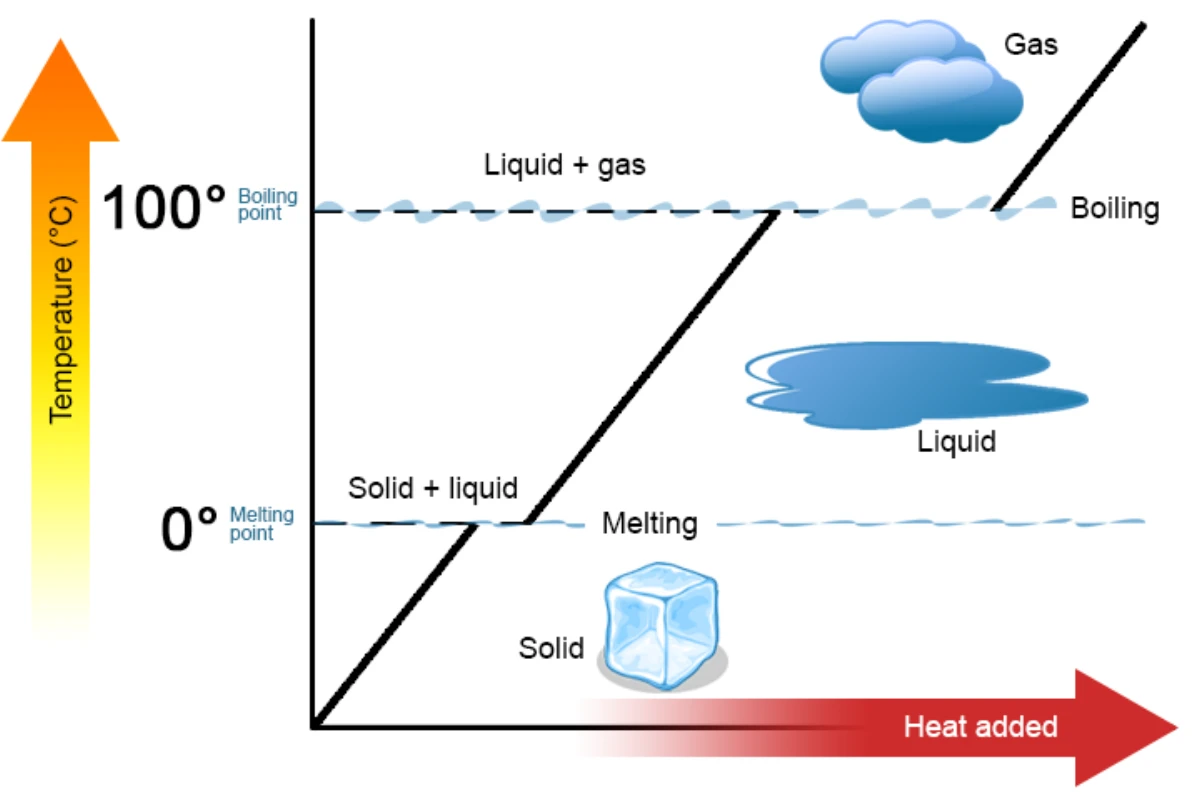
When you heat a substance, the temperature rises steadily - until you hit a phase change. Then something strange happens: you keep adding heat, but the temperature stops rising. All that energy goes into breaking intermolecular forces rather than speeding up molecules. Understanding this behavior is essential for interpreting heating curves on the MCAT.
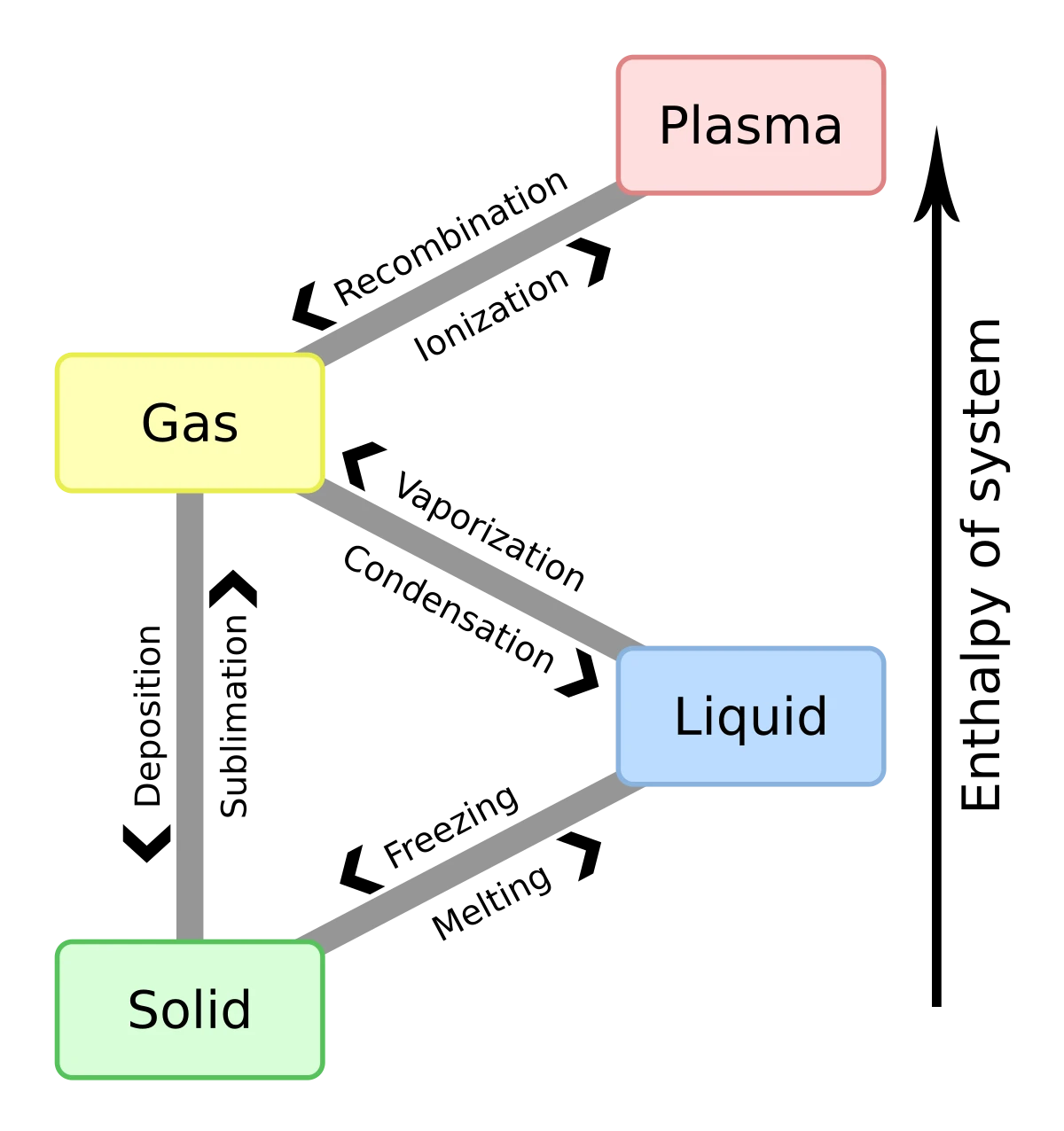
Phase Change Terminology
Phase Change
Name
Direction
ΔH Sign
Solid → Liquid
Melting (fusion)
Endothermic
+
Liquid → Gas
Vaporization (boiling)
Endothermic
+
Solid → Gas
Sublimation
Endothermic
+
Gas → Liquid
Condensation
Exothermic
-
Liquid → Solid
Freezing
Exothermic
-
Gas → Solid
Deposition
Exothermic
-
Key rule: Breaking intermolecular forces requires energy (endothermic). Forming intermolecular forces releases energy (exothermic). Going from more ordered → less ordered absorbs heat.
All phase transitions and their names. Upward arrows (increasing enthalpy) represent endothermic changes; downward arrows represent exothermic changes. Credit: Wikimedia Commons, CC BY-SA 4.0
The Heating Curve
Heating curve for water. Sloped regions represent temperature changes within a single phase (q = mcΔT). Flat plateaus at 0 C and 100 C represent phase transitions where all added energy goes into breaking intermolecular forces (q = nΔH). Credit: Wikimedia Commons, CC BY-SA 3.0
A heating curve plots temperature (y-axis) vs. heat added (x-axis) for a substance being heated from solid to gas at constant pressure. It has five distinct regions:
Solid warming (sloped line): Temperature rises as heat increases the kinetic energy of molecules in the solid. q = mcΔT using c(solid).
Melting plateau (flat line at melting point): Temperature stays constant while the solid melts. All added heat goes into breaking intermolecular forces. q = n × ΔH(fus).
Liquid warming (sloped line): Temperature rises again. q = mcΔT using c(liquid).
Boiling plateau (flat line at boiling point): Temperature stays constant while the liquid vaporizes. q = n × ΔH(vap).
Gas warming (sloped line): Temperature rises. q = mcΔT using c(gas).
Key Formulas for Heating Curves
ΔH(vap) >> ΔH(fus)
The enthalpy of vaporization is always much larger than the enthalpy of fusion for the same substance. This is because vaporization completely separates molecules from each other (overcoming all remaining intermolecular forces), while melting only loosens the rigid crystal structure.
For water:
ΔH(fus) = 6.01 kJ/mol (melting ice)
ΔH(vap) = 40.7 kJ/mol (boiling water)
The boiling plateau on a heating curve is much wider than the melting plateau because more energy is needed.
Why the Boiling Plateau Matters
Calculating Total Heat for a Complete Heating Process
To find the total heat needed to convert ice at -20 C to steam at 120 C, you must add five separate terms:
Heat the ice from -20 C to 0 C: q₁ = mc(ice)ΔT
Melt the ice at 0 C: q₂ = nΔH(fus)
Heat the water from 0 C to 100 C: q₃ = mc(water)ΔT
Boil the water at 100 C: q₄ = nΔH(vap)
Heat the steam from 100 C to 120 C: q₅ = mc(steam)ΔT
q(total) = q₁ + q₂ + q₃ + q₄ + q₅
Entropy and Phase Changes
Phase changes also involve entropy changes:
Melting: ΔS = ΔH(fus) / T(melting) > 0
Boiling: ΔS = ΔH(vap) / T(boiling) > 0
At the phase transition temperature, ΔG = 0 (the two phases are in equilibrium). This is consistent with ΔG = ΔH - TΔS = 0, so T = ΔH/ΔS at the phase boundary.
On a heating curve, you are at a flat region at 100 C. What phases are present, and what is happening to the added heat energy?
Click to reveal answer
Liquid water and water vapor (steam) coexist. The flat region at 100 C is the boiling plateau. The added heat is being used entirely to overcome intermolecular forces (hydrogen bonds) and convert liquid water to gas. Temperature remains constant because the energy increases potential energy (separating molecules), not kinetic energy (molecular speed).
Why is ΔH(vap) always much larger than ΔH(fus) for the same substance?
Click to reveal answer
Because vaporization completely separates molecules. Melting only disrupts the rigid crystal lattice while keeping molecules close together (liquid state). Vaporization must completely overcome the remaining intermolecular forces to send molecules into the gas phase, where they are far apart and essentially independent. This requires much more energy.