
Entropy (ΔS)
Enthalpy tells you about heat flow, but it does not tell the whole story of whether a reaction will happen on its own. Some endothermic reactions DO happen spontaneously - ice melts at room temperature even though it absorbs heat. The missing piece of the puzzle is entropy.
What Is Entropy?
Entropy (S) is a measure of the disorder or randomness in a system. More precisely, it counts the number of microstates - the different ways particles can be arranged while still looking the same from the outside.
A neatly stacked deck of cards (one specific arrangement) has low entropy. A shuffled deck (one of trillions of possible arrangements) has high entropy. Nature overwhelmingly favors shuffled decks because there are so many more disordered arrangements than ordered ones.
The Second Law of Thermodynamics
The Third Law of Thermodynamics
The third law states that the entropy of a perfect crystal at absolute zero (0 K) is exactly zero. This provides an absolute reference point for entropy - unlike enthalpy, where we can only measure changes. This is why elements in their standard states do NOT have S° = 0 (unlike ΔHf° = 0). Every substance at temperatures above 0 K has some molecular motion and therefore some entropy.
Predicting Entropy Changes
You can often predict the sign of ΔS without any calculation by asking: “Did things become more or less disordered?”
ΔS > 0 (entropy increases) when:
- Solids melt into liquids
- Liquids vaporize into gases
- A reaction produces more moles of gas
- A solid dissolves in a solvent
- Temperature increases
ΔS < 0 (entropy decreases) when:
- Gases condense into liquids
- Liquids freeze into solids
- A reaction produces fewer moles of gas
- Molecules combine into a larger molecule
- A gas dissolves in a liquid
Entropy Ranking by Phase
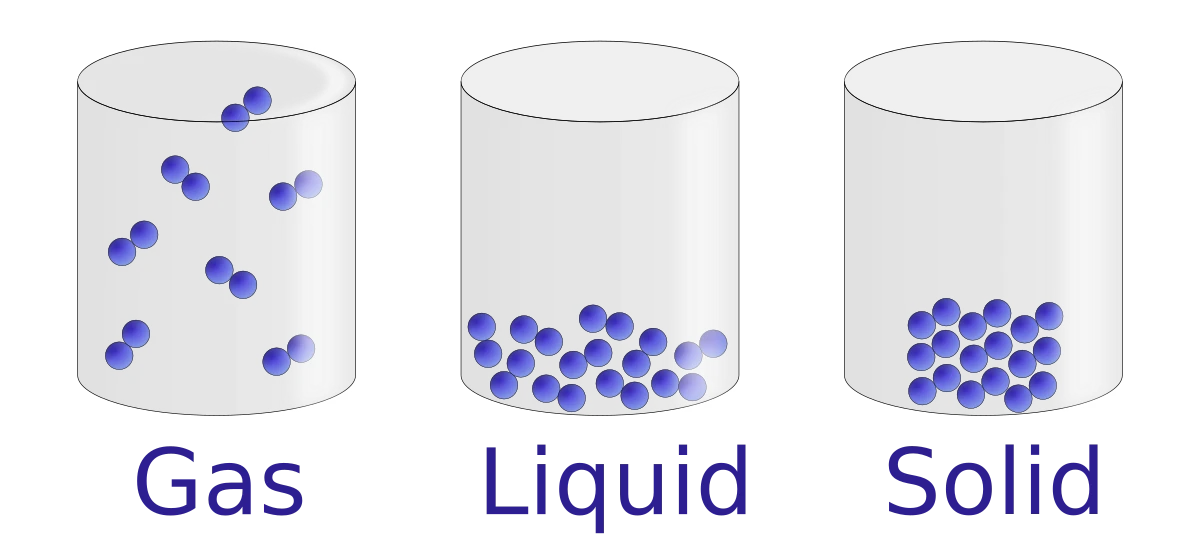
S(gas) >> S(liquid) > S(solid)
A gas at any temperature has enormously more entropy than the same substance as a liquid, which has more entropy than the solid. Phase changes are the biggest drivers of entropy change.
Calculating ΔS° for a Reaction
Just like enthalpy, you can calculate the standard entropy change using tabulated values:
Entropy and Temperature
The relationship between entropy change and heat transfer at a given temperature is:
ΔS = q(rev) / T
where q(rev) is the heat transferred in a reversible process and T is the absolute temperature in Kelvin. This equation tells you two things:
- Adding heat to a system increases its entropy (q > 0 → ΔS > 0)
- The same amount of heat causes a LARGER entropy change at low temperatures than at high temperatures