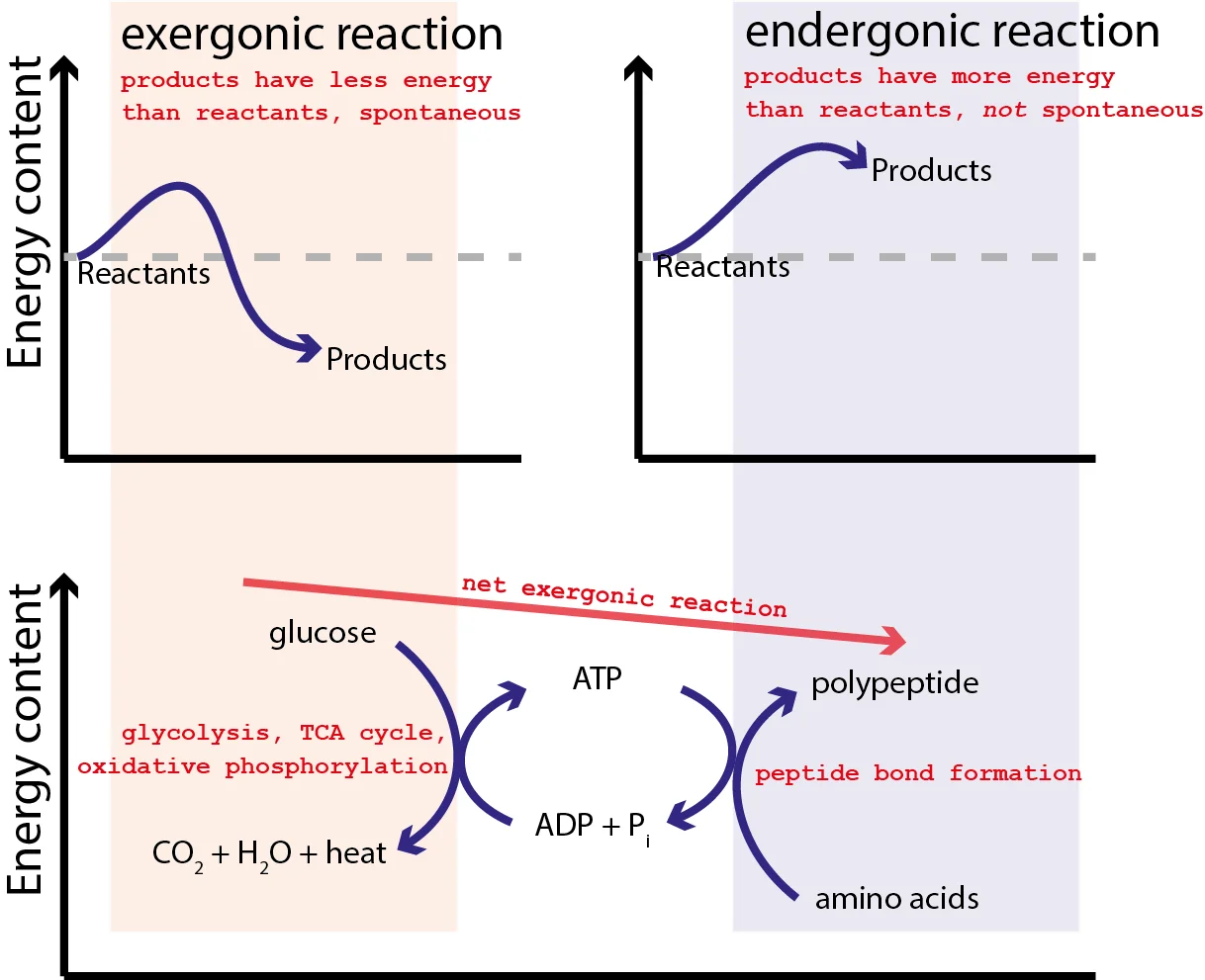
If a reaction has a positive ΔG (nonspontaneous), does that mean it can never happen? Not at all. Nature has an elegant solution: couple the nonspontaneous reaction with a highly spontaneous (exergonic) one. If the combined ΔG is negative, the overall process is spontaneous. This is how your body drives thousands of thermodynamically unfavorable reactions every second.
How Coupling Works
Two reactions can be coupled if they share a common intermediate and are catalyzed by the same enzyme (or occur in the same cellular pathway). The overall ΔG is simply the sum of the individual ΔG values:
ΔG(overall) = ΔG₁ + ΔG₂
If ΔG₁ is positive (nonspontaneous) and ΔG₂ is sufficiently negative (spontaneous), the sum can be negative, making the overall process spontaneous.
ATP: The Universal Energy Currency
The most common coupling partner in biology is ATP hydrolysis:
ATP + H₂O → ADP + Pi, ΔG° = -30.5 kJ/mol
This reaction is strongly exergonic because:
The products (ADP + Pi) have less electrostatic repulsion than ATP (which has four negative charges clustered on its phosphate groups)
The products are stabilized by resonance and hydration
Coupled reactions in biological systems. Exergonic processes (like glucose oxidation) generate ATP, which then provides the energy to drive endergonic processes (like protein synthesis). The overall ΔG must be negative for the coupled process to be spontaneous. Credit: Wikimedia Commons, CC BY-SA 3.0
Example: Glutamine Synthesis
The synthesis of glutamine from glutamate and ammonia is nonspontaneous:
The coupled reaction is spontaneous. The enzyme glutamine synthetase catalyzes this coupled reaction in a single active site.
Beyond ATP
Other high-energy molecules can serve as coupling partners:
Molecule
Hydrolysis ΔG° (kJ/mol)
Phosphoenolpyruvate (PEP)
-61.9
1,3-Bisphosphoglycerate
-49.4
Creatine phosphate
-43.1
ATP → ADP + Pi
-30.5
Glucose-6-phosphate
-13.8
Key Principles for the MCAT
You can add ΔG values for coupled reactions because ΔG is a state function
The coupled ΔG must be negative for the overall process to be spontaneous
Enzymes facilitate coupling by bringing both reactions together in one active site, but they do NOT change the thermodynamics
ATP hydrolysis provides about -30.5 kJ/mol under standard conditions (and even more under cellular conditions, roughly -50 to -54 kJ/mol)
A reaction has ΔG° = +25 kJ/mol. Can it be made spontaneous by coupling with ATP hydrolysis (ΔG° = -30.5 kJ/mol)?
Click to reveal answer
Yes. The overall ΔG° = +25 + (-30.5) = -5.5 kJ/mol, which is negative. The coupled reaction is spontaneous. ATP hydrolysis provides more than enough free energy to drive the unfavorable reaction.
Does coupling a nonspontaneous reaction with ATP hydrolysis change the equilibrium constant of the original reaction?
Click to reveal answer
No - but the COUPLED reaction has a different (larger) overall K. The individual equilibrium constants do not change. However, the overall equilibrium constant for the coupled reaction is the product of the two individual K values: K(overall) = K₁ × K₂. Since ATP hydrolysis has a very large K, the overall K is much larger than K₁ alone.