
Calorimetry
You know that mixing certain chemicals makes the solution hot or cold. But how do scientists actually measure the exact amount of heat released or absorbed? The answer is calorimetry - a technique that captures heat flow by measuring temperature changes in a known mass of water (or another substance).
Specific Heat and Heat Capacity
Before we can do calorimetry calculations, you need two definitions:
Specific heat (c): The amount of energy needed to raise the temperature of 1 gram of a substance by 1 C. Water’s specific heat is 4.18 J/(g·C) - one of the highest of any common substance. This is why water heats up and cools down slowly compared to metals.
Heat capacity (C): The total amount of energy needed to raise the temperature of a specific object by 1 C. Heat capacity = mass × specific heat (C = mc).
Coffee Cup Calorimeter (Constant Pressure)
The coffee cup calorimeter is simply an insulated cup (usually Styrofoam) with a thermometer. The reaction occurs in aqueous solution inside the cup, and since the cup is open to the atmosphere, the pressure is constant.
Key point: At constant pressure, q = ΔH. So the coffee cup calorimeter directly measures the enthalpy change of the reaction.
How it works:
- Mix reactants in the calorimeter
- Measure the temperature change of the solution
- Calculate q using q = mcΔT (using the mass and specific heat of the solution)
- The heat gained by the solution equals the heat released by the reaction (or vice versa): q(rxn) = -q(solution)
Bomb Calorimeter (Constant Volume)
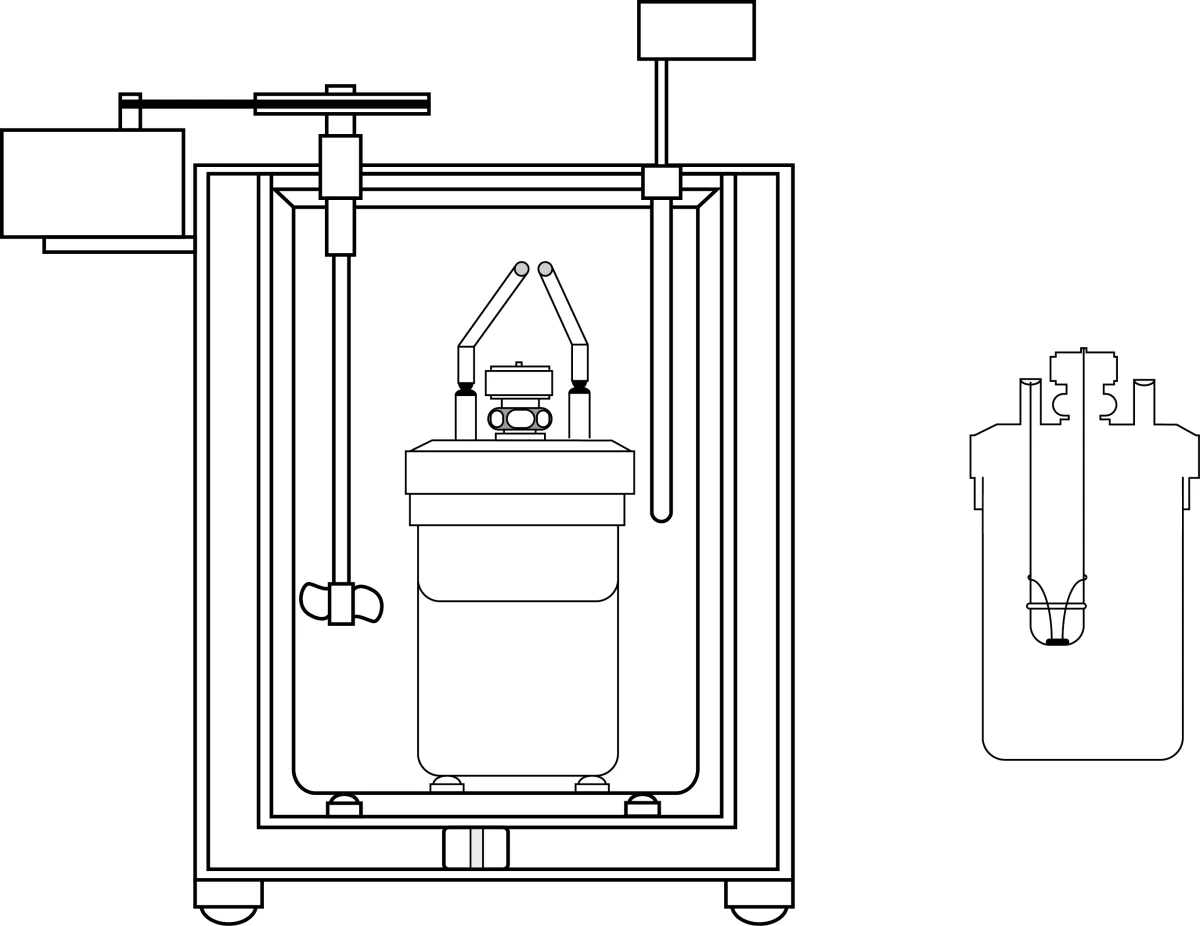
The bomb calorimeter is a sealed, rigid steel container (“the bomb”) immersed in a known mass of water. The sample is placed inside the bomb with excess oxygen and ignited electrically.
Key point: Because the volume cannot change, no PV work is done (w = 0). All energy goes into heat. At constant volume, q = ΔU (not ΔH).
The temperature of the surrounding water rises, and we calculate:
q = C(calorimeter) × ΔT
where C(calorimeter) is the total heat capacity of the calorimeter (including the water and the bomb itself), often given in the problem in units of kJ/C.
Coffee Cup vs. Bomb: Summary
| Feature | Coffee Cup | Bomb |
|---|---|---|
| Held constant | Pressure (open to atmosphere) | Volume (sealed rigid container) |
| Measures | ΔH (enthalpy change) | ΔU (internal energy change) |
| Formula | q = mcΔT | q = C(cal) × ΔT |
| Best for | Acid-base reactions, dissolving | Combustion reactions |
| Precision | Lower (heat loss through cup) | Higher (well-insulated) |
Assumptions in Calorimetry
For MCAT problems, you can usually assume:
- The calorimeter is perfectly insulated (no heat loss to the room)
- The solution has the density and specific heat of pure water [1 g/mL, 4.18 J/(g·C)]
- All heat from the reaction is absorbed by the solution (coffee cup) or by the calorimeter (bomb)
Worked Example
A student dissolves 5.0 g of NaOH (molar mass 40 g/mol) in 100 mL of water in a coffee cup calorimeter. The temperature rises from 22.0 C to 28.5 C. What is the molar enthalpy of dissolution?
- q(solution) = mcΔT = (100 g)(4.18 J/g·C)(6.5 C) = 2,717 J = 2.72 kJ
- q(rxn) = -q(solution) = -2.72 kJ (exothermic - temperature went up)
- Moles NaOH = 5.0 g / 40 g/mol = 0.125 mol
- ΔH = q(rxn) / moles = -2.72 kJ / 0.125 mol = -21.7 kJ/mol