Some reactions are impossible to measure directly. You cannot stick a thermometer into the formation of diamond from graphite because that reaction requires extreme pressure and takes geological time. But you CAN measure the combustion of graphite and the combustion of diamond separately. Hess’s law lets you combine those measurable reactions to calculate the enthalpy change for the unmeasurable one.
The Principle
The Three Manipulation Rules
When combining reactions to reach a target, you have three tools:
Rule 1 - Reverse: If you flip a reaction (swap products and reactants), change the sign of ΔH.
Forward: C(s) + O₂(g) → CO₂(g), ΔH = -393.5 kJ
Reverse: CO₂(g) → C(s) + O₂(g), ΔH = +393.5 kJ
Rule 2 - Multiply: If you multiply all coefficients by a factor n, multiply ΔH by the same factor.
Rule 3 - Add: Stack the manipulated reactions and add them. Species that appear on both sides cancel out (like algebra). Add the ΔH values.
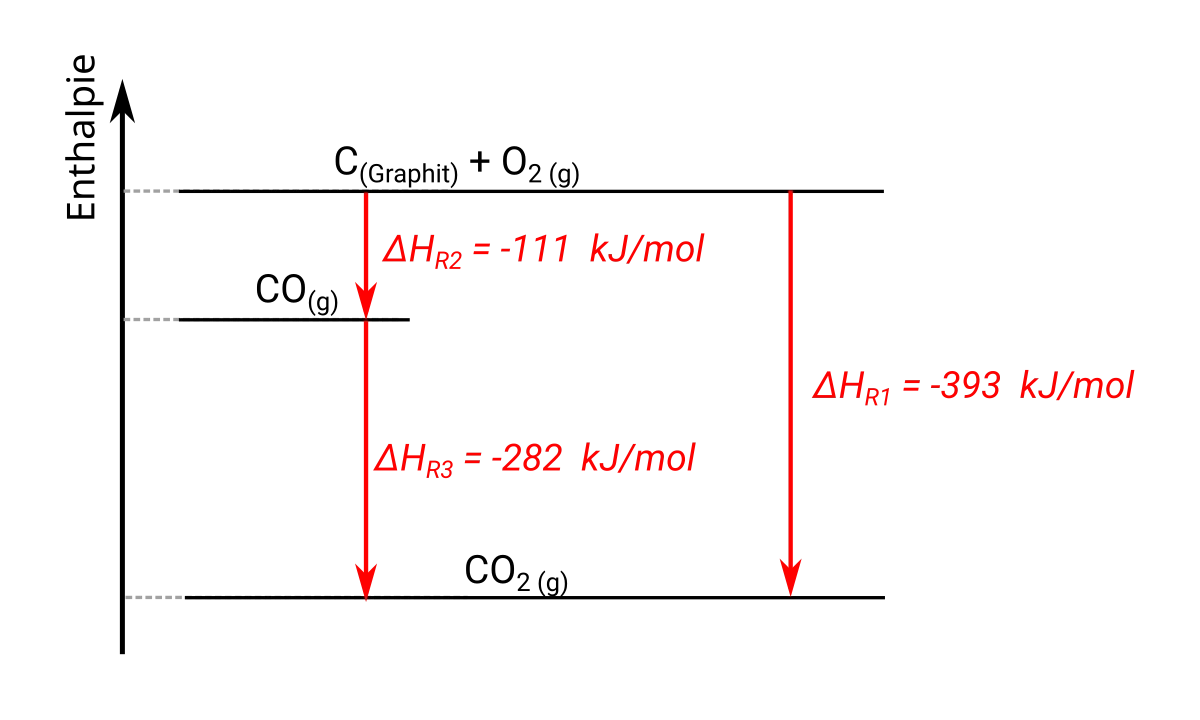
Hess's law illustrated with carbon combustion. Whether C goes directly to CO₂ (ΔH = -393 kJ/mol) or passes through CO as an intermediate (-111 + -282 = -393 kJ/mol), the total enthalpy change is identical. Credit: Wikimedia Commons, CC BY-SA 4.0
Worked Example
Target reaction: C(s) + O₂(g) → CO₂(g), ΔH = ?
Given:
C(s) + 21 O₂(g) → CO(g), ΔH₁ = -110.5 kJ
CO(g) + 21 O₂(g) → CO₂(g), ΔH₂ = -283.0 kJ
Solution: Both reactions are already in the correct direction. Add them:
Scan the given reactions - identify which ones contain your target reactants and products
Reverse or multiply reactions as needed so intermediates cancel
Add everything up, including the ΔH values
Verify: check that the final equation matches the target
If ΔH for a reaction is -150 kJ, what is ΔH for the same reaction run in reverse and with all coefficients tripled?
Click to reveal answer
ΔH = +450 kJ. Reversing the reaction flips the sign: +150 kJ. Tripling the coefficients multiplies ΔH by 3: 150 × 3 = +450 kJ. Apply both manipulations.
Why does Hess's law work? What underlying property of enthalpy makes it valid?
Click to reveal answer
Because enthalpy is a state function. State functions depend only on the initial and final states, not on the path taken. Therefore, the total enthalpy change is the same whether a reaction proceeds in one step or through multiple intermediate steps. You can add up any combination of steps that connect the same starting and ending points.