
Enthalpy (ΔH)
Every chemical reaction involves energy. Some reactions release energy and feel hot to the touch. Others absorb energy and feel cold. Enthalpy is the thermodynamic quantity that tracks this heat flow at constant pressure - which is how most reactions in your body and in the lab actually occur.
What Is Enthalpy?
Enthalpy (H) is defined as:
In practice, you almost never calculate H directly. Instead, you work with the change in enthalpy:
Δ = H(products) - H(reactants)
Exothermic vs. Endothermic
| Property | Exothermic | Endothermic |
|---|---|---|
| ΔH sign | Negative (ΔH < 0) | Positive (ΔH > 0) |
| Energy flow | System releases heat to surroundings | System absorbs heat from surroundings |
| Surroundings feel | Warmer | Cooler |
| Products vs. reactants | Products at LOWER energy | Products at HIGHER energy |
| Example | Combustion of methane | Photosynthesis |
Enthalpy Diagrams
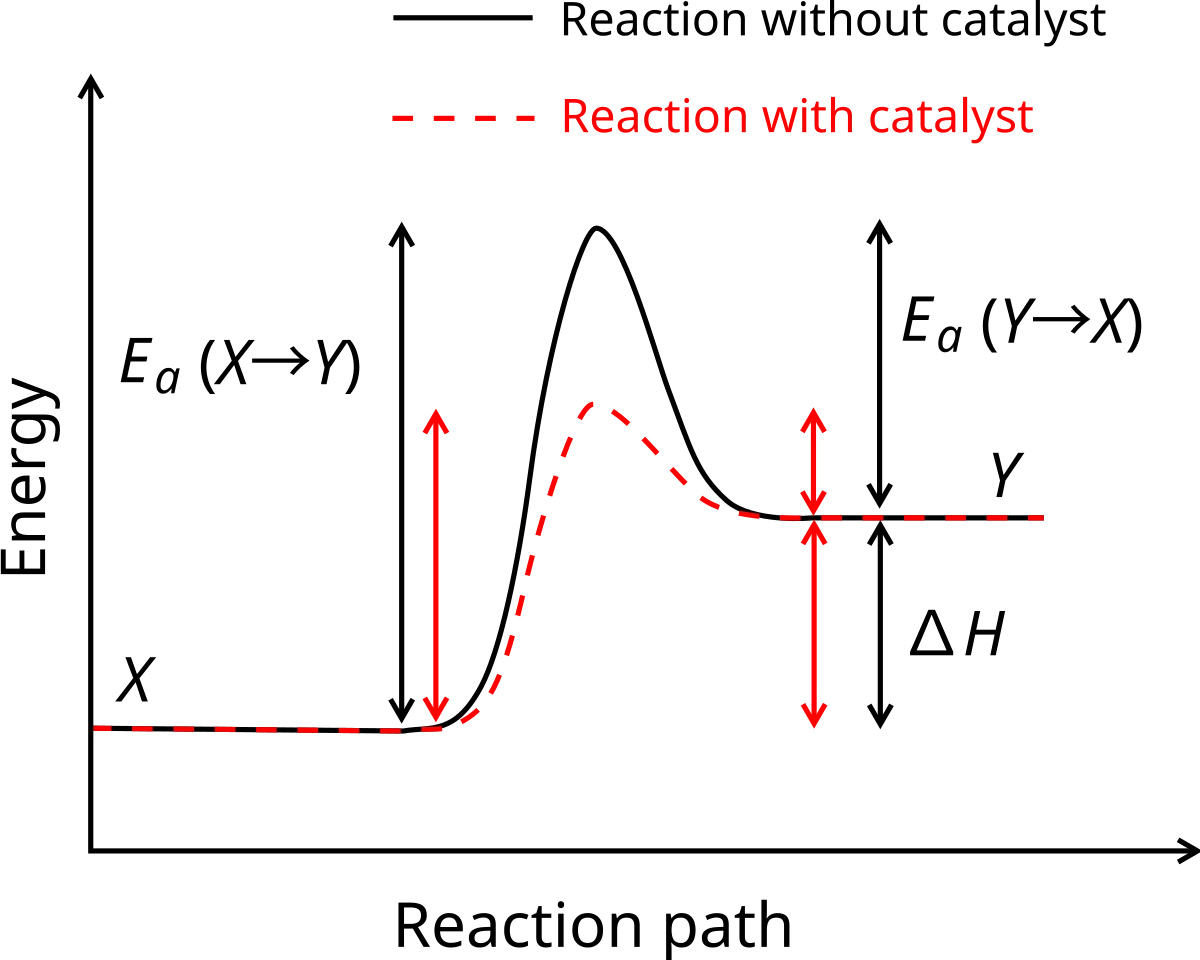
An enthalpy diagram places reactants and products on a vertical energy axis. For an exothermic reaction, the products sit lower than the reactants - energy was released going “downhill.” For an endothermic reaction, the products sit higher - energy was absorbed going “uphill.”
The vertical distance between reactants and products is |ΔH|. The direction tells you the sign.
Enthalpy and the PV Term
The full definition H = U + PV includes a pressure-volume term. For reactions involving only solids and liquids, volume changes are tiny, so ΔH is almost equal to ΔU. But for reactions involving gases, the PV term matters because gases expand or compress significantly.
For an ideal gas at constant temperature: PV = nRT
So ΔH = ΔU + Δ(nRT) = ΔU + ΔnRT
where Δn = moles of gaseous products - moles of gaseous reactants. If a reaction produces more moles of gas than it consumes (Δn > 0), ΔH > ΔU. If it produces fewer moles of gas (Δn < 0), ΔH < ΔU.
Reversibility of Enthalpy
Because enthalpy is a state function, the enthalpy change for the reverse reaction has the same magnitude but opposite sign:
- Forward: H₂(g) + O₂(g) → H₂O(l), ΔH = -285.8 kJ
- Reverse: H₂O(l) → H₂(g) + O₂(g), ΔH = +285.8 kJ
If it costs 285.8 kJ to decompose water, then forming water releases exactly 285.8 kJ. This principle is essential for Hess’s law calculations.
Stoichiometry and Enthalpy
ΔH values are reported per mole of reaction as written. If you double all the coefficients, you double ΔH:
- H₂(g) + O₂(g) → H₂O(l), ΔH = -285.8 kJ
- 2 H₂(g) + O₂(g) → 2 H₂O(l), ΔH = -571.6 kJ
Always check the stoichiometry when using ΔH values in calculations.