
Pi Bonds
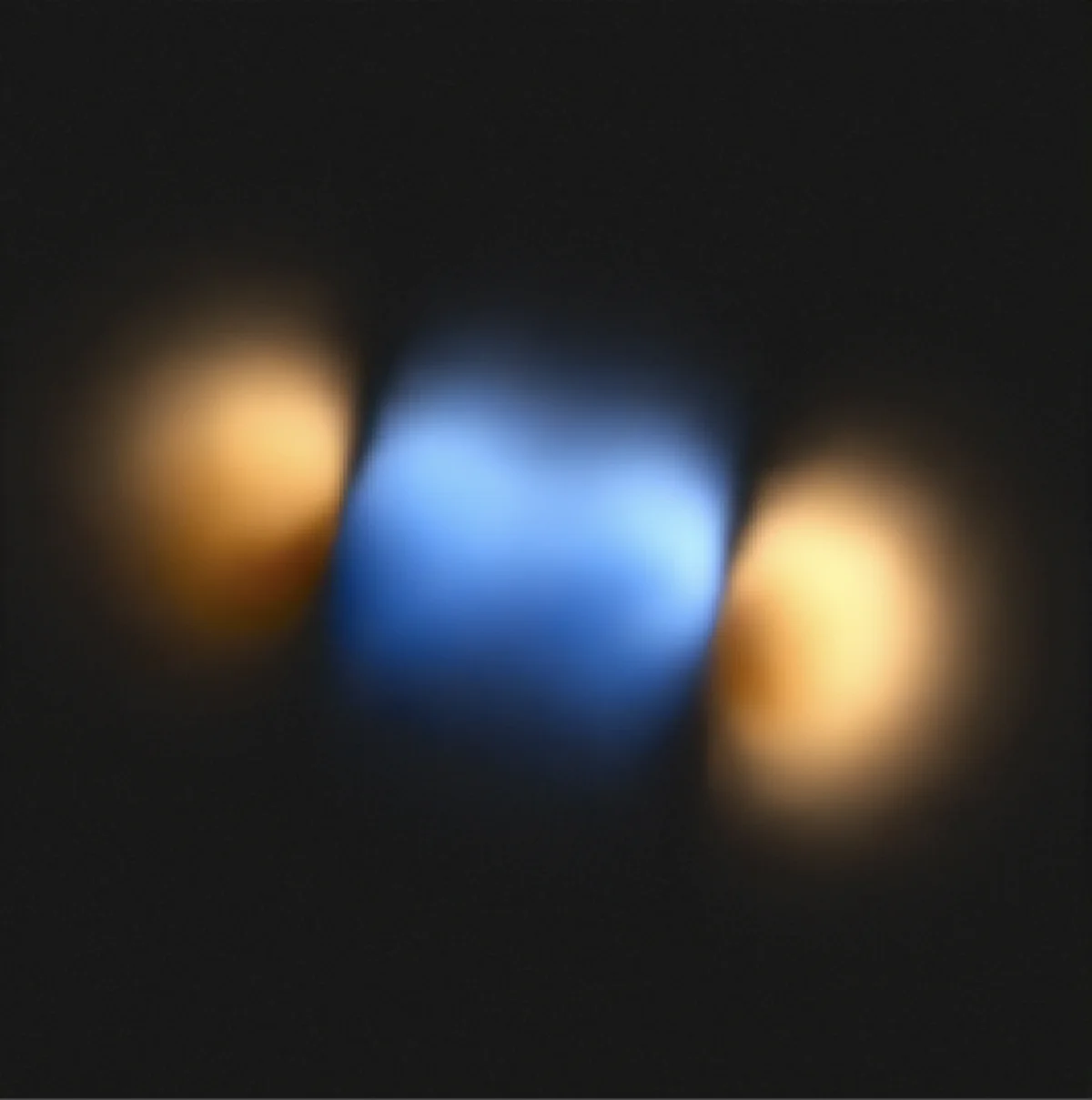
You have already seen that sigma bonds form through head-on overlap - like a handshake. Pi bonds form differently. Two p orbitals on adjacent atoms align parallel to each other and overlap side-by-side, above and below the bond axis. The electron density does not sit between the nuclei like in a sigma bond. Instead, it forms two lobes - one above the plane and one below.
How Pi Bonds Form
A pi bond requires two unhybridized p orbitals on adjacent atoms that are parallel to each other. These p orbitals overlap laterally - their lobes are side by side, not pointing at each other.
The electron density in a pi bond sits in two regions: one above and one below the plane defined by the sigma bond framework. There is a nodal plane right along the bond axis where the pi electron density is exactly zero. This is fundamentally different from a sigma bond, where the highest electron density is right along the axis.
Pi Bonds in Double and Triple Bonds
Pi bonds never exist alone. They are always layered on top of a sigma bond. This is because sigma bonds form first (they are lower energy and more stable), and pi bonds add on:
- Single bond (e.g., C-C): 1 sigma, 0 pi
- Double bond (e.g., C=C): 1 sigma + 1 pi
- Triple bond (e.g., C triple bond C): 1 sigma + 2 pi
In a double bond, the sigma bond forms from head-on overlap of hybrid orbitals (sp2-sp2 for a C=C bond). The pi bond forms from side-by-side overlap of the unhybridized p orbitals that remain after hybridization.
In a triple bond, the sigma bond forms from sp-sp overlap. The two pi bonds form from the two remaining unhybridized p orbitals on each carbon, oriented perpendicular to each other. One pi bond is in the horizontal plane, the other in the vertical plane.
Properties of Pi Bonds
1. They are weaker than sigma bonds. Side-by-side overlap is less effective than head-on overlap because the orbitals do not point directly at each other. The pi bond in ethene has a bond energy of about 264 kJ/mol, compared to about 347 kJ/mol for a typical C-C sigma bond.
However, the total bond energy of a double bond (one sigma + one pi) is greater than a single bond (one sigma only). The C=C double bond has a total dissociation energy of about 614 kJ/mol.
2. They restrict rotation. This is the most important consequence of pi bonds in organic chemistry. To rotate around a double bond, you would have to break the pi bond by twisting the p orbitals out of alignment. That costs about 264 kJ/mol - far too much energy at room temperature.
This restricted rotation is why cis/trans (E/Z) isomerism exists around double bonds. The two sides of a double bond are locked in place. Groups on the same side (cis/Z) cannot flip to the other side (trans/E) without breaking the pi bond.
3. They have a nodal plane. The sigma bond framework defines a plane, and the pi electron density sits above and below this plane. There is zero electron density right at the plane. This matters because electrophiles attack the pi electron cloud from above or below, not from the side.
Recognizing Pi Bonds in Structures
Any time you see a double bond line (=) or triple bond line, pi bonds are present. But pi bonds also appear in less obvious places:
- Aromatic rings: Benzene has three pi bonds (though they are delocalized)
- Carbonyl groups (C=O): One sigma + one pi between carbon and oxygen
- Carboxylate ions (COO-): Pi electrons delocalized over both C-O bonds
- Amide bonds: Partial pi bond character in the C-N bond due to resonance
Pi Bonds and Planarity
Atoms connected by a pi bond and all atoms directly attached to them must lie in the same plane. This is because the p orbitals forming the pi bond must be parallel, and parallel p orbitals require a planar arrangement.
For ethene (H2C=CH2), all six atoms (two carbons and four hydrogens) are coplanar. The molecule is flat.
For molecules with extended pi systems (conjugation), the planar requirement extends across the entire conjugated region. This planarity has major consequences for molecular shape, especially in aromatic compounds and in biological molecules like the peptide bond.
Counting Pi Bonds - Quick Practice
| Molecule | Structure | Pi bonds |
|---|---|---|
| Ethane | CH3-CH3 | 0 |
| Ethene | CH2=CH2 | 1 |
| Ethyne | CH is triple bond CH | 2 |
| Benzene | C6H6 (ring with alternating double bonds) | 3 |
| Acetone | CH3-CO-CH3 | 1 (in C=O) |
| Carbon dioxide | O=C=O | 2 |
| Acetic acid | CH3-COOH | 1 (in C=O) |