
Amino Acids
Amino acids are the building blocks of proteins. Each has an alpha-carbon with four attachments: a hydrogen, an amine group (-NH₂), a carboxylic acid (-COOH), and a variable side chain (-R). At physiological pH, the amine is protonated and the carboxylic acid is deprotonated, giving the characteristic zwitterionic form.
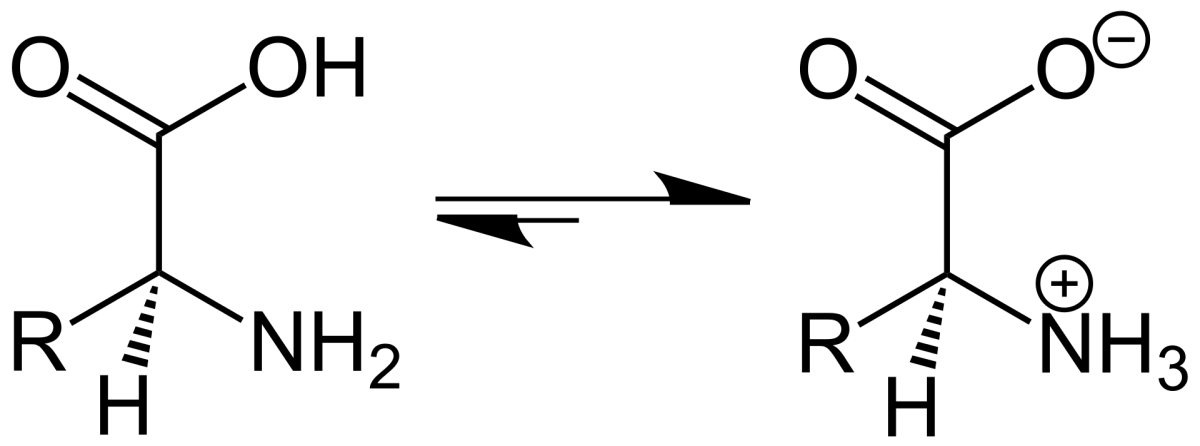
General Structure
H₂N-CHR-COOH (neutral form, theoretical)
⁺H₃N-CHR-COO⁻ (zwitterion, actual form at pH 7.4)
The alpha-carbon is chiral (except in glycine, where R = H). All 20 proteinogenic amino acids in proteins are in the L configuration (S absolute configuration for all except cysteine, where the CIP priority of the sulfur flips the label to R).
Key pKa Values
Simple (non-ionizable side chain) amino acid:
- alpha-COOH: pKa ~2 (lowered from 4-5 by the adjacent protonated amine’s inductive pull).
- alpha-NH₃⁺: pKa ~9 (lowered from ~10 of a simple amine by the adjacent negative carboxylate’s inductive pull).
At pH 7.4, both groups are fully ionized (COOH deprotonated, NH₃ protonated) → zwitterion.
Isoelectric Point (pI)
The isoelectric point is the pH at which the amino acid has net zero charge on average. For simple amino acids:
pI = (pKa₁ + pKa₂) / 2
For glycine: pI = (2.35 + 9.78) / 2 = 6.06.
For amino acids with ionizable side chains (e.g., lysine, aspartate), pI is calculated by averaging the two pKa values bracketing the zwitterionic form.
Titration Curve
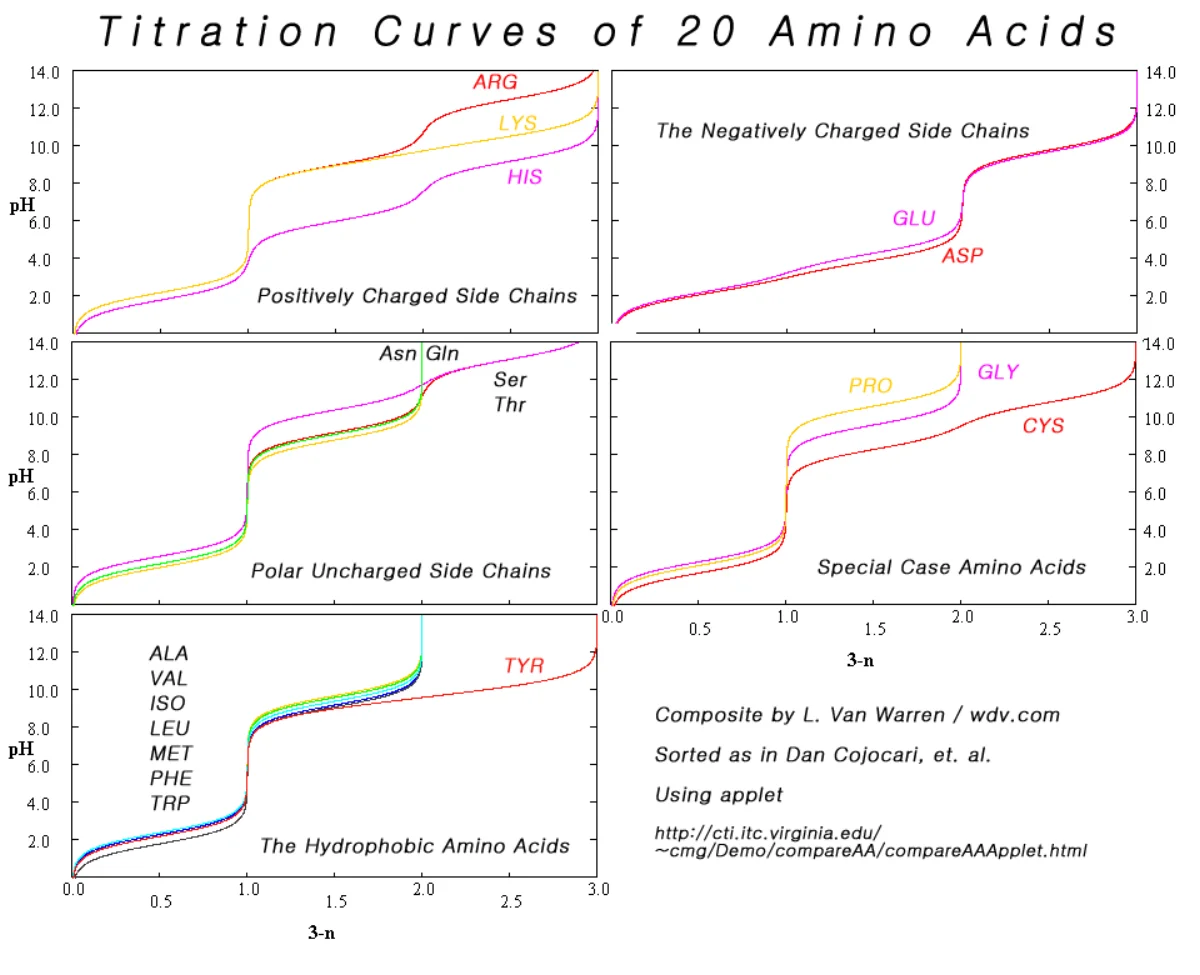
A plot of pH vs. equivalents of base added shows three regions:
- Below pKa₁ (~2): COOH is protonated; molecule is NH₃⁺-COOH (net +1 charge).
- Between pKa₁ and pKa₂: zwitterion dominates (NH₃⁺-COO⁻, net zero).
- Above pKa₂ (~9): NH₂ is deprotonated; molecule is NH₂-COO⁻ (net -1 charge).
Each pKa corresponds to an inflection point on the titration curve, and the midpoint between them is the pI.
Strecker Synthesis of Amino Acids
Starting materials: an aldehyde, NH₃, and HCN.
- Aldehyde + NH₃ → imine (R-CH=NH).
- Imine + HCN → aminonitrile (R-CH(NH₂)-CN).
- Acid hydrolysis of nitrile → carboxylic acid: R-CH(NH₂)-COOH.
Net: RCHO + NH₃ + HCN + H₂O (acid) → alpha-amino acid.
Named after the 19th-century chemist Adolph Strecker. On the AAMC content outline.

Gabriel Synthesis of Primary Amines (and by extension, amino acids)
Problem with direct alkylation of ammonia: over-alkylation (product mixture of 1°, 2°, 3° amines). Gabriel synthesis solves this using potassium phthalimide.
- Potassium phthalimide (a “masked” ammonia where the nitrogen is flanked by two carbonyls, preventing further alkylation) + R-X → N-alkyl phthalimide.
- Hydrolysis with hydrazine (N₂H₄) or strong acid/base → primary amine + phthalhydrazide (or phthalic acid).
For amino acid synthesis: use an alkyl halide with a pre-installed -COOH (like diethyl alpha-bromomalonate). Phthalimide displaces Br, giving an N-alkyl phthalimide with the ester. Hydrolysis gives the amino acid with clean 1° amine.
D and L Amino Acids
Naturally occurring amino acids are almost exclusively L-amino acids (S configuration at alpha-C for 19 of 20; R for cysteine). D-amino acids appear in bacterial cell walls (peptidoglycan) and a few natural products.
The strict L-selectivity of biology is enforced by aminoacyl-tRNA synthetases, which only accept L-amino acids for protein synthesis. Racemized (D) amino acids cannot be incorporated into standard proteins.