
Nitrogen Heterocycles
Nitrogen heterocycles are aromatic rings containing one or more nitrogens. They appear everywhere in biology - DNA/RNA bases, amino acid side chains (histidine’s imidazole, tryptophan’s indole), and alkaloid natural products. Understanding aromaticity in these systems requires knowing where each nitrogen’s lone pair lives.
Pyrrole (5-Membered Ring, 1 N)
Structure: 5-membered aromatic ring with one nitrogen (N-H at the ring position).
Key fact: the nitrogen’s lone pair is IN the aromatic pi system. It contributes 2 of the 6 pi electrons needed for Huckel’s 4n+2 rule (n=1).
Consequences:
- Pyrrole IS aromatic.
- The N-H proton is relatively acidic (pKa ~17) - hydrogen bond donor.
- Pyrrole nitrogen is NOT basic (protonating the nitrogen would remove the lone pair from the pi system, breaking aromaticity).
- Pyrrole is weakly basic at C2 (electrophilic attack on the ring protonates a ring carbon, which is better than disrupting aromaticity).
Pyrrole units appear in heme (hemoglobin’s oxygen-binding cofactor), chlorophyll, and vitamin B12.
Pyridine (6-Membered Ring, 1 N)
Structure: 6-membered aromatic ring with one nitrogen. No N-H.
Key fact: the nitrogen’s lone pair is NOT in the pi system. It sits in an sp² hybrid orbital in the plane of the ring.
Consequences:
- Pyridine IS aromatic (6 pi electrons come from the 3 C=C of the ring, plus the N contributes one p electron to the ring).
- The sp² lone pair on N is available for protonation.
- Pyridine is a modest base (conjugate acid pKa ~5.2).
- Commonly used as a base in organic synthesis (to soak up HCl in acylation reactions).
Imidazole (5-Membered Ring, 2 N)
Structure: 5-membered aromatic ring with 2 nitrogens. One has an H (pyrrole-like), the other does not (pyridine-like).
- Pyrrole-like N-H: lone pair is in the pi system (aromatic). N-H is acidic (pKa ~14.5).
- Pyridine-like N: sp² lone pair available. Basic (conjugate acid pKa ~7.0).
Imidazole’s pKa ~7.0 makes it the only basic nitrogen heterocycle in this set with pKa near physiological pH. Histidine’s side chain has an imidazole ring, which is why histidine can serve as both acid and base in enzyme active sites (at pH 7, ~50% protonated, ~50% deprotonated - instantly responsive to pH changes).
Purines and Pyrimidines (DNA/RNA Bases)
DNA and RNA bases are nitrogen heterocycles:
- Pyrimidines (6-membered, 2 N): cytosine (C), thymine (T, in DNA only), uracil (U, in RNA only).
- Purines (fused 6+5 ring, 4 N): adenine (A), guanine (G).
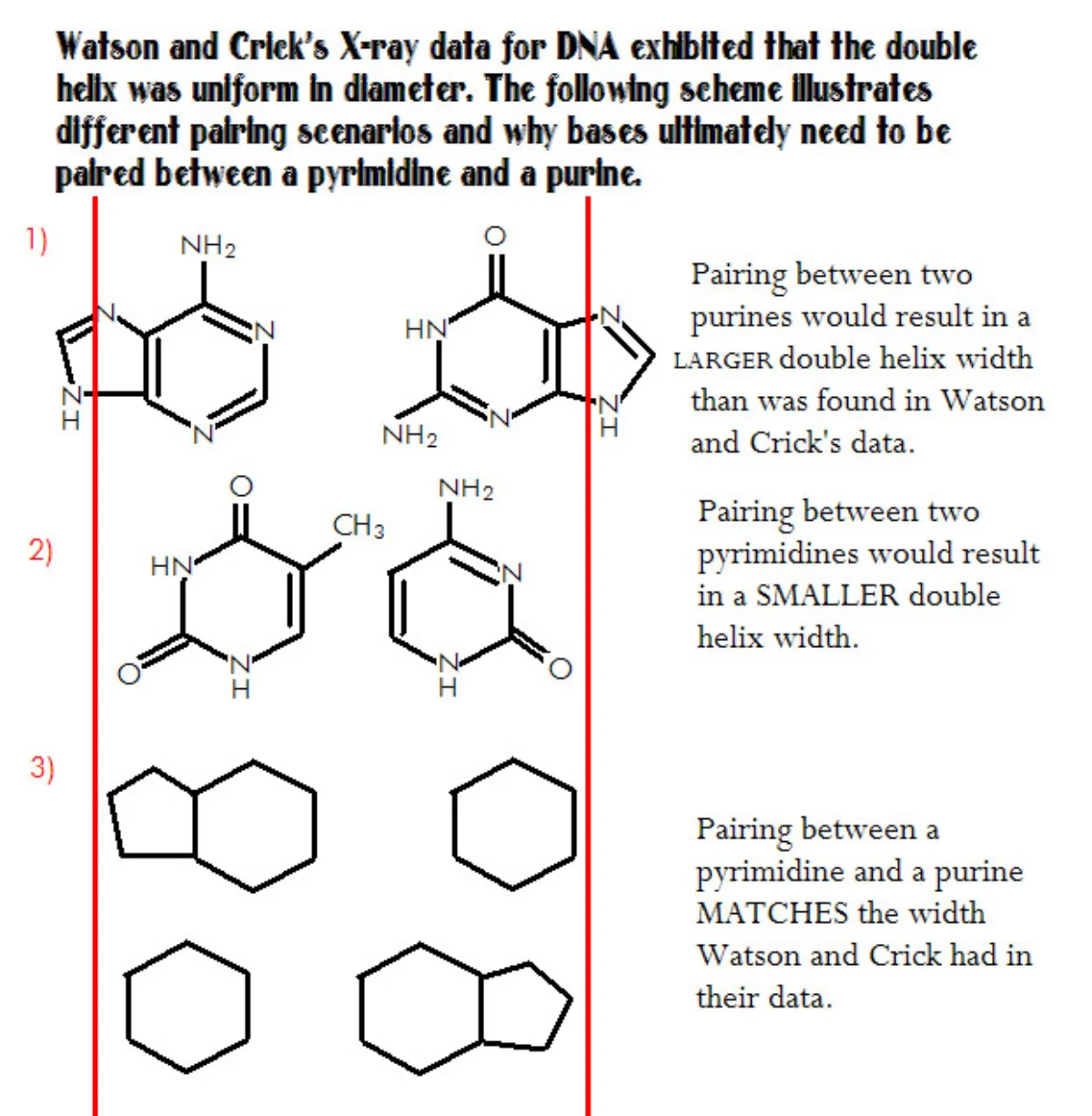
These bases do hydrogen bonding: A pairs with T (or U in RNA) via 2 H-bonds; G pairs with C via 3 H-bonds. The specificity of base pairing is the chemical basis of the genetic code.
The bases are connected to sugar (ribose or deoxyribose) via a glycosidic bond at the N1 of pyrimidines or N9 of purines, producing nucleosides. Adding phosphate gives nucleotides (ATP, GTP, dNTPs, etc.).
Indole and Tryptophan
Indole is a bicyclic aromatic system (benzene fused with pyrrole). It appears as the side chain of tryptophan, the largest amino acid. Indole absorbs UV strongly at 280 nm, which is the basis of protein quantification by UV absorbance (tryptophan dominates the 280 nm protein absorbance).
Indole nitrogen, like pyrrole N, has its lone pair in the pi system - not basic.
Imidazolium in Histidine Catalysis
In the serine protease active site (trypsin, chymotrypsin), histidine’s imidazole acts as a general base to deprotonate serine’s -OH, making it a better nucleophile for attacking the substrate’s peptide bond. The imidazolium then donates the proton back at a different point in the mechanism, regenerating neutral imidazole. This “proton shuttle” is one of the most elegant acid-base roles in enzyme catalysis.