
ATP
Adenosine triphosphate (ATP) is the universal energy currency of the cell. Its hydrolysis to ADP + Pi releases about 7.3 kcal/mol under standard conditions - enough to drive almost every energy-requiring reaction in the cell when coupled properly.
Click Hydrolyze below to cleave the γ-phosphate: the terminal phosphate separates, the energy burst fires, and you are left with ADP + Pᵢ.
ATP hydrolysis
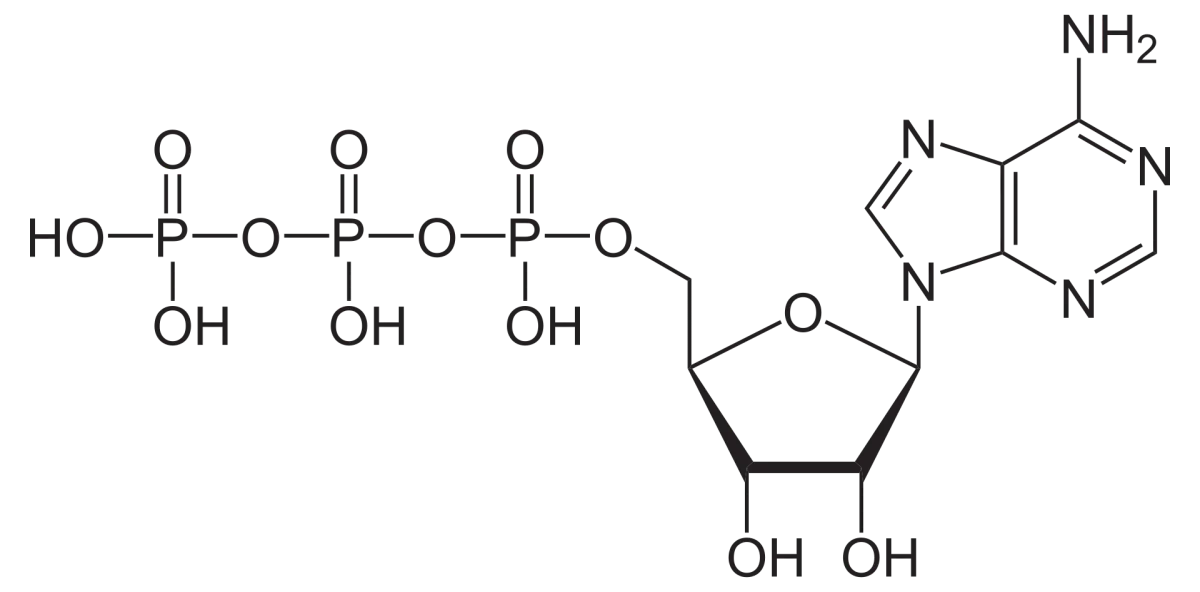
Structural Components
ATP has three components:
- Adenine: the purine base (nitrogen heterocycle with a fused 6+5 ring system).
- Ribose: a 5-carbon sugar with hydroxyls at 2’, 3’, and 5’ positions.
- Three phosphates: connected in a row to the 5’ position of ribose.
Adenosine = adenine + ribose (a nucleoside). Adding one, two, or three phosphates gives AMP, ADP, or ATP (nucleotides).
The Two Types of Bonds
Phosphoester bond: ribose-phosphate. One P-O-C bond. Low-energy (ΔG hydrolysis ~3 kcal/mol). This is the bond connecting the ribose’s 5’-oxygen to the first phosphate (alpha-phosphate).
Phosphoanhydride bond: phosphate-phosphate. Two phosphates sharing an oxygen via P-O-P. HIGH-energy (ΔG hydrolysis ~7.3 kcal/mol). ATP has TWO phosphoanhydride bonds: alpha-beta and beta-gamma.
Why Phosphoanhydride Bonds Are High-Energy
Three reasons ATP hydrolysis (breaking a phosphoanhydride) is exergonic:
-
Electrostatic repulsion. The three phosphate groups of ATP each carry negative charges at physiological pH (ATP has about -4 net charge). These charges repel each other. Hydrolysis releases them from proximity, relieving electrostatic strain.
-
Resonance stabilization of products. After hydrolysis, the released Pi (HPO₄²⁻ or H₂PO₄⁻) is more resonance-stabilized (charge on 4 O) than it was in the ATP (where it was constrained to one P-O-P linkage). The products are more stable than the reactant.
-
Hydration stabilization. Pi is easier to solvate in water than it was when locked in ATP.
Note: “high-energy bond” does not mean the bond itself is strong - it is actually moderately weak. What makes the bond high-energy is the thermodynamic difference between ATP and ADP+Pi products.
ATP Hydrolysis Reactions
Three main reactions:
- ATP → ADP + Pi: terminal (gamma) phosphoanhydride hydrolysis. ~7.3 kcal/mol released. Most common use.
- ATP → AMP + PPi (pyrophosphate): alpha-beta phosphoanhydride hydrolysis. The released PPi is often further hydrolyzed to 2 Pi (another 7.3 kcal/mol), making the overall ATP → AMP + 2 Pi reaction very exergonic (~19 kcal/mol combined).
- ATP → AMP + Pi + Pi: both phosphoanhydride bonds broken.
Reaction 2 is used for highly unfavorable syntheses (amino acid activation for tRNA loading, fatty acid activation for CoA thioester synthesis). Breaking pyrophosphate provides the extra thermodynamic push.
ATP Synthesis
ATP is synthesized from ADP + Pi by:
- Oxidative phosphorylation: ATP synthase, driven by the electrochemical gradient across the inner mitochondrial membrane.
- Substrate-level phosphorylation: direct phosphate transfer from a high-energy substrate (like phosphoenolpyruvate or 1,3-bisphosphoglycerate in glycolysis).
The cell continuously cycles between ATP and ADP, with steady-state ATP concentrations around 3 mM.
Other Nucleotide Triphosphates
Other NTPs have similar energy profiles:
- GTP: used in protein synthesis (ribosome) and signal transduction (G-proteins).
- UTP: activated sugars for polysaccharide synthesis.
- CTP: phospholipid synthesis (CDP-choline intermediate).
- dATP, dTTP, dGTP, dCTP: DNA synthesis.
All have similar high-energy phosphoanhydride bonds.
Phosphoanhydride bonds (high energy): the two P-O-P linkages between alpha-beta phosphates and between beta-gamma phosphates. These are broken in ATP hydrolysis to release ~7.3 kcal/mol each. Phosphoester bond (low energy): the C-O-P linkage connecting ribose’s 5’-O to the alpha-phosphate. This bond is much more stable. Students sometimes confuse these; the MCAT explicitly tests the distinction.