
Binding Energy & Mass Defect
Here’s a strange fact: weigh two protons and two neutrons separately. Now weigh the helium-4 nucleus they form. The nucleus weighs less than the sum of its parts.
Where did the missing mass go? It was converted into the energy that glues the nucleus together. This “missing mass” is called the mass defect, and the energy it represents — via Einstein’s — is the nuclear binding energy.
This single phenomenon is the reason nuclear reactions release millions of times more energy than chemical reactions, and it’s why atomic bombs and nuclear reactors exist.
Mass Defect
The mass defect (Δm) is the difference between the mass of the individual nucleons and the actual mass of the assembled nucleus:
E = mc
Einstein’s famous equation connects the mass defect to binding energy:
A useful conversion: 1 amu of mass corresponds to 931.5 MeV of energy. This allows you to skip the calculation entirely - just multiply the mass defect in amu by 931.5 to get the binding energy in MeV.
Example
Helium-4 has a mass defect of about 0.0304 amu. Its binding energy is:
E = 0.0304 x 931.5 MeV/amu = 28.3 MeV
This means you would need to supply 28.3 MeV to completely disassemble a helium-4 nucleus into two free protons and two free neutrons.
Binding Energy per Nucleon
The total binding energy tells you how much energy holds the entire nucleus together, but to compare the stability of different nuclei, we need the binding energy per nucleon (BE/A). This is simply the total binding energy divided by the number of nucleons.
The Binding Energy per Nucleon Curve
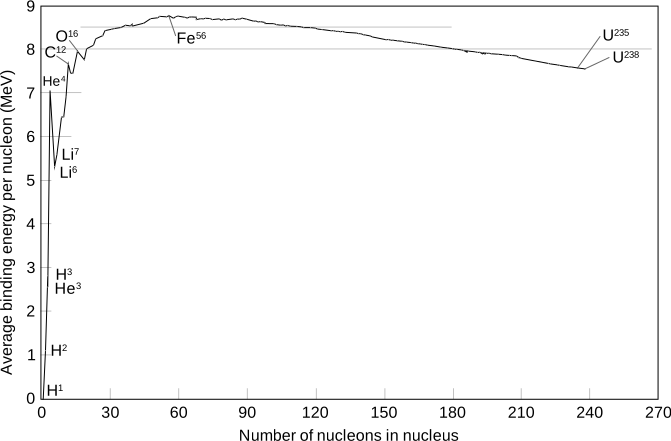
If you plot binding energy per nucleon (y-axis) against mass number A (x-axis), you get a curve that rises steeply for light nuclei, peaks at iron-56, and then gradually decreases for heavy nuclei.
This curve is the single most important diagram in nuclear physics for the MCAT. It explains everything:
- Light nuclei (left of iron): have relatively low BE/A. Combining them (fusion) moves up the curve toward iron, releasing energy.
- Heavy nuclei (right of iron): also have lower BE/A than iron. Splitting them (fission) moves toward iron from the other direction, also releasing energy.
- Iron-56 sits at the peak: it is the most tightly bound nucleus. You cannot extract energy by either fusing or splitting iron.
Why Nuclear Reactions Release So Much Energy
Chemical reactions involve rearranging electrons and breaking/forming chemical bonds, with energies on the order of a few eV per reaction. Nuclear reactions involve rearranging nucleons and tapping into the mass defect, with energies on the order of MeV per reaction - roughly a million times more energy per event.
This enormous energy difference is why a small amount of nuclear fuel can power a city, while burning the same mass of coal would barely heat a building.