
Mass Spectrometer
Imagine you’re sorting coins by weight, but you can’t touch them. Instead, you roll them down a ramp (giving them all the same kinetic energy), then blow a fan across their path as they fly out. The heavier coins resist the wind and fly farther before curving; the lighter coins curve sharply. By measuring where each coin lands, you know its mass.
A mass spectrometer does essentially the same thing — except the “coins” are ions, the “ramp” is an electric field, and the “fan” is a magnetic field. The device is one of the most important tools in chemistry, biochemistry, forensics, and pharmaceutical research. Watson and Crick used mass spectrometry data (among other things) when figuring out DNA’s structure; modern proteomics and drug-testing labs depend on it every day.
How a Mass Spectrometer Works
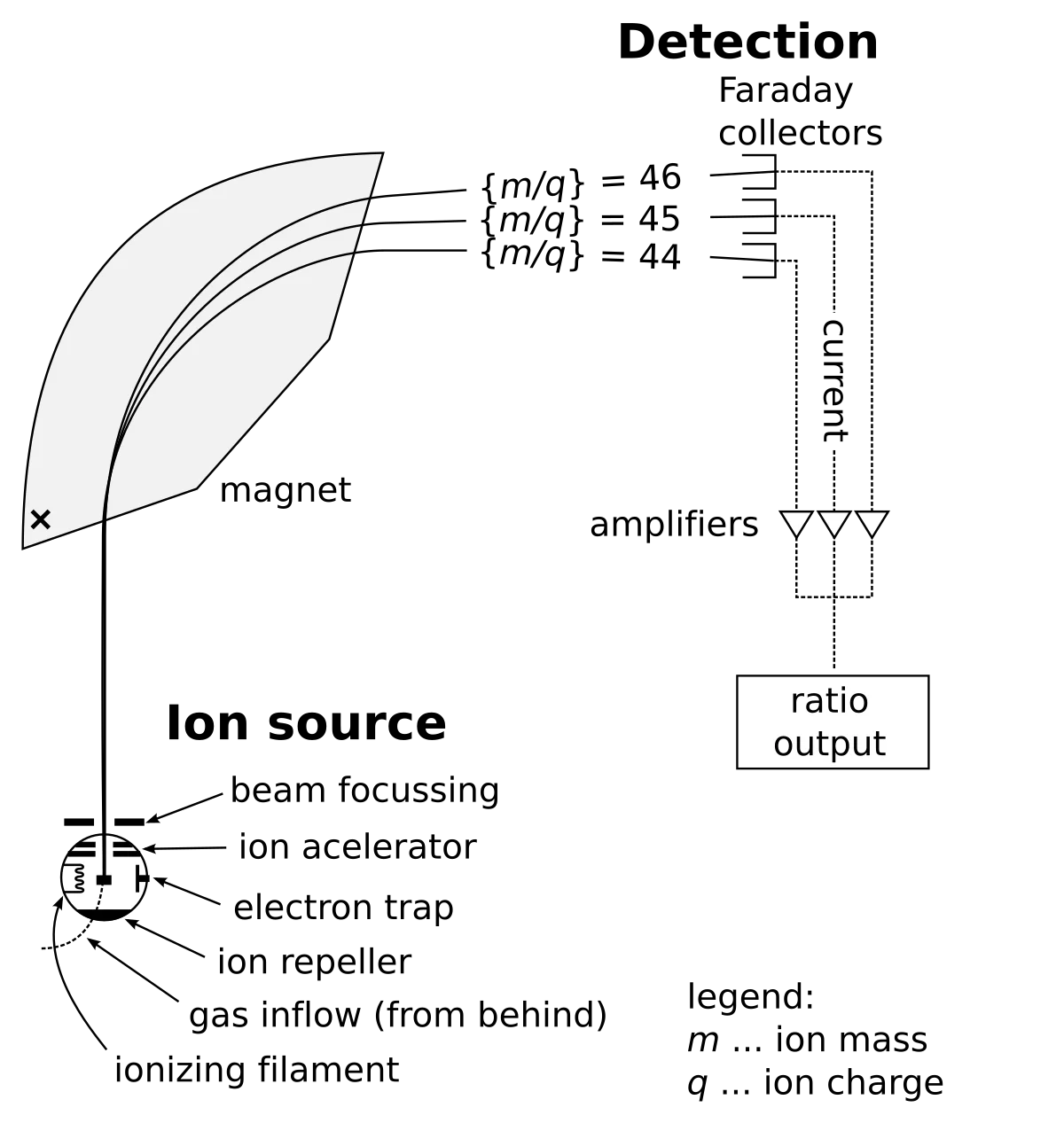
A mass spectrometer separates ions by their mass-to-charge ratio (m/q). The process has four stages:
1. Ionization
The sample is ionized - atoms or molecules are stripped of one or more electrons (or, less commonly, gain electrons) to become charged. Common methods include electron bombardment and electrospray ionization. The result is a beam of ions with charge q.
2. Acceleration
The ions pass through a potential difference (voltage V), which accelerates them. The kinetic energy gained equals the work done by the electric field:
All ions with the same charge gain the same kinetic energy, but lighter ions end up moving faster than heavier ions.
3. Deflection
The ions enter a uniform magnetic field (B) directed perpendicular to their velocity. The magnetic force provides centripetal acceleration, bending the ions into a circular path:
Solving for the radius:
4. Detection
A detector (photographic plate or electronic detector) records where each ion strikes. Ions with different m/q values land at different positions, separated by their radius of curvature.
Velocity Selector (Optional Stage)
Some mass spectrometers include a velocity selector before the magnetic deflection stage. A velocity selector uses crossed electric and magnetic fields. Only ions with a specific velocity pass through undeflected:
where E is the electric field strength and B is the magnetic field strength. All other ions are deflected into the walls. This ensures that all ions entering the magnetic deflection region have the same speed, simplifying the analysis.
Deriving m/q
Combining the acceleration and deflection equations (for a mass spectrometer with a velocity selector where all ions have speed ):
From deflection:
Rearranging:
Without a velocity selector, combining with :
You do not need to memorize these combined equations, but you should be able to derive them by combining the two base formulas.
Applications
- Isotope identification: separating isotopes of the same element (same Z, different A) based on mass differences.
- Molecular weight determination: identifying unknown compounds by their molecular mass.
- Forensic and environmental analysis: detecting trace amounts of specific substances.
- Pharmaceutical development: confirming drug purity and structure.