
The Bohr Model
Picture a ladder. You can stand on the first rung, the second rung, or the third — but you can’t hover between rungs. Electrons in an atom work the same way: they can only exist at specific, fixed energy levels. They can jump between levels, but they can’t sit in between.
This is the core idea behind the Bohr model, and it explains one of the most surprising facts in chemistry: atoms emit and absorb light in specific colors (discrete spectral lines), not a continuous rainbow. The colors of fireworks, the orange of a sodium street lamp, the unique fingerprint of every element on a spectrometer — all come from this one quantization rule.
Quantized Energy Levels
In 1913, Niels Bohr proposed that electrons in hydrogen orbit the nucleus only at certain allowed radii, each corresponding to a specific energy. These orbits are labeled by the principal quantum number n, where n = 1, 2, 3, and so on.
Key values to know:
| n | Energy (eV) |
|---|---|
| 1 | -13.6 |
| 2 | -3.4 |
| 3 | -1.51 |
| 4 | -0.85 |
| infinity | 0 (free) |
The ground state (n = 1) is the lowest energy level and the most stable. Any level above n = 1 is an excited state. The ionization energy of hydrogen - the energy needed to completely remove the electron from the ground state - is 13.6 eV.
Electron Transitions
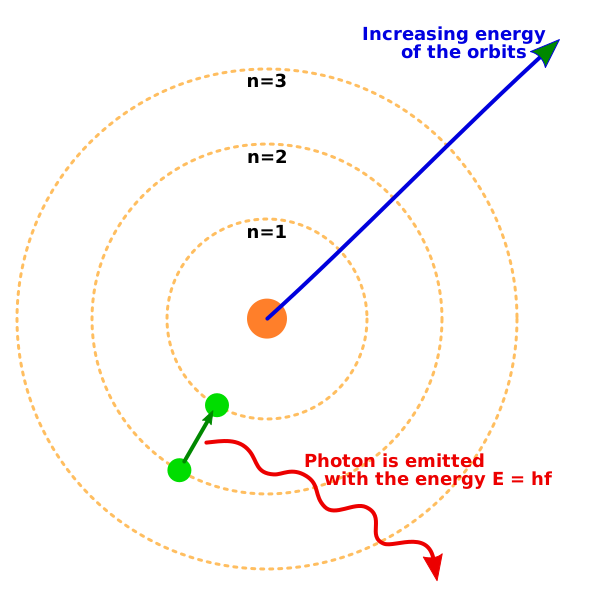
An electron can jump between energy levels by absorbing or emitting a photon whose energy exactly matches the difference between the two levels.
- Absorption: an electron absorbs a photon and jumps to a higher level ( to ).
- Emission: an electron drops to a lower level and emits a photon ( to ).
Example Calculation
What wavelength photon is emitted when a hydrogen electron drops from n = 3 to n = 2?
Energy difference: | - | = |-1.51 - (-3.4)| = 1.89 eV
Convert to joules: 1.89 eV x 1.6 x J/eV = 3.02 x J
Wavelength: λ = hc / E = (6.63 x )(3 x ) / (3.02 x ) = 6.59 m = 659 nm
This is red light - part of the Balmer series (visible range), which we will explore in the next section.
The Heisenberg Uncertainty Principle
The Bohr model imagines electrons in neat circular orbits, but quantum mechanics tells us we cannot actually pin down an electron’s exact position and momentum at the same time.
This is not about imperfect instruments. It is a fundamental limit built into nature. An electron does not have a precise position and momentum simultaneously - it exists as a probability cloud around the nucleus.
For the MCAT, you need to understand the uncertainty principle conceptually. You will not be asked to perform calculations with it, but you should recognize that it explains why the Bohr model’s neat circular orbits are an oversimplification. Real electrons are better described by probability distributions (orbitals), which you studied in General Chemistry.