
The Photoelectric Effect
Imagine trying to knock a coconut out of a tree. Throw a hundred ping-pong balls at it: nothing happens. Each one is too light to dislodge the coconut, no matter how many you throw. Now throw a single baseball hard enough — it knocks the coconut right down.
The photoelectric effect works the same way. Shining dim ultraviolet light on a metal can eject electrons. But flooding the metal with bright red light does nothing — because each red photon carries too little energy, and you cannot combine photon energies. This single result was so weird that it didn’t fit classical wave theory of light, and Einstein’s 1905 explanation (using photons) won him the Nobel Prize. The photoelectric effect is a centerpiece of how the MCAT tests the particle nature of light.
Red light shines on a metal and ejects no electrons. You make the red light ten times brighter. What happens?
Test your prediction with the simulation below. Start below the threshold and crank the intensity: more photons arrive, but nothing comes off the plate. Then slide the frequency past the threshold and watch electrons fly off, getting faster as the light gets bluer while intensity only changes how many there are.
The Experiment
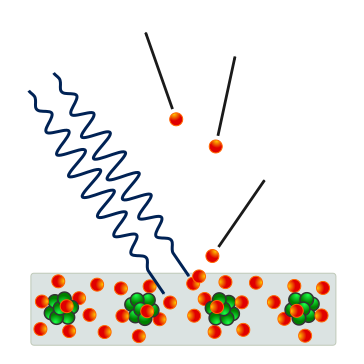
When light shines on a metal surface, electrons can be ejected. These ejected electrons are called photoelectrons. Classical wave theory predicted that any frequency of light should work, as long as the intensity is high enough. But experiments showed something completely different:
- Below a certain threshold frequency (), no electrons are ejected regardless of intensity.
- Above , electrons are ejected immediately - even at extremely low intensity.
- Increasing the intensity of light above increases the number of ejected electrons, but not their speed.
- Increasing the frequency above increases the maximum kinetic energy of the ejected electrons.
These results made no sense under the wave model of light. Einstein explained them in 1905 by proposing that light comes in discrete packets - photons - each carrying energy E = hf.
Einstein’s Photoelectric Equation
The work function (φ) is a property of the metal - it is the minimum energy an electron needs to escape the surface. Different metals have different work functions. For example, cesium has a low work function (~2.1 eV) while platinum has a high one (~5.6 eV).
Threshold Frequency
The threshold frequency is the minimum frequency that can eject electrons. At this frequency, the photon carries just enough energy to overcome the work function, with nothing left over for kinetic energy:
Intensity vs. Frequency
This distinction trips up many students, so here it is clearly:
| What you change | What happens |
|----------------|--------------|
| Increase frequency (above ) | Each photon carries more energy, so ejected electrons are faster (higher KE_max) |
| Increase intensity (above ) | More photons hit the surface per second, so more electrons are ejected (higher current), but each electron has the same KE_max |
| Increase intensity (below ) | Nothing happens - more photons, but each one still lacks sufficient energy |
Graphical Representation
A graph of KE_max vs. frequency is a straight line:
- Slope = h (Planck’s constant) - the same for all metals
- x-intercept = (threshold frequency) - different for each metal
- y-intercept = -φ (negative work function)
For frequencies below , the graph sits at KE_max = 0 (no electrons ejected). Different metals produce parallel lines shifted left or right depending on their work function.
KE_max = hf - φ = 6.0 - 4.0 = 2.0 eV. The photon’s energy minus the work function gives the leftover kinetic energy. If the photon energy were less than 4.0 eV, no electrons would be ejected at all.
The number of ejected electrons doubles (twice as many photons), but the maximum kinetic energy stays the same. Each photon still carries the same energy (hf), so each electron gets the same KE_max = hf - φ. Intensity affects quantity of photons, not energy per photon.