
Radioactive Decay
Some nuclei are unstable. They have too many protons, too many neutrons, or simply too much energy, and they spontaneously transform into more stable configurations by ejecting particles or energy. This is radioactive decay — and it’s happening right now in the ground beneath your feet, in the bananas in your kitchen, and in trace amounts of carbon-14 inside your own body.
The process is entirely random for any individual nucleus — you cannot predict when one specific atom will decay. But for large collections of atoms, the statistics are remarkably precise (next section: half-life). The MCAT focuses on three main types of decay (alpha, beta, gamma) and the conservation rules that govern them.
Why Do Nuclei Decay?
The nucleus holds protons tightly packed together, and protons repel each other via the electromagnetic force. The strong nuclear force overcomes this repulsion and holds the nucleus together, but it only works at extremely short range (about m). When the balance between these forces tips unfavorably - too many protons for the neutrons to stabilize, or too many neutrons for the size of the nucleus - the nucleus becomes unstable and decays.
Alpha Decay
In α decay, the nucleus ejects an α particle - a helium-4 nucleus containing 2 protons and 2 neutrons.
Result: Z decreases by 2, A decreases by 4. The parent element transforms into an element two positions to the left on the periodic table.
Example:
Alpha particles are heavy and doubly charged (+2). They are the least penetrating form of radiation - a sheet of paper or the dead outer layer of skin stops them. However, if an α emitter is inhaled or ingested, it becomes extremely dangerous because all that energy is deposited in a tiny area of living tissue.
Beta-Minus Decay
In β-minus decay, a neutron inside the nucleus converts into a proton, emitting an electron (β particle) and an antineutrino.
Result: Z increases by 1 (one more proton), A stays the same (total nucleons unchanged). The element shifts one position to the right on the periodic table.
Example:
Beta-minus decay occurs in neutron-rich nuclei. The nucleus has too many neutrons relative to protons, so it converts one to restore balance.
Beta-Plus Decay (Positron Emission)
In β-plus decay, a proton converts into a neutron, emitting a positron (the antimatter counterpart of an electron) and a neutrino.
Result: Z decreases by 1 (one fewer proton), A stays the same. The element shifts one position to the left on the periodic table.
Example:
Beta-plus decay occurs in proton-rich nuclei. The positron, once emitted, quickly encounters an electron and both annihilate, producing two γ rays. This annihilation is the basis of PET (positron emission tomography) scanning.
Gamma Decay
Gamma decay is the emission of a high-energy photon (γ ray) from an excited nucleus. It often follows α or β decay, when the daughter nucleus is left in an excited state.
Result: Z stays the same, A stays the same. Only energy is released - no particles, no change in identity. The nucleus simply drops to a lower energy state.
Gamma rays are the most penetrating form of radiation. They require thick lead or concrete to stop.
Summary Table
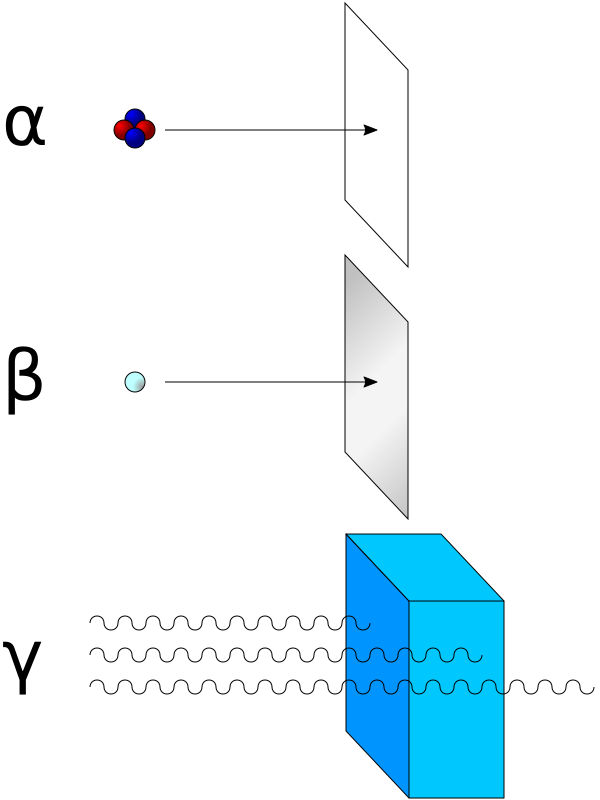
| Decay Type | Particle Emitted | Change in Z | Change in A | Penetration |
|---|---|---|---|---|
| Alpha | -2 | -4 | Lowest (paper stops it) | |
| Beta-minus | +1 | 0 | Medium (aluminum stops it) | |
| Beta-plus | -1 | 0 | Medium (then annihilation) | |
| Gamma | photon (γ ray) | 0 | 0 | Highest (lead/concrete) |