
Half-Life
Imagine 1000 popcorn kernels in a hot pan. After one minute, roughly half have popped — about 500 unpopped left. Another minute, half of the remaining pop — now about 250. After another minute, ~125. Each “round” cuts the remaining count in half.
Radioactive decay works exactly the same way. After each half-life, exactly half the remaining unstable nuclei have decayed. The MCAT loves this topic because the math is dead simple (just halving), and the underlying physics ties to carbon-14 dating, drug half-lives in biology, medical imaging tracers, and any first-order kinetic process you learned about in chemistry.
A radioactive sample has a half-life of 3 seconds. After 6 seconds (two half-lives), how much of the sample remains?
The simulation below lets you watch this process in real time. Each circle represents a single radioactive atom with an independent, random chance of decaying each moment - yet despite the randomness, the overall curve follows a smooth, predictable exponential. Hit “Start Decay” and watch the law of large numbers in action.
The Half-Life Equation
The half-life () is the time it takes for half of a radioactive sample to decay. After n half-lives, the fraction of the original sample remaining is:
The Half-Life Table
This table is worth memorizing - it covers nearly every MCAT half-life question:
| Half-lives (n) | Fraction remaining | Percent remaining |
|----------------|-------------------|-------------------|
| 0 | 1 | 100% |
| 1 | | 50% |
| 2 | | 25% |
| 3 | | 12.5% |
| 4 | | 6.25% |
| 5 | | 3.125% |
Solving Half-Life Problems
Step 1: Find the Number of Half-Lives
Divide the total time by the half-life: n = t /
Step 2: Apply the Fraction
Multiply the initial amount by ()^n.
Example
A sample contains 800 mg of iodine-131 ( = 8 days). How much remains after 24 days?
n = 24 / 8 = 3 half-lives
Amount remaining = 800 x = 800 x = 100 mg
First-Order Kinetics
Radioactive decay is a first-order process, which means the rate of decay is proportional to the amount of radioactive material present. The more atoms you have, the more decays per second - but the fraction that decays per unit time stays constant.
This is the same first-order kinetics you learned in chemistry. The decay constant (λ) relates to the half-life:
Semi-Log Plots
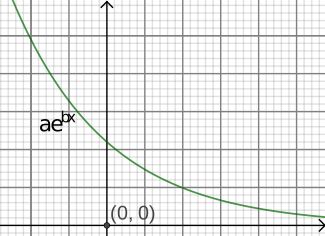
On a normal (linear) graph, radioactive decay produces a curved exponential line that swoops downward. But if you plot the natural log of the amount remaining (ln N) versus time, you get a straight line with slope = -λ.
Activity
The activity of a radioactive sample is the number of decays per second, measured in becquerels (Bq) or curies (Ci). Activity follows the same half-life pattern as the number of atoms:
Activity = λ x N
Since N decreases by half each half-life, so does the activity. A freshly prepared sample is most active, and the activity drops exponentially over time.
30 mg. n = = 3 half-lives. Amount remaining = 240 x = 240 x = 30 mg.
4 half-lives. ()⁴ = . Each half-life cuts the remaining amount in half: 1 to to to to .