
Fission and Fusion
In the last section you learned that both fission and fusion release energy — because both move nuclei toward the iron-56 peak on the binding energy curve. But the two processes couldn’t be more different in practice. Fission splits heavy nuclei apart and powers nuclear reactors and atomic bombs. Fusion fuses light nuclei together and powers every star in the universe — including the sun, right now, turning hydrogen into helium.
Here’s how each one actually works, where it occurs, and why one is hard to do on Earth while the other happens naturally in billions of stars.
Nuclear Fission
Fission is the splitting of a heavy nucleus into two or more lighter nuclei, typically accompanied by the release of neutrons and a large amount of energy.
How Fission Works
- A slow (thermal) neutron is absorbed by a heavy nucleus (commonly uranium-235 or plutonium-239).
- The nucleus becomes excited and unstable.
- The nucleus splits into two medium-sized daughter nuclei, typically releasing 2-3 additional neutrons.
- The mass of the products is slightly less than the mass of the reactants - the missing mass appears as kinetic energy (about 200 MeV per fission event).
Chain Reactions
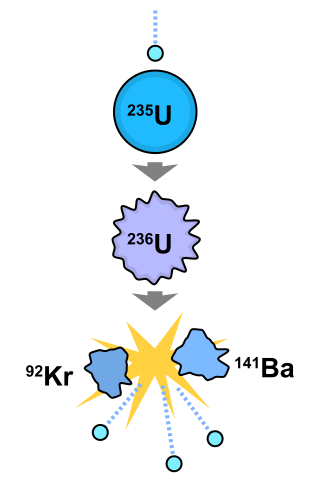
The 2-3 neutrons released by each fission event can strike other uranium nuclei and trigger further fissions. If enough fissile material is present, this creates a self-sustaining chain reaction.
- Subcritical: on average, fewer than one neutron per fission causes another fission. The reaction dies out.
- Critical: exactly one neutron per fission causes another fission. The reaction is self-sustaining at a constant rate. This is how nuclear power plants operate.
- Supercritical: more than one neutron per fission causes further fissions. The reaction grows exponentially. This is how nuclear weapons work.
Control Rods
In a nuclear reactor, control rods (made of materials that absorb neutrons, such as boron or cadmium) are inserted between fuel rods to regulate the chain reaction. Pushing the rods in absorbs more neutrons, slowing the reaction. Pulling them out allows more neutrons to cause fissions, speeding it up. At steady operation, the reactor is kept exactly critical.
Nuclear Fusion
Fusion is the combining of two light nuclei into a heavier nucleus, releasing energy. This is the process that powers every star in the universe.
The Sun’s Fusion Cycle
The dominant process in the sun is the proton-proton chain, which effectively fuses four hydrogen nuclei (protons) into one helium-4 nucleus:
The mass of four protons is greater than the mass of one helium-4 nucleus. The difference (~0.029 amu per event, or about 26.7 MeV) is released as kinetic energy and radiation.
Why Fusion Is Hard on Earth
Fusion requires temperatures of millions of degrees to overcome Coulomb repulsion between positively charged nuclei. At these temperatures, matter exists as plasma. Containing this plasma is the central engineering challenge - no solid container can withstand those temperatures. Current approaches use magnetic confinement (tokamaks) or inertial confinement (lasers).
Comparing Fission and Fusion
| Feature | Fission | Fusion |
|---|---|---|
| Process | Heavy nucleus splits | Light nuclei combine |
| Fuel | Uranium-235, Plutonium-239 | Hydrogen isotopes (deuterium, tritium) |
| Direction on BE curve | Heavy nuclei move left toward iron | Light nuclei move right toward iron |
| Energy per event | ~200 MeV | ~26.7 MeV (per 4H to He) |
| Energy per kilogram of fuel | High | Even higher |
| Conditions | Neutron bombardment | Extreme temperature (~ K) |
| Waste | Radioactive fission products | Helium (non-radioactive) |