
Equipotential Lines
Topographic maps use contour lines to connect points of equal elevation. Walk along a contour line and you stay at the same height — no climbing, no descending, no work against gravity.
Equipotential lines are the electrical version. They connect points of equal voltage. Move a charge along an equipotential and no work is done, because the charge stays at the same “electrical altitude.” Move it across equipotentials, and work happens. The whole topographic-map analogy from the previous section keeps paying off here.
What Are Equipotential Lines?
An equipotential line (in 2D) or equipotential surface (in 3D) connects all points that share the same electric potential V. Key properties:
- No work is done moving a charge along an equipotential. Since W = -qΔV and ΔV = 0 along an equipotential, W = 0. The charge neither gains nor loses energy.
- Equipotential lines are always perpendicular to electric field lines. This is a fundamental geometric relationship. The field points in the direction of steepest voltage drop, which is always at right angles to lines of constant voltage.
- Equipotential lines never cross. A point in space has one and only one value of V, so two different equipotential lines cannot intersect.
Equipotential Patterns for Common Configurations
Point Charge
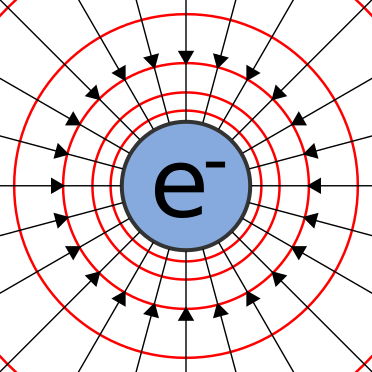
The equipotential surfaces around a single point charge are concentric spheres (or circles in 2D). Each sphere has a constant V = kq/r. The spheres are more closely spaced near the charge (where V changes rapidly) and more widely spaced far away.
The field lines radiate outward (for +) or inward (for -), crossing the spherical equipotentials at right angles.
Parallel Plates
Between parallel plates, the equipotential surfaces are flat planes parallel to the plates (straight lines in 2D). They are evenly spaced because the field is uniform - the voltage drops by the same amount for each equal step across the gap.
If the positive plate is at +100 V and the negative plate is at 0 V with 10 cm separation, the equipotential lines at 2 cm intervals would be at +80 V, +60 V, +40 V, +20 V, evenly spaced across the gap.
Dipole
The equipotential pattern around a dipole is more complex. The equipotential surfaces are distorted, but the perpendicular bisector of the dipole (the line halfway between the two charges, perpendicular to the dipole axis) is a special equipotential: V = 0 along this entire surface.
The Perpendicular Rule in Practice
The perpendicular relationship between field lines and equipotentials is one of the most useful shortcuts on the MCAT:
- If you know the equipotential pattern, you can sketch the field lines (draw them perpendicular to the equipotentials, pointing from high V to low V).
- If you know the field lines, you can sketch the equipotentials (draw them perpendicular to the field lines).
- Where equipotential lines are closely spaced, the field is strong (voltage changes rapidly over a short distance).
- Where equipotential lines are widely spaced, the field is weak.
Conductors as Equipotential Surfaces
The entire surface of a conductor in electrostatic equilibrium is an equipotential surface. The interior is also at the same potential. This follows from the fact that E = 0 inside a conductor - if there is no field, there is no voltage change, so the entire conductor sits at a single potential.