
Electric Dipoles
Think about a battery. Positive end on top, negative end on the bottom. Now imagine shrinking that battery down to the size of a molecule — you’d have something very close to what physicists call a dipole.
“Dipole” literally means “two poles” — like a battery has two ends, or a bar magnet has a north and a south pole. In electricity, a dipole is any object with a positive side and a negative side separated by some distance.
This idea matters enormously in biology. Water molecules are dipoles. The amino acids in your proteins are dipoles. The phospholipids in every cell membrane are dipoles. Understanding how dipoles behave explains why salt dissolves in water, why oil and water don’t mix, why proteins fold the way they do, and how your nerve cells send signals.
Breaking Down the Concept: What Makes a Dipole?
Let’s build this up step by step.
You already know from Section 5.1 that objects can have positive or negative charge. Now imagine you have two small charged objects:
- One has a charge of +q (some amount of positive charge)
- The other has a charge of -q (the same amount, but negative)
If you hold these two charges apart at some distance d, congratulations - you’ve created a dipole.
The Dipole Moment: How “Strong” Is the Dipole?
Not all dipoles are created equal. A dipole with large charges far apart is “stronger” than one with tiny charges close together. We capture this with a quantity called the dipole moment.
The dipole moment tells you two things:
- How much charge separation there is (bigger charges and bigger distances both make it larger)
- Which direction the dipole points (from negative toward positive, by convention)
Why does the formula make sense? If you double the charge (bigger q), the dipole is twice as “strong.” If you double the separation distance (bigger d), the dipole is also twice as strong. The dipole moment captures both effects by multiplying them together.
What Happens When You Put a Dipole in an Electric Field?
This is where dipoles get interesting. Remember from Section 5.3 that an electric field pushes positive charges in one direction and negative charges in the opposite direction.
Now think about what happens to our dipole (with its positive end and negative end) when we place it in an electric field:
- The positive end gets pushed in the direction of the field
- The negative end gets pushed against the field direction
If the dipole is sitting at an angle to the field, these two pushes create a twist - what physicists call a torque. The dipole rotates until it lines up with the field.
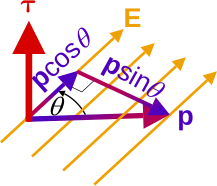
The Torque Formula
How strong is this twisting force? It depends on three things:
- How strong the dipole is (the dipole moment p)
- How strong the electric field is (E)
- What angle the dipole makes with the field (θ)
This makes intuitive sense. When the dipole is already aligned with the field, there’s no reason for it to rotate - the positive end is already pointing the way the field wants to push it. But when the dipole is sideways to the field, it experiences maximum twist.
Energy Stored in a Dipole’s Orientation
When you rotate a dipole against the field (fighting the twist), you’re doing work on it - storing energy. When you let it rotate back into alignment, that stored energy is released.
This is the same idea as gravitational potential energy: lift a ball above the ground and you store energy; let it fall and that energy converts to motion.
Understanding the Energy Formula
Let’s make sense of this formula by checking extreme cases:
When θ = 0° (dipole aligned with field):
- cos 0° = 1
- U = -pE(1) = -pE (the most negative value possible)
- This is the lowest energy state - the dipole is “relaxed”
When θ = 90° (dipole perpendicular to field):
- cos 90° = 0
- U = -pE(0) = 0
- This is a middle energy state
When θ = 180° (dipole pointing opposite to field):
- cos 180° = -1
- U = -pE(-1) = +pE (the most positive value possible)
- This is the highest energy state - the dipole is “fighting” the field
Summary Table: How Angle Affects a Dipole
| Angle (θ) | Position | Torque | Energy | Stability |
|---|---|---|---|---|
| 0° | Aligned with field | Zero | Lowest (-pE) | Stable equilibrium |
| 90° | Perpendicular to field | Maximum (pE) | Middle (0) | Rotating |
| 180° | Opposite to field | Zero | Highest (+pE) | Unstable equilibrium |
Why Dipoles Matter in Biology
Now that you understand what dipoles are and how they behave, let’s see why this matters for the MCAT and for understanding life itself.
Water: The Most Important Dipole
Water () is a dipole, and this single fact explains an enormous amount of biology and chemistry.
Here’s why water is a dipole: Oxygen atoms attract electrons more strongly than hydrogen atoms do (oxygen is more “electronegative” - see bonding and electronegativity for more). In a water molecule, the shared electrons spend more time near the oxygen, giving it a partial negative charge (δ-). The hydrogen atoms, having lost some electron density, end up with partial positive charges (δ+).
The result: one end of the water molecule is slightly negative, the other end is slightly positive. That’s a dipole.
Dipoles in Proteins and Membranes
The same principle extends throughout biology:
-
Amino acids (the building blocks of proteins) often have polar side chains - parts of the molecule that act as dipoles. When a protein folds, these dipoles interact with each other and with water, helping determine the protein’s final shape.
-
Cell membranes are made of phospholipids, which have a polar “head” (a dipole that interacts with water) and nonpolar “tails” (not dipoles, so they avoid water). This is why membranes form the way they do - the polar heads face the watery environment while the nonpolar tails tuck inside.