
Electric Fields
In the previous section, you learned how to compute the force between two specific charges. But here’s the deeper question: what is a charged object doing to the space around it, even before another charge shows up?
That’s where the electric field comes in. It’s one of the most important ideas in physics, and once you internalize it, electromagnetism becomes much more intuitive.
What Is an Electric Field?
Compare to gravity. Earth creates a gravitational field around itself. Even when nothing is falling, the field is there — sitting silently in space. Drop a ball into that field and the ball feels a force. The field existed before the ball arrived.
An electric field works the same way. A charged object creates an “influence zone” around itself. Bring another charge into that zone and it feels a force. The field was there all along; the second charge just reveals it.
The Formula: Force Per Unit Charge
We define the electric field as the force a positive test charge would experience, divided by that charge:
Direction matters. The electric field points the way a positive charge would be pushed (this is a convention):
- Near a positive source charge: points away (positive charges repel each other).
- Near a negative source charge: points toward it (positives are attracted).
Field from a Point Charge
If you know Coulomb’s law (), you can derive the field formula. Force on a test charge near source charge is . Divide by :
Notice what this formula does not contain: the test charge. The field is a property of space created by the source charge. It exists whether or not another charge is there to feel it.
Visualizing Fields: Field Lines
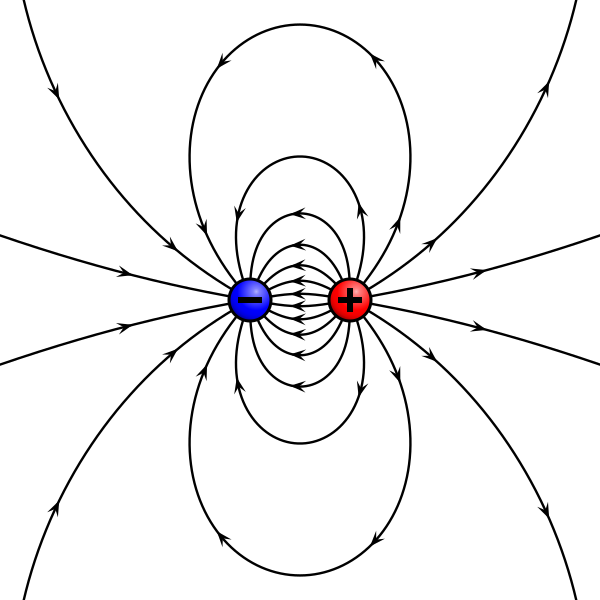
Electric fields are invisible, so how do we picture them? Physicists use field lines — imaginary lines drawn throughout space showing which direction a positive test charge would be pushed at every point.
The Rules of Field Lines
- Lines point away from positive charges (where positives would be pushed away).
- Lines point toward negative charges (where positives would be attracted).
- Lines never cross (every point in space has only one field direction).
- Line density = field strength. Where lines are packed close together, the field is strong.
Multiple Charges: Superposition
What if several charges create fields at the same point? They don’t interfere or cancel in any complicated way — fields add as vectors. This is the principle of superposition.
How to use it:
- Calculate the field from charge #1 at the point of interest (magnitude and direction).
- Calculate the field from charge #2 at the same point.
- Add the vectors. Same direction → magnitudes add. Opposite directions → subtract. Perpendicular → use the Pythagorean theorem.
Each charge creates its field as if the others weren’t there.
The Most Important Setup: Parallel Plates
Take two large metal plates, put positive charge on one and negative charge on the other, set them facing each other. What’s the field between them?
The field is uniform — same strength and direction everywhere between the plates. Field lines are straight, parallel, and evenly spaced, running from the positive plate to the negative plate.
This setup is special because most electric fields vary with distance (). Between parallel plates, the field is constant. That makes the math dramatically simpler for many problems.
Why this matters: a uniform field means constant force on any charge between the plates. Constant force → constant acceleration. Constant acceleration → you can use the kinematic equations you already know. Many MCAT problems involve charged particles accelerating between plates — they solve like projectile-motion problems with the electric force playing the role of gravity.
Gauss’s Law: The Conceptual Version
The MCAT only tests Gauss’s law conceptually — no calculations. But the idea is elegant and worth understanding.
The concept: Draw any imaginary closed surface (think a balloon) around some charges. Count how many field lines poke through that surface. Gauss’s law says: that count depends only on how much charge is inside the surface.
It does not depend on:
- The shape of the surface.
- Where inside the surface the charges sit.
- Charges outside the surface.