Pull a load of laundry from the dryer and you’ll notice socks clinging to shirts, crackling sounds when you peel pieces apart, and maybe a small spark when you touch the metal door. That’s not magic — it’s electric charge in action.
When two different materials rub together (like clothes tumbling in a dryer), electrons transfer from one surface to the other. One material ends up with extra electrons (net negative charge); the other is missing some (net positive charge). The resulting attraction between opposite charges is what makes your socks cling to your shirts.
This chapter is the foundation for everything in electrostatics, circuits, and magnetism. Get the basics of charge — what it is, how it moves, how things become charged — and the rest builds straightforwardly on top.
What Is Electric Charge?
Electric charge is a fundamental property of matter, just like mass. There are exactly two types: positive and negative. Protons carry positive charge; electrons carry negative; neutrons carry none. Like charges repel; opposite charges attract.
Quantization of Charge
Charge comes in discrete packets. You can’t have half an electron’s worth of charge. The smallest unit of free charge is the elementary charge:
The SI unit of charge is the coulomb (C). One coulomb is an enormous amount of charge — roughly 6.25×10¹⁸ electrons. In everyday static electricity (like the laundry example), you’re typically dealing with nanocoulombs (10−9 C) or microcoulombs (10−6 C).
Conservation of Charge
Charge is never created or destroyed — only transferred. Rub a balloon on your hair: the balloon gains −5 nC of charge, your hair gains +5 nC. Total system charge is still zero. (Just like before.)
Conductors vs. Insulators
Conductors (metals, saltwater, plasma) have electrons that can move freely throughout the material. Touch a charged conductor and the charge spreads over the entire surface. Metals conduct because their outer electrons are delocalized in a “sea” of shared electrons.
Insulators (rubber, glass, plastic, dry wood) hold electrons tightly in place. Charge placed on an insulator stays where you put it — it doesn’t spread. This is why you can charge one end of a plastic rod and the other end stays neutral.
Semiconductors (silicon, germanium) sit in between. Their conductivity can be tuned by adding impurities (doping) — that’s the basis of every chip in every electronic device. Not a major MCAT topic, but you should know the category exists.
Three Methods of Charging
Charging by Friction (Triboelectric)
Rub two different materials together → electrons transfer from one to the other. Which material gains electrons depends on the triboelectric series. Classic example: rubbing a glass rod with silk pulls electrons off the glass (glass → positive, silk → negative). This is also what’s happening when you shuffle across carpet on a dry day and shock yourself on a doorknob — friction with the carpet has charged you.
Charging by Contact (Conduction)
Touch a charged object to a neutral conductor. Charge flows between them until they reach the same potential. Both objects end up with the same sign of charge. If a negatively charged rod touches a neutral metal sphere, electrons hop from rod to sphere, and now both are negative.
Charging by Induction
Bring a charged object near (but not touching) a neutral conductor. Charges in the conductor rearrange — opposite charges drift toward the nearby object, like charges drift to the far side. Now ground the conductor (connect it to Earth) while the charged object is still nearby — the repelled charges drain off into the ground. Remove the ground, then remove the charging object, and the conductor is left with a net charge opposite to the original object.
Polarization (of Insulators)
Even insulators respond to nearby charges. When a charged rod is brought near a neutral insulator, the electrons within each atom or molecule shift slightly, creating tiny induced dipoles. The material isn’t truly charged, but the near side becomes slightly attracted to the rod. This is why a charged balloon sticks to a neutral wall, why a charged comb attracts small bits of paper, and why dust collects on TV screens.
A negatively charged rod is brought near a neutral metal sphere without touching it. The sphere is then grounded and the ground wire removed. Finally, the rod is removed. What is the final charge of the sphere?
Click to reveal answer
Net positive. While the negative rod was nearby, it repelled electrons in the sphere to the far side. Grounding let those repelled electrons escape to the Earth. When the ground and rod were removed, the sphere was left with an electron *deficit* — net positive charge. This is charging by induction → opposite sign from the inducing object.
Why does charge always reside on the outer surface of a conductor at electrostatic equilibrium?
Click to reveal answer
Because like charges repel and move as far from each other as possible. In a conductor, charges are free to move. They redistribute until the electric field inside the conductor is zero. The only configuration that achieves this is one where all excess charge sits on the outer surface.
A charged balloon sticks to a neutral wall. Why?
Click to reveal answer
Polarization of the insulator. The charged balloon induces tiny dipoles in the wall's molecules — opposite charges drift toward the balloon, like charges drift away. The induced opposite charges are slightly *closer* to the balloon than the like charges, so attraction wins out over repulsion → balloon sticks. The wall isn't truly charged — its electrons just shifted slightly within each molecule.
Hold two magnets in your hands. Push two north poles toward each other and you feel resistance that gets dramatically stronger as they get close. Flip one magnet around and they snap together so hard they pinch your fingers. Now imagine the same thing for electric charges instead of magnets — same intuition, but charges can be positive or negative, and the force between them follows a precise mathematical rule discovered by Charles-Augustin de Coulomb in 1785.
That rule is Coulomb’s law, and it governs almost every electrostatic problem you’ll see on the MCAT. The structure of the equation looks almost identical to Newton’s law of gravitation — which is a useful coincidence to remember, because if you know one, the other is mostly mechanical.
The Equation
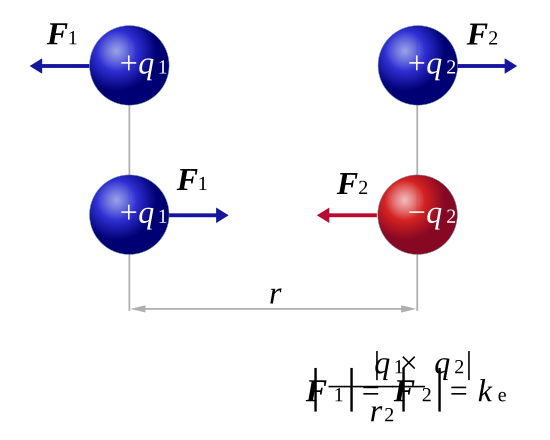
The force is attractive when the charges have opposite signs (one +, one −) and repulsive when they have the same sign (both + or both −). The sign of the product q1q2 tells you which: negative product → attraction; positive → repulsion.
Coulomb's law: two charges exert equal-and-opposite forces on each other (Newton's 3rd law). Like charges repel; opposites attract. Force magnitude follows an inverse-square law with distance. Credit: Wikimedia Commons, CC BY-SA
The Inverse-Square Law
The single most important feature of Coulomb’s law is the r2 in the denominator. Force drops off fast with distance:
Double the distance → force drops to 41.
Triple the distance → force drops to 91.
Halve the distance → force quadruples.
Coulomb’s Law vs. Newton’s Law of Gravitation
Coulomb’s law looks almost identical to gravity:
Feature
Coulomb’s law
Gravity
Formula
F=kq1q2/r2
F=Gm1m2/r2
Constant
k=9×10⁹
G=6.67×10⁻¹¹
Property
Charge
Mass
Direction
Attract OR repel
Always attract
Relative strength
Vastly stronger
Vastly weaker
The electric force is much stronger than gravity. The electrostatic force between a proton and electron in a hydrogen atom is about 1039 (a 1 followed by 39 zeros) times stronger than the gravitational force between them. Gravity only dominates on cosmic scales (planets, stars, galaxies) because most macroscopic objects are electrically neutral — positive and negative charges cancel out, so the residual electric force across the room is tiny. Mass never cancels — gravity always adds up.
Superposition of Forces
When more than two charges are present, the net force on any one charge is the vector sum of all the individual Coulomb forces acting on it. Calculate the force from each other charge separately, then add the force vectors. This is the principle of superposition — and it’s what lets you handle multi-charge problems with the same simple two-body equation.
For the MCAT, superposition problems usually involve only two or three charges arranged symmetrically. Use symmetry to simplify: if two charges exert equal forces at right angles, the net force is along the diagonal with magnitude F2. Review vector addition if perpendicular force combinations feel rusty.
Common MCAT Problem Types
Distance-change problems: “If the distance is halved, what happens to the force?” Apply inverse-square: F × 4.
Charge-change problems: “If both charges double, what happens to the force?” F∝q1q2, so doubling both → F × 4.
Three-charge equilibrium: “Where should a third charge be placed so the net force on it is zero?” Find the point where forces from the two fixed charges are equal and opposite.
Two charges are separated by distance d. If d is reduced to d/3 while the charges stay the same, by what factor does the force change?
Click to reveal answer
9× larger.F∝1/r2. If r becomes r/3, r2 becomes r2/9, so 1/r2 becomes 9/r2. Force scales by 9.
How does Coulomb's law differ from Newton's law of gravitation? Give two key differences.
Click to reveal answer
1) The electric force can be attractive *or* repulsive (gravity is always attractive). 2) The electric force is vastly stronger than gravity (~1039× stronger for a proton-electron pair). Both follow the inverse-square law and have the same mathematical structure.
Two charges, +2 μC and +3 μC, are 0.1 m apart. What is the magnitude of the force between them? Is it attractive or repulsive?
Click to reveal answer
About 5.4 N, repulsive.F=kq1q2/r2=(9×109)(2×10−6)(3×10−6)/(0.1)2=(9×109)(6×10−12)/0.01=54×10−3/0.01=5.4 N. Both positive → repulsive.
In the previous section, you learned how to compute the force between two specific charges. But here’s the deeper question: what is a charged object doing to the space around it, even before another charge shows up?
That’s where the electric field comes in. It’s one of the most important ideas in physics, and once you internalize it, electromagnetism becomes much more intuitive.
What Is an Electric Field?
Compare to gravity. Earth creates a gravitational field around itself. Even when nothing is falling, the field is there — sitting silently in space. Drop a ball into that field and the ball feels a force. The field existed before the ball arrived.
An electric field works the same way. A charged object creates an “influence zone” around itself. Bring another charge into that zone and it feels a force. The field was there all along; the second charge just reveals it.
The Formula: Force Per Unit Charge
We define the electric field as the force a positive test charge would experience, divided by that charge:
Direction matters. The electric field points the way a positive charge would be pushed (this is a convention):
Near a positive source charge: E points away (positive charges repel each other).
Near a negative source charge: E points toward it (positives are attracted).
Field from a Point Charge
If you know Coulomb’s law (F=kq1q2/r2), you can derive the field formula. Force on a test charge q2 near source charge q1 is F=kq1q2/r2. Divide by q2:
Notice what this formula does not contain: the test charge. The field is a property of space created by the source charge. It exists whether or not another charge is there to feel it.
Visualizing Fields: Field Lines
Electric fields are invisible, so how do we picture them? Physicists use field lines — imaginary lines drawn throughout space showing which direction a positive test charge would be pushed at every point.
The Rules of Field Lines
Lines point away from positive charges (where positives would be pushed away).
Lines point toward negative charges (where positives would be attracted).
Lines never cross (every point in space has only one field direction).
Line density = field strength. Where lines are packed close together, the field is strong.
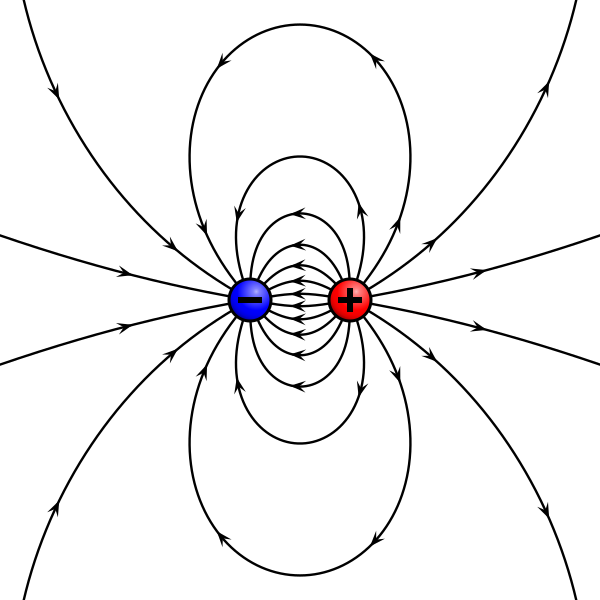
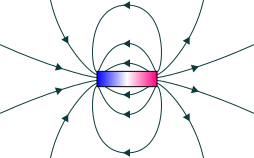
Field lines around a dipole (a positive and negative charge near each other). Lines emerge from the positive charge and curve around to enter the negative charge. Lines are packed more tightly near the charges — that's where the field is strongest. Credit: Wikimedia Commons, CC BY-SA
Multiple Charges: Superposition
What if several charges create fields at the same point? They don’t interfere or cancel in any complicated way — fields add as vectors. This is the principle of superposition.
How to use it:
Calculate the field from charge #1 at the point of interest (magnitude and direction).
Calculate the field from charge #2 at the same point.
Add the vectors. Same direction → magnitudes add. Opposite directions → subtract. Perpendicular → use the Pythagorean theorem.
Each charge creates its field as if the others weren’t there.
The Most Important Setup: Parallel Plates
Take two large metal plates, put positive charge on one and negative charge on the other, set them facing each other. What’s the field between them?
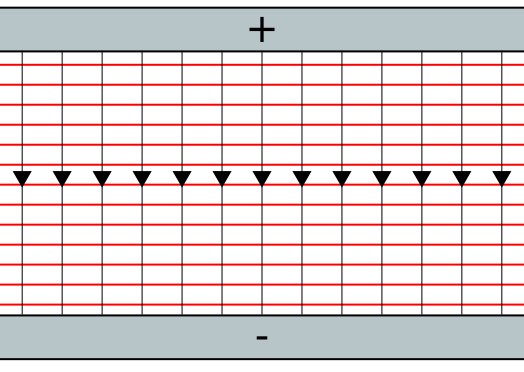
The field is uniform — same strength and direction everywhere between the plates. Field lines are straight, parallel, and evenly spaced, running from the positive plate to the negative plate.
This setup is special because most electric fields vary with distance (E=kq/r2). Between parallel plates, the field is constant. That makes the math dramatically simpler for many problems.
Why this matters: a uniform field means constant force on any charge between the plates. Constant force → constant acceleration. Constant acceleration → you can use the kinematic equations you already know. Many MCAT problems involve charged particles accelerating between plates — they solve like projectile-motion problems with the electric force playing the role of gravity.
Gauss’s Law: The Conceptual Version
The MCAT only tests Gauss’s law conceptually — no calculations. But the idea is elegant and worth understanding.
The concept: Draw any imaginary closed surface (think a balloon) around some charges. Count how many field lines poke through that surface. Gauss’s law says: that count depends only on how much charge is inside the surface.
It does not depend on:
The shape of the surface.
Where inside the surface the charges sit.
Charges outside the surface.
A diagram shows field lines widely spaced on the left and closely spaced on the right. Where is the electric field stronger?
Click to reveal answer
On the right. Field-line density tracks field strength. Closer lines → stronger field. Wider spacing → weaker field.
What is the direction of the electric field at a point near a negative charge?
Click to reveal answer
Toward the negative charge. The electric field direction is conventionally defined as the direction a *positive* test charge would move. A positive charge is attracted toward a negative source, so E points inward toward negative charges.
Two parallel plates are 2 cm apart with a 100 V potential difference between them. What is the field strength between them?
Click to reveal answer
5000 V/m (or 5000 N/C).E=V/d=100/0.02=5000 V/m. Same field strength everywhere between the plates — that's the uniformity of the parallel-plate setup.
In §5.3 you learned the rules of electric fields. Now it’s time to apply those rules to the specific charge arrangements the MCAT loves: single point charges, pairs of charges, dipoles, and parallel plates. Each has a characteristic field pattern you should recognize on sight.
The strategy is always the same: calculate E from each source charge, get the direction (away from + charges, toward − charges), and add the vectors.
Electric Field from a Single Point Charge
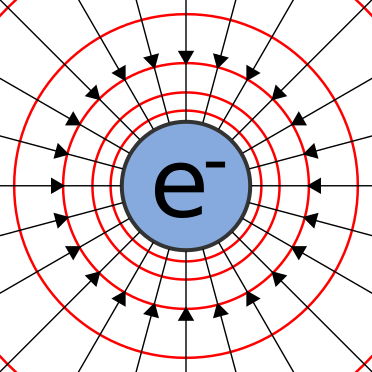
The field radiates symmetrically outward from a positive point charge and inward toward a negative one. Field strength falls off as 1/r2 — same inverse-square pattern as Coulomb’s law.
Superposition with Multiple Charges
When several point charges are present, the field at any location is the vector sum of the individual fields from each charge. The recipe:
Pick the point where you want to know the field.
Calculate E from each source charge using E=kq/r2.
Determine the direction of each individual field (away from + charges, toward − charges).
Add the vectors.
Two Equal Positive Charges
Place two identical positive charges on a horizontal line. At the midpoint between them, the fields from each charge point in opposite directions and cancel completely. E=0 at the midpoint. Above or below the midpoint, the fields partially add, producing a net upward or downward field perpendicular to the line.
But what if the charges aren’t equal?
🎯 Predict First
Two positive charges sit on a line some distance apart: q1 = +4 µC and q2 = +1 µC. Where is the electric field zero?
Drag the q1 and q2 sliders and watch the arrow pattern reorganize around the two charges. The green ring marks the null point where the fields cancel exactly. Make the charges equal, then unequal, then flip one sign, and notice where the null point moves (and when it leaves the picture entirely).
q1: +4 µCq2: +1 µCStatus: null point between charges
Two Opposite Charges (Dipole Configuration)
Place a positive charge on the left, a negative charge on the right. At the midpoint, both fields point in the same direction (from + toward −), so they add. The field at the midpoint is strong, not zero. (More on this in §5.8 — Electric Dipoles.)
The Dipole Field Pattern
A dipole is a positive and negative charge of equal magnitude separated by a small distance. The field pattern has a distinctive shape:
Between the charges: field points from + to −.
Along the axis (line connecting the charges): field points away from + and toward −, creating a continuous flow from positive to negative.
Along the perpendicular bisector: field points antiparallel to the dipole moment.
Far from the dipole: field falls off as 1/r3 — faster than a single point charge (1/r2). Dipoles cancel each other out at distance much faster than a lone charge would.
You don’t need to calculate dipole fields on the MCAT, but you should recognize the pattern in a diagram: field lines emerge from the positive end and curve around to enter the negative end, forming closed-looking loops.
Electric Field Between Parallel Plates
Two large parallel conducting plates with equal-and-opposite charge produce the simplest possible field: uniform and constant between the plates.
This uniform field is the workhorse of MCAT electrostatics. A charged particle between the plates experiences a constant force (F=qE) → constant acceleration → projectile-motion-style problems. Charge between plates is geometrically the same as a ball thrown in gravity — and you solve it with the same kinematic equations.
Uniform field between parallel plates. Field lines are straight, parallel, and evenly spaced — a constant field throughout the region between the plates. Credit: Wikimedia Commons, CC BY-SA
Conductors in Electrostatic Equilibrium
Three facts about conductors at electrostatic equilibrium that often appear on the MCAT:
The electric field inside the conductor is exactly zero.
All excess charge sits on the outer surface.
The field just outside the surface is perpendicular to the surface.
All three follow from charges being free to move. If there were any field inside the conductor, the charges would move in response — until there wasn’t. Equilibrium = no field inside.
Two charges of +Q and −Q are placed on the x-axis, separated by distance d. What’s the direction of the field at the exact midpoint?
Click to reveal answer
From the + charge toward the − charge. The + charge produces a field pointing away from it (so toward the midpoint, then on toward the − side). The − charge produces a field pointing toward it (also toward the − side). Both fields point the same way → they add → strong nonzero field from + to −.
Voltage across two parallel plates is 200 V; plate separation is 0.05 m. What is the field?
Click to reveal answer
4000 V/m (or 4000 N/C).E=V/d=200/0.05=4000 V/m. Uniform across the gap, pointing from + plate to − plate.
Two equal positive charges sit on the x-axis at ±a. What is the field at the origin? At a point directly above the midpoint?
Click to reveal answer
At the origin: E=0 (fields from each charge cancel). Above the midpoint: field is nonzero and points upward — the horizontal components from the two charges cancel by symmetry, but the vertical components add. This is a classic symmetry-based MCAT problem.
If you’ve studied gravitational potential energy, you already understand the core idea. Hold a ball above the ground — it has stored energy. Release it — the stored energy converts into motion as the ball falls.
Electric potential energy is the same concept, just with electric charges instead of gravity. When two charges are arranged in a particular configuration, there’s energy stored in that arrangement. Move the charges around, and you’re either storing more energy or releasing it. Same logic, different force — and conservation of energy still applies.
Building the Formula from What You Know
You learned in Section 5.2 that the force between two charges follows Coulomb’s law:
F=r2kq1q2
Potential energy and force are closely related. In fact, if you know how force changes with distance, you can figure out potential energy (this involves calculus, which you don’t need for the MCAT). The result is:
Understanding the Sign: Positive vs. Negative Energy
The sign of U tells you something crucial about the system. This is where many students get confused, so let’s build intuition.
Like Charges: Positive Potential Energy
When both charges have the same sign (both positive, or both negative), the product q1×q2 is positive, so U is positive.
What does positive energy mean physically? Think about it: like charges repel. To push them close together, you have to fight against that repulsion - you have to do work on the system. That work gets stored as potential energy, just like compressing a spring stores energy.
Unlike Charges: Negative Potential Energy
When the charges have opposite signs (one positive, one negative), the product q1×q2 is negative, so U is negative.
What does negative energy mean? Unlike charges attract. They naturally “want” to come together - you don’t have to push them. In fact, you’d have to do work to pull them apart. The system is in an energy “hole” - it would take energy input to escape.
Quick Reference: What Does the Sign Mean?
Charges
Sign of q1q2
Sign of U
Physical meaning
Both + or both -
Positive
Positive
Energy stored by pushing together; will fly apart if released
One + and one -
Negative
Negative
Bound together; would need energy to separate
How Does Energy Change as Charges Move?
The electric force is what physicists call a conservative force - the same category as gravity. This means we can track energy using potential energy, and total mechanical energy is conserved (as long as no other forces are doing work).
(Initial kinetic energy + initial potential energy = final kinetic energy + final potential energy)
This means:
When U decreases, K increases (potential energy converts to speed)
When U increases, K decreases (speed converts to potential energy)
What Makes U Increase or Decrease?
U increases when you fight the natural tendency:
Pushing like charges closer together (they want to repel)
Pulling unlike charges apart (they want to attract)
U decreases when you go with the natural tendency:
Letting like charges fly apart (they naturally repel)
Letting unlike charges come together (they naturally attract)
Force vs. Energy: Why One Has r2 and the Other Has r
Here’s something that often confuses students: the force equation has r2 in the denominator, but the energy equation only has r.
Quantity
Formula
Falls off as…
Force
F=r2kq1q2
1/r2 (fast)
Potential Energy
U=rkq1q2
1/r (slower)
This means at large distances, you might barely feel any force between two charges (force has dropped to nearly zero), but there can still be significant potential energy stored in the system.
Classic Problem Type: Distance of Closest Approach
Here’s a common MCAT problem setup:
A positive charge is fired toward another positive charge (which is held fixed). How close does the moving charge get before it stops and bounces back?
Solution approach:
At the start: the moving charge has kinetic energy (K1=21mv2) and some potential energy (U1)
At closest approach: all the kinetic energy has converted to potential energy. The charge momentarily stops (K2=0) before bouncing back
Apply conservation of energy: K1+U1=U2
If the charges start very far apart, U1≈0, so:
21mv2=rclosestkq1q2
Solve for rclosest.
Energy in Uniform Electric Fields
When you have a uniform field (like between parallel plates), there’s a simpler formula for potential energy change:
ΔU=qEd
where:
q = the charge being moved
E = the electric field strength
d = distance moved along (or against) the field direction
This is the electrical version of ΔU=mgh in gravity. Compare them:
Gravitational
Electrical
Meaning
m (mass)
q (charge)
“How much stuff” responds to the field
g (gravitational field)
E (electric field)
How strong the field is
h (height)
d (distance)
How far you move through the field
Two protons are brought from very far apart to a separation of 1×10⁻¹⁰ m. Is the potential energy of the system positive or negative? Did the potential energy increase or decrease?
Click to reveal answer
The PE is positive (both charges are positive, so q1q2>0) and the PE increased. At infinite separation, U=0. As the protons were pushed closer together against their repulsive force, work was done on the system, increasing U. The system stores energy like a compressed spring, ready to push the protons apart if released.
An electron and a proton start very far apart and are released from rest. As they accelerate toward each other, what happens to the potential energy and kinetic energy of the system?
Click to reveal answer
The potential energy decreases (becomes more negative) and the kinetic energy increases. The charges are opposite, so U is negative and becomes even more negative as they move closer (U=kq1q2/r, with q1q2 negative and r decreasing). The lost PE converts to KE. Total energy is conserved.
You’ve seen voltage written on batteries: 1.5 V on a AA, 9 V on a transistor battery, 12 V on a car battery. But what does that number actually mean? And how is “voltage” different from the “potential energy” we covered in the previous section?
This is one of the trickiest distinctions in physics, and the MCAT loves to test it. The good news: there’s a single mountain-and-hiker analogy that makes it click forever. Let’s break it down.
The Big Idea: Voltage Is Like Elevation
Imagine you are hiking and you look at a topographic map. The map shows the elevation at every point on the landscape - 500 meters here, 800 meters there - regardless of whether anyone is actually standing at those spots. The elevation is a property of the location, not of any particular hiker.
Voltage (electric potential) is the electrical version of elevation.
Just as a map can tell you the height at every point on a mountain, voltage tells you the “electrical height” at every point in space around a charged object. This electrical height exists whether or not any other charge is sitting there to experience it.
Building Up from What You Know
In the previous section, you learned about electric potential energy (U) - the energy stored when two charges are positioned relative to each other. That formula was:
U=rkq1q2
(energy depends on BOTH charges)
Now we want to separate out the contribution of just ONE charge - the source charge that creates the “electrical landscape.” We define:
V=rkq
(voltage depends on only the SOURCE charge)
The voltage V tells you what the source charge has done to space. If you later bring in a second charge, you can easily find the potential energy by multiplying:
U=qV
(energy = charge × voltage)
Key Properties of Voltage
Voltage is a scalar - it has magnitude but no direction. Unlike electric field (a vector), you don’t need to worry about components or angles.
Voltage is created by source charges - it is a property of a location in space
Voltage is positive near positive charges and negative near negative charges
Voltage decreases with distance from a positive charge (since V = kq/r, bigger r means smaller V)
Voltage is zero at infinity - we define our reference point there
The Critical Distinction: V vs. U
This is the most important concept in this section. The MCAT tests it repeatedly because students often confuse these two quantities.
The Analogy That Makes It Click
Think about a mountain:
The mountain’s height (elevation) exists whether or not anyone is climbing it. A peak might be 4,000 meters high - that’s a fact about the location itself.
A climber’s potential energy depends on both the mountain’s height AND the climber’s mass. A 100 kg climber at 4,000 m has twice the gravitational PE of a 50 kg climber at the same height.
Now translate this to electricity:
Voltage (V) is like the mountain’s height. It’s a property of the location, created by source charges. It exists whether or not any test charge is there.
Potential energy (U) depends on both the voltage AND the charge you place there. U = qV - the energy depends on the “height” (V) and the “mass” (q).
Side-by-Side Comparison
Voltage (V)
Potential Energy (U)
What it measures
”Electrical height” at a location
Energy stored between charges
Formula
V=kq/r
U=qV=kq1q2/r
Depends on
Source charge only
Both charges
Exists at empty point?
Yes
No
Units
Volts (V) = J/C
Joules (J)
Analogy
Height of the hill
Energy of a boulder on the hill
Potential Difference: What Batteries Actually Measure
When you see “9V” on a battery, what does that mean? It’s the potential difference - the difference in voltage between the two terminals.
In most physics problems, what matters isn’t the absolute voltage at a point, but the difference in voltage between two points:
ΔV=Vfinal−Vinitial
This difference tells you how much energy per coulomb is available to move charges from one point to another.
How Charges Move in Voltage Differences
Think about what you learned about potential energy and conservation of energy. When an object moves from high potential energy to low potential energy, that lost PE becomes kinetic energy.
The same happens with charges:
A positive charge naturally moves from high voltage to low voltage (like a ball rolling downhill)
A negative charge naturally moves from low voltage to high voltage (attracted toward the positive region)
Energy from Voltage Differences
The change in potential energy when a charge moves through a voltage difference is:
ΔU=qΔV
If a positive charge (q>0) moves from high V to low V (ΔV<0), then ΔU is negative - the charge loses potential energy. That energy becomes kinetic energy. The charge speeds up.
How Voltage Connects to Electric Field
You learned in Section 5.3 that electric fields point from positive charges toward negative charges. Here’s another way to think about it:
Electric fields point from high voltage to low voltage.
This makes sense: the field points in the direction a positive charge would naturally move, which is “downhill” on the voltage landscape.
The mathematical relationship in a uniform field (like between parallel plates) is:
E=dV
where V is the voltage across the plates and d is the distance between them. The field strength tells you how quickly the voltage changes with distance.
The Electron-Volt: A Convenient Energy Unit
When dealing with single electrons or atoms, the joule is an inconveniently large unit. It’s like measuring your commute in millimeters.
The electron-volt (eV) is a more practical unit at atomic scales:
1 eV=1.6×10⁻¹⁹ J
An electron-volt is the energy an electron gains when it accelerates through a voltage difference of 1 volt. Since the electron has charge q=1.6×10⁻¹⁹ C:
What is the key difference between electric potential (V) and electric potential energy (U)?
Click to reveal answer
V is a property of a point in space (created by source charges), while U is a property of a specific charge at that point. V = kq/r depends only on the source charge and location. U = qV depends on both the source and the test charge. V is the "elevation"; U is the energy a particular "boulder" has at that elevation.
A proton is released from rest in a region where the voltage is 500 V and moves to a region where the voltage is 200 V. Does the proton gain or lose kinetic energy?
Click to reveal answer
The proton gains kinetic energy. A positive charge naturally moves from high V (500 V) to low V (200 V), losing potential energy. By conservation of energy, the lost PE converts to KE. The proton speeds up, gaining KE=qΔV=(1.6×10⁻¹⁹ C)(300 V)=4.8×10⁻¹⁷ J.
Topographic maps use contour lines to connect points of equal elevation. Walk along a contour line and you stay at the same height — no climbing, no descending, no work against gravity.
Equipotential lines are the electrical version. They connect points of equal voltage. Move a charge along an equipotential and no work is done, because the charge stays at the same “electrical altitude.” Move it across equipotentials, and work happens. The whole topographic-map analogy from the previous section keeps paying off here.
What Are Equipotential Lines?
An equipotential line (in 2D) or equipotential surface (in 3D) connects all points that share the same electric potential V. Key properties:
No work is done moving a charge along an equipotential. Since W = -qΔV and ΔV = 0 along an equipotential, W = 0. The charge neither gains nor loses energy.
Equipotential lines are always perpendicular to electric field lines. This is a fundamental geometric relationship. The field points in the direction of steepest voltage drop, which is always at right angles to lines of constant voltage.
Equipotential lines never cross. A point in space has one and only one value of V, so two different equipotential lines cannot intersect.
Equipotential Patterns for Common Configurations
Point Charge
Equipotential contours around a point charge. The concentric circles represent surfaces of constant voltage. Electric field lines cross every equipotential at 90 degrees. Lines are closer together near the charge, indicating a stronger field. Credit: Wikimedia Commons, CC BY-SA
The equipotential surfaces around a single point charge are concentric spheres (or circles in 2D). Each sphere has a constant V = kq/r. The spheres are more closely spaced near the charge (where V changes rapidly) and more widely spaced far away.
The field lines radiate outward (for +) or inward (for -), crossing the spherical equipotentials at right angles.
Parallel Plates
Between parallel plates, the equipotential surfaces are flat planes parallel to the plates (straight lines in 2D). They are evenly spaced because the field is uniform - the voltage drops by the same amount for each equal step across the gap.
If the positive plate is at +100 V and the negative plate is at 0 V with 10 cm separation, the equipotential lines at 2 cm intervals would be at +80 V, +60 V, +40 V, +20 V, evenly spaced across the gap.
Dipole
The equipotential pattern around a dipole is more complex. The equipotential surfaces are distorted, but the perpendicular bisector of the dipole (the line halfway between the two charges, perpendicular to the dipole axis) is a special equipotential: V = 0 along this entire surface.
The Perpendicular Rule in Practice
The perpendicular relationship between field lines and equipotentials is one of the most useful shortcuts on the MCAT:
If you know the equipotential pattern, you can sketch the field lines (draw them perpendicular to the equipotentials, pointing from high V to low V).
If you know the field lines, you can sketch the equipotentials (draw them perpendicular to the field lines).
Where equipotential lines are closely spaced, the field is strong (voltage changes rapidly over a short distance).
Where equipotential lines are widely spaced, the field is weak.
Conductors as Equipotential Surfaces
The entire surface of a conductor in electrostatic equilibrium is an equipotential surface. The interior is also at the same potential. This follows from the fact that E = 0 inside a conductor - if there is no field, there is no voltage change, so the entire conductor sits at a single potential.
Why is no work done when moving a charge along an equipotential surface?
Click to reveal answer
Because ΔV = 0 along an equipotential, and W = -qΔV = 0. All points on an equipotential surface are at the same voltage. Since the work done on a charge depends on the potential difference between start and end points, and that difference is zero along an equipotential, no energy is transferred.
Between two parallel plates, the equipotential lines are evenly spaced straight lines. What does this tell you about the electric field?
Click to reveal answer
The electric field is uniform (constant magnitude and direction). Even spacing of equipotentials means the voltage changes at a constant rate with distance. Since E = ΔV/Δd, a constant rate of voltage change means a constant field. The field lines are perpendicular to the equipotentials, running straight from the positive plate to the negative plate.
Think about a battery. Positive end on top, negative end on the bottom. Now imagine shrinking that battery down to the size of a molecule — you’d have something very close to what physicists call a dipole.
“Dipole” literally means “two poles” — like a battery has two ends, or a bar magnet has a north and a south pole. In electricity, a dipole is any object with a positive side and a negative side separated by some distance.
This idea matters enormously in biology. Water molecules are dipoles. The amino acids in your proteins are dipoles. The phospholipids in every cell membrane are dipoles. Understanding how dipoles behave explains why salt dissolves in water, why oil and water don’t mix, why proteins fold the way they do, and how your nerve cells send signals.
Breaking Down the Concept: What Makes a Dipole?
Let’s build this up step by step.
You already know from Section 5.1 that objects can have positive or negative charge. Now imagine you have two small charged objects:
One has a charge of +q (some amount of positive charge)
The other has a charge of -q (the same amount, but negative)
If you hold these two charges apart at some distance d, congratulations - you’ve created a dipole.
The Dipole Moment: How “Strong” Is the Dipole?
Not all dipoles are created equal. A dipole with large charges far apart is “stronger” than one with tiny charges close together. We capture this with a quantity called the dipole moment.
The dipole moment tells you two things:
How much charge separation there is (bigger charges and bigger distances both make it larger)
Which direction the dipole points (from negative toward positive, by convention)
Why does the formula make sense? If you double the charge (bigger q), the dipole is twice as “strong.” If you double the separation distance (bigger d), the dipole is also twice as strong. The dipole moment captures both effects by multiplying them together.
What Happens When You Put a Dipole in an Electric Field?
This is where dipoles get interesting. Remember from Section 5.3 that an electric field pushes positive charges in one direction and negative charges in the opposite direction.
Now think about what happens to our dipole (with its positive end and negative end) when we place it in an electric field:
The positive end gets pushed in the direction of the field
The negative end gets pushed against the field direction
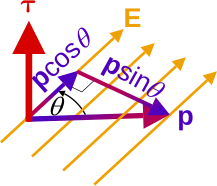
If the dipole is sitting at an angle to the field, these two pushes create a twist - what physicists call a torque. The dipole rotates until it lines up with the field.
A dipole in an electric field. The positive end (+) is pushed right (with the field), while the negative end (-) is pushed left (against the field). These opposite pushes on opposite ends create a twisting force (torque) that rotates the dipole until it aligns with the field. Credit: Wikimedia Commons, CC BY-SA
The Torque Formula
How strong is this twisting force? It depends on three things:
How strong the dipole is (the dipole moment p)
How strong the electric field is (E)
What angle the dipole makes with the field (θ)
This makes intuitive sense. When the dipole is already aligned with the field, there’s no reason for it to rotate - the positive end is already pointing the way the field wants to push it. But when the dipole is sideways to the field, it experiences maximum twist.
Energy Stored in a Dipole’s Orientation
When you rotate a dipole against the field (fighting the twist), you’re doing work on it - storing energy. When you let it rotate back into alignment, that stored energy is released.
This is the same idea as gravitational potential energy: lift a ball above the ground and you store energy; let it fall and that energy converts to motion.
Understanding the Energy Formula
Let’s make sense of this formula by checking extreme cases:
When θ = 0° (dipole aligned with field):
cos 0° = 1
U = -pE(1) = -pE (the most negative value possible)
This is the lowest energy state - the dipole is “relaxed”
When θ = 90° (dipole perpendicular to field):
cos 90° = 0
U = -pE(0) = 0
This is a middle energy state
When θ = 180° (dipole pointing opposite to field):
cos 180° = -1
U = -pE(-1) = +pE (the most positive value possible)
This is the highest energy state - the dipole is “fighting” the field
Summary Table: How Angle Affects a Dipole
Angle (θ)
Position
Torque
Energy
Stability
0°
Aligned with field
Zero
Lowest (-pE)
Stable equilibrium
90°
Perpendicular to field
Maximum (pE)
Middle (0)
Rotating
180°
Opposite to field
Zero
Highest (+pE)
Unstable equilibrium
Why Dipoles Matter in Biology
Now that you understand what dipoles are and how they behave, let’s see why this matters for the MCAT and for understanding life itself.
Water: The Most Important Dipole
Water (H2O) is a dipole, and this single fact explains an enormous amount of biology and chemistry.
Here’s why water is a dipole: Oxygen atoms attract electrons more strongly than hydrogen atoms do (oxygen is more “electronegative” - see bonding and electronegativity for more). In a water molecule, the shared electrons spend more time near the oxygen, giving it a partial negative charge (δ-). The hydrogen atoms, having lost some electron density, end up with partial positive charges (δ+).
The result: one end of the water molecule is slightly negative, the other end is slightly positive. That’s a dipole.
Dipoles in Proteins and Membranes
The same principle extends throughout biology:
Amino acids (the building blocks of proteins) often have polar side chains - parts of the molecule that act as dipoles. When a protein folds, these dipoles interact with each other and with water, helping determine the protein’s final shape.
Cell membranes are made of phospholipids, which have a polar “head” (a dipole that interacts with water) and nonpolar “tails” (not dipoles, so they avoid water). This is why membranes form the way they do - the polar heads face the watery environment while the nonpolar tails tuck inside.
A dipole is placed perpendicular to a uniform electric field (θ = 90°). What is the torque on the dipole, and what will happen next?
Click to reveal answer
The torque is at its maximum value (τ = pE), and the dipole will rotate to align with the field. At θ = 90°, sin θ = 1, so the torque formula τ = pE sin θ gives its largest value. The dipole rotates toward θ = 0° (aligned with the field), where torque is zero and potential energy is minimized. Once aligned, it stays there - that's a stable equilibrium.
Why is water such an effective solvent for ionic compounds like NaCl?
Click to reveal answer
Because water molecules are dipoles. The partially negative oxygen end (δ−) is attracted to positive ions like Na+. The partially positive hydrogen ends (δ+) are attracted to negative ions like Cl−. Water molecules cluster around each ion, forming a "hydration shell" that stabilizes the ion in solution and overcomes the attraction holding the ionic crystal together.
At what orientation does a dipole in an electric field have maximum potential energy? Minimum potential energy?
Click to reveal answer
Maximum energy: when the dipole points opposite to the field (θ = 180°, U = +pE). Minimum energy: when the dipole is aligned with the field (θ = 0°, U = -pE). Think of it like a pendulum: hanging down (aligned) is low energy; balanced upside down (anti-aligned) is high energy. The dipole naturally wants to rotate to the low-energy aligned position.
Stick a compass on a table and the needle swings to point north. Hold a strong magnet nearby and the needle snaps toward the magnet instead. The compass is responding to magnetic fields — invisible vector fields that exert forces on moving charges and magnetic materials.
Magnetic fields differ from electric fields in one fundamental way: while electric fields can be produced by stationary charges, magnetic fields are fundamentally tied to motion — moving charges, electric currents, or the intrinsic “spin” of electrons. No motion, no magnetism. (The MRI machine in a hospital generates its enormous magnetic field by running massive electric currents through superconducting coils.)
Magnetic Field Lines
Magnetic field lines describe the direction and strength of the magnetic field, following rules similar to electric field lines:
Outside a bar magnet, field lines emerge from the north pole and curve around to enter the south pole.
Inside the magnet, lines run from south to north (they form continuous closed loops - they never start or stop).
Field lines never cross.
The density of field lines represents field strength. Lines are densest near the poles.
Sources of Magnetic Fields
Bar Magnets
Magnetic field lines around a bar magnet. Lines emerge from the north pole and curve around to enter the south pole, forming continuous closed loops. Inside the magnet, lines run from south to north. Field strength is greatest near the poles where lines are densest. Credit: Wikimedia Commons, CC BY-SA
A bar magnet produces the classic dipole field pattern. Every magnet has both a north and south pole. Break a magnet in half and you get two smaller magnets, each with its own north and south pole. There’s no such thing as an isolated magnetic pole (magnetic monopole).
Current-Carrying Wires
A straight wire carrying current produces circular magnetic field lines that loop around the wire. The direction follows the right-hand rule.
The field strength around a straight wire decreases with distance from the wire (proportional to 1/r, not 1/r2). You won’t need this formula for the MCAT, but you should know qualitatively that the field is strongest close to the wire.
Current Loops and Solenoids
Bend a current-carrying wire into a loop and the magnetic field looks like that of a tiny bar magnet. Stack many loops together into a coil (solenoid) and you get a strong, nearly uniform field inside. This is how electromagnets work - and it’s the basis of MRI machines, electric motors, and speakers.
Paramagnetism vs. Diamagnetism
The AAMC specifically lists these two forms of magnetism. Both describe how materials respond to an external magnetic field.
Paramagnetism: Materials with unpaired electrons (like iron, aluminum, and oxygen). The unpaired electrons act like tiny magnets that weakly align with an external field, causing the material to be slightly attracted. When the external field is removed, the alignment is lost. Think of paramagnetic atoms as compass needles that align with the field but have no memory.
Diamagnetism: Materials with all electrons paired (like copper, gold, water, and most organic molecules). An external field induces a tiny opposing magnetic moment in each atom, causing the material to be very weakly repelled. Diamagnetism is present in all materials but is extremely weak and usually masked by paramagnetism or ferromagnetism when those are present.
Property
Paramagnetic
Diamagnetic
Electrons
Unpaired electrons present
All electrons paired
Response to external field
Weakly attracted
Very weakly repelled
Without external field
No net magnetism
No net magnetism
Examples
O2, Fe2+, Al
H2O, Cu, Au, most organic molecules
Earth’s Magnetic Field
The Earth itself acts like a giant bar magnet. The geographic north pole is near the magnetic south pole (which is why the north-seeking end of a compass points toward geographic north - it’s attracted to the magnetic south pole). The Earth’s field protects us from charged particles in the solar wind by deflecting them toward the poles, producing auroras.
What is the difference between a paramagnetic and a diamagnetic material?
Click to reveal answer
Paramagnetic materials have unpaired electrons and are weakly attracted to an external magnetic field. Diamagnetic materials have all electrons paired and are very weakly repelled by an external field. Both effects disappear when the external field is removed. Paramagnetism is stronger than diamagnetism.
Using the right-hand rule, determine the direction of the magnetic field above a horizontal wire carrying conventional current to the right.
Click to reveal answer
The field points out of the page (toward you) above the wire. Point your right thumb to the right (direction of current). Your fingers curl upward behind the wire and come over the top toward you. Above the wire, the field points out of the page.
Here’s something strange: put a charged particle in a magnetic field and nothing happens. The particle just sits there. No force, no motion, no nothing.
Start that particle moving, though, and a force suddenly appears — and it acts in a bizarre direction. Not along the field. Not along the motion. Sideways to both.
This counterintuitive behavior is the essence of magnetic forces on charges. Once you’ve got the right-hand rule down and you’ve seen a few worked examples, it stops feeling weird and starts feeling consistent. Let’s build it up step by step.
The Key Insight: Motion Required
Compare electric and magnetic forces:
| Type | Does a stationary charge feel a force? |
|------|---------------------------------------|
| Electric force | Yes - just place it in an electric field |
| Magnetic force | No - the charge must be moving |
Why the difference? At a deep level, electric and magnetic fields are two aspects of the same phenomenon (electromagnetism), but for the MCAT, just remember: magnetic forces only act on moving charges.
The Magnetic Force Formula
This formula should remind you of the torque on a dipole (τ = pE sin θ). The sin θ factor keeps appearing because it captures “how much of the motion/orientation is perpendicular to the field.”
The Weirdest Part: The Force Is Sideways
Here’s what trips up most students: the magnetic force doesn’t push the charge in the direction of the field, and it doesn’t push along the direction of motion. It pushes perpendicular to both.
Finding the Direction: The Right-Hand Rule
So the force is perpendicular to both velocity and field. But which perpendicular direction? There are two options (up or down, left or right, etc.). The right-hand rule tells you which.
The right-hand rule for magnetic force. Point your fingers along velocity (v), curl them toward the magnetic field (B), and your thumb points in the direction of force (F) on a positive charge. Credit: Wikimedia Commons, CC BY-SA
Step-by-Step Instructions
Hold up your right hand (this is important - not your left!)
Point your fingers in the direction the charge is moving (velocity v)
Curl your fingers toward the direction of the magnetic field (B)
Your thumb now points in the direction of the force (F) - but ONLY for positive charges
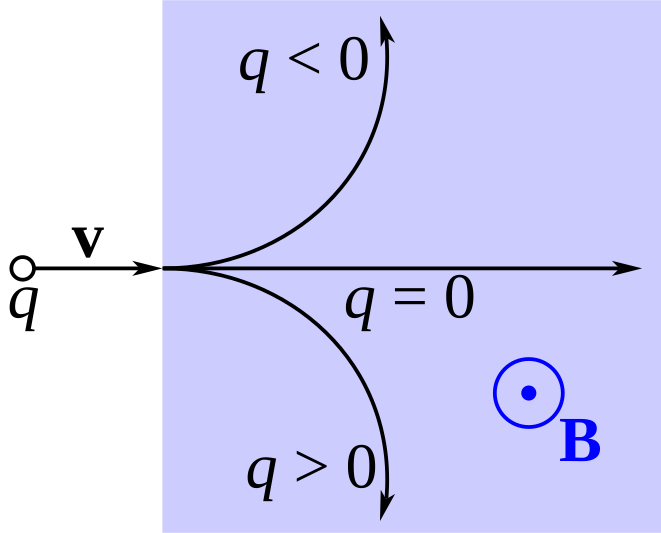
For negative charges (like electrons): Do the right-hand rule, then flip the direction. The force on a negative charge is opposite to what the right-hand rule gives.
Practice Example
A proton moves to the right in a magnetic field pointing into the page.
Point fingers right (velocity direction)
Curl fingers into the page (field direction)
Thumb points… up!
The force on the proton is upward.
🎯 Predict First
A proton moving to the right enters a magnetic field pointing out of the page. Which way does the magnetic force initially push it?
Launch the proton in the simulation below and compare the red force arrow with your prediction. Then switch to an electron, or flip the field into the page, and watch the curve reverse direction. Adjust speed and field strength and note what each one does to the size of the circle.
Particle
B
Radius: 6.0 (rel. units)Direction: ClockwiseRule: F = qvB, F ⊥ v
Circular Motion in a Magnetic Field
Here’s a beautiful consequence of the sideways force: if a charged particle enters a magnetic field moving perpendicular to the field, it moves in a circle.
Why? Think about it:
The force is always perpendicular to the velocity (sideways)
A force perpendicular to motion doesn’t speed up or slow down the object - it just turns it
The force keeps turning the particle, always perpendicular
What shape has constant turning? A circle!
This is exactly like circular motion from centripetal force. The magnetic force provides the centripetal force that keeps the particle moving in a circle.
Finding the Radius
Since the magnetic force IS the centripetal force, we can set them equal:
Magnetic force = Centripetal force
qvB=rmv2
Solve for r:
What does this formula tell us?
Heavier particles (larger m) → bigger circles
Faster particles (larger v) → bigger circles
More charge (larger q) → tighter circles
Stronger field (larger B) → tighter circles
This is how mass spectrometers work: particles with different masses curve differently, allowing them to be separated and identified.
The “No Work” Rule
This is a crucial conceptual point that the MCAT loves to test.
Remember from work and energy that work is only done when a force has a component along the direction of motion:
W=Fdcosθ
For magnetic forces, the force is always perpendicular to the velocity. That means θ=90°, and cos90°=0. So:
W=Fd×0=0
Velocity Selector: Combining Electric and Magnetic Forces
What if you want only particles traveling at a specific speed to pass through? Use a velocity selector.
Here’s the setup: create both an electric field AND a magnetic field in the same region, oriented perpendicular to each other. A charged particle enters and feels two forces:
Electric force:FE=qE (pushes in one direction, let’s say up)
Magnetic force:FB=qvB (pushes in the opposite direction, down)
For particles at exactly the right speed, these forces cancel:
qE=qvB
Solving for v:
v=BE
Particles traveling at this speed feel no net force and go straight through. Particles traveling faster or slower get deflected.
A proton moves to the right through a magnetic field directed into the page. In what direction is the magnetic force on the proton?
Click to reveal answer
The force is directed upward. Using the right-hand rule: point your fingers to the right (velocity), curl them into the page (toward B). Your thumb points upward. Since the proton is a positive charge, the right-hand rule gives the correct direction directly.
Why can a magnetic force change the direction of a charged particle but not its speed?
Click to reveal answer
Because the magnetic force is always perpendicular to the velocity, it does zero work (W=Fdcos90°=0). With no work done, there is no change in kinetic energy, and therefore no change in speed. The force only changes the direction of the velocity vector, not its magnitude. This is why charged particles follow circular (not spiral) paths in uniform magnetic fields.
Current in a wire is just a large number of moving charges traveling together through a conductor. Since a magnetic field exerts a force on each moving charge, it also exerts a force on the wire as a whole.
This is the principle that makes electric motors spin, speakers vibrate, and MRI machines work. Every time you turn on a fan, hear sound from headphones, or watch an electric car accelerate, the magnetic-force-on-a-current-carrying-wire equation is doing its work. The physics is a straightforward extension of the single-charge Lorentz force.
Force on a Straight Current-Carrying Wire
This equation comes directly from F = qvB sin θ, applied to all the moving charges in the wire at once. The product of charge and velocity for all the charges becomes current times length (IL replaces qv).
Direction: Right-Hand Rule (FBI)
The direction of the force on the wire follows the same right-hand rule as for a single moving charge:
Point your fingers in the direction of conventional current (I).
Curl your fingers toward the magnetic field (B).
Your thumb points in the direction of the force (F).
The Motor Principle
An electric motor is simply a current-carrying loop of wire placed in a magnetic field. The magnetic force pushes one side of the loop up and the other side down, creating a torque that spins the loop. A commutator reverses the current direction every half-turn so the torque always pushes in the same rotational direction.
The torque on a rectangular current loop in a magnetic field is:
τ=nIABsinθ
where n = number of turns, I = current, A = area of the loop, B = magnetic field, and θ = angle between the field and the normal to the loop. This is the same sinθ pattern as torque on a dipole.
Forces Between Parallel Wires
Two parallel wires carrying current exert forces on each other through their magnetic fields. Each wire creates a magnetic field, and the other wire sits in that field and experiences a force.
Same-direction currents attract. The magnetic field from wire 1 pushes wire 2 toward wire 1, and vice versa.
Opposite-direction currents repel. The magnetic field from wire 1 pushes wire 2 away, and vice versa.
This might seem counterintuitive (same-direction currents attract, while same-sign charges repel), but you can verify it with the right-hand rule. First, find the direction of the magnetic field from wire 1 at the location of wire 2. Then find the force on wire 2 using F = BIL.
A Note on Units
The tesla (T) is the SI unit of magnetic field. It can be expressed in several equivalent ways:
1 T=1 kg/(A⋅s2)=1 N/(A⋅m)=1 V⋅s/m2
The most useful equivalence for problem-solving is 1 T = 1 N/(A·m), which you can verify by checking that F=BIL gives newtons when B is in tesla, I is in amps, and L is in meters.
A 0.5 m wire carries a current of 3 A perpendicular to a 0.2 T magnetic field. What is the force on the wire?
Click to reveal answer
F=BILsinθ=(0.2 T)(3 A)(0.5 m)(sin90°)=0.3 N. Since the wire is perpendicular to the field, sinθ=1 and we get the maximum possible force for these values.
Two long parallel wires carry currents in opposite directions. Do they attract or repel each other?
Click to reveal answer
They repel each other. Opposite-direction currents create magnetic forces that push the wires apart. Same-direction currents attract; opposite-direction currents repel. You can verify this by applying the right-hand rule to find the field from one wire at the location of the other, then finding the force direction.
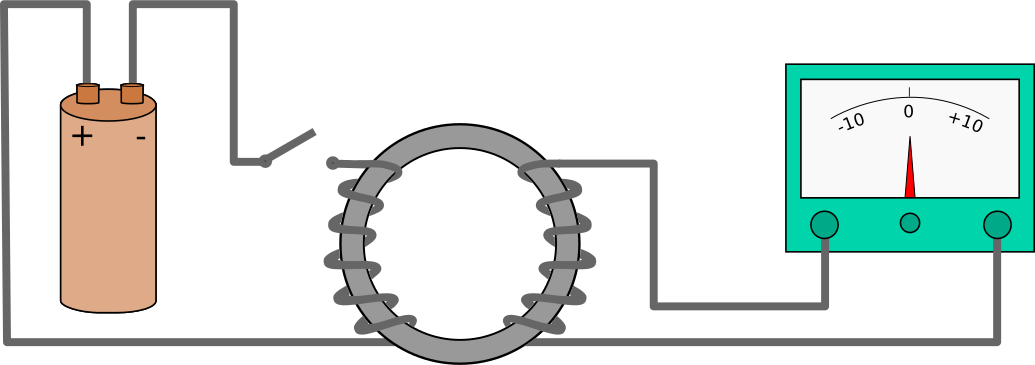
In 1831, Michael Faraday discovered something that quite literally changed the world: a changing magnetic field can create an electric current — without any battery or power source. Move a magnet through a coil of wire and a current flows. Stop moving the magnet and the current stops. Move it the other way and the current reverses.
This is electromagnetic induction, and it’s the principle behind every electrical generator, every transformer in every power line, every induction cooktop, every wireless phone charger, and every MRI machine. Your wall outlets exist because Faraday figured this out.
If you’ve studied electric fields and magnetic fields, you know that these fields can exert forces on charges. Induction goes a step further: a changing magnetic field can actually create an electric field, which then pushes charges around a circuit.
Magnetic Flux
Faraday's induction experiment. Moving a magnet into or out of a coil changes the magnetic flux through the coil, inducing an EMF and driving a current. The faster the magnet moves, the larger the induced EMF. Credit: Wikimedia Commons, CC BY-SA
Before we can talk about induction, we need the concept of magnetic flux - the total amount of magnetic field passing through a surface.
Magnetic flux (Φ) through a surface is:
Φ=BAcosθ
where B = magnetic field (T), A = area of the loop (m²), and θ = angle between B and the normal (perpendicular) to the surface. The unit of flux is the weber (Wb), where 1 Wb = 1 T·m².
Flux is maximum when the field is perpendicular to the surface (θ=0°, cosθ=1) and zero when the field is parallel to the surface (θ=90°, cosθ=0).
Faraday’s Law (Conceptual)
Faraday’s law states that a changing magnetic flux through a loop induces an EMF (voltage) in the loop. The faster the flux changes, the larger the induced EMF.
Three ways to change flux (and induce an EMF):
Change B - move a magnet closer to or farther from the loop, or turn an electromagnet on/off.
Change A - expand or contract the loop (like pulling a wire through a field).
Change θ - rotate the loop in the field (this is how generators work).
Lenz’s Law
Lenz’s law tells you the direction of the induced current: the induced current flows in a direction that opposes the change in flux that caused it.
Applying Lenz’s Law Step by Step
Determine the direction of the external magnetic field through the loop.
Determine whether the flux is increasing or decreasing.
The induced current will create a magnetic field that opposes the change:
If flux is increasing, the induced field opposes the external field (points opposite).
If flux is decreasing, the induced field supports the external field (points same direction).
Use the right-hand rule to find the current direction that produces the needed induced field.
Example
A bar magnet with its north pole pointing down is dropped toward a horizontal loop of wire. The downward magnetic flux through the loop is increasing. By Lenz’s law, the induced current must create an upward magnetic field to oppose the increase. Using the right-hand rule, this means the current flows counterclockwise when viewed from above.
Applications
Generators
A generator is the reverse of a motor. A motor takes current and produces rotation. A generator takes rotation and produces current. Spinning a wire loop in a magnetic field continuously changes the flux (by changing θ), inducing an alternating EMF. That’s the basis of AC power generation at every power plant.
Transformers
A transformer uses electromagnetic induction to change the voltage of AC power. Two coils (primary and secondary) are wound around a shared iron core. Alternating current in the primary coil creates a changing magnetic field, which induces an EMF in the secondary coil.
The voltage ratio depends on the number of turns:
V1V2=N1N2
A step-up transformer (N2>N1) increases voltage. A step-down transformer (N2<N1) decreases voltage. Energy is conserved (ideally): if voltage goes up, current goes down proportionally.
Eddy Currents
When a conducting material (not just a wire loop) is exposed to a changing magnetic field, induced currents swirl through the bulk of the material. These are called eddy currents. They oppose the change in flux (Lenz’s law) and dissipate energy as heat. Eddy currents are why:
A metal pendulum swinging between the poles of a magnet slows down rapidly.
Induction cooktops heat metal pots without a flame.
Electromagnetic brakes work without friction pads.
A circular wire loop is in a region where the magnetic field is increasing. According to Lenz's law, in what direction does the induced current flow?
Click to reveal answer
The induced current flows in the direction that creates a magnetic field opposing the increase. If the external field points into the page and is increasing, the induced current must create a field pointing out of the page (to oppose the increase). By the right-hand rule, this means the current flows counterclockwise (when viewed from the side where the field is coming out).
A transformer has 100 turns in the primary coil and 500 turns in the secondary. If the input voltage is 120 V, what is the output voltage? Is this a step-up or step-down transformer?
Click to reveal answer
V2=V1(N2/N1)=120 V×(500/100)=600 V. This is a step-up transformer (N2>N1, so voltage increases). By conservation of energy, the output current will be 51 of the input current (if the input current is 2 A, the output current is 0.4 A).