
Field from Charges
In §5.3 you learned the rules of electric fields. Now it’s time to apply those rules to the specific charge arrangements the MCAT loves: single point charges, pairs of charges, dipoles, and parallel plates. Each has a characteristic field pattern you should recognize on sight.
The strategy is always the same: calculate from each source charge, get the direction (away from + charges, toward − charges), and add the vectors.
Electric Field from a Single Point Charge
The field radiates symmetrically outward from a positive point charge and inward toward a negative one. Field strength falls off as — same inverse-square pattern as Coulomb’s law.
Superposition with Multiple Charges
When several point charges are present, the field at any location is the vector sum of the individual fields from each charge. The recipe:
- Pick the point where you want to know the field.
- Calculate from each source charge using .
- Determine the direction of each individual field (away from + charges, toward − charges).
- Add the vectors.
Two Equal Positive Charges
Place two identical positive charges on a horizontal line. At the midpoint between them, the fields from each charge point in opposite directions and cancel completely. at the midpoint. Above or below the midpoint, the fields partially add, producing a net upward or downward field perpendicular to the line.
But what if the charges aren’t equal?
Two positive charges sit on a line some distance apart: q1 = +4 µC and q2 = +1 µC. Where is the electric field zero?
Drag the q1 and q2 sliders and watch the arrow pattern reorganize around the two charges. The green ring marks the null point where the fields cancel exactly. Make the charges equal, then unequal, then flip one sign, and notice where the null point moves (and when it leaves the picture entirely).
Two Opposite Charges (Dipole Configuration)
Place a positive charge on the left, a negative charge on the right. At the midpoint, both fields point in the same direction (from + toward −), so they add. The field at the midpoint is strong, not zero. (More on this in §5.8 — Electric Dipoles.)
The Dipole Field Pattern
A dipole is a positive and negative charge of equal magnitude separated by a small distance. The field pattern has a distinctive shape:
- Between the charges: field points from + to −.
- Along the axis (line connecting the charges): field points away from + and toward −, creating a continuous flow from positive to negative.
- Along the perpendicular bisector: field points antiparallel to the dipole moment.
- Far from the dipole: field falls off as — faster than a single point charge (). Dipoles cancel each other out at distance much faster than a lone charge would.
You don’t need to calculate dipole fields on the MCAT, but you should recognize the pattern in a diagram: field lines emerge from the positive end and curve around to enter the negative end, forming closed-looking loops.
Electric Field Between Parallel Plates
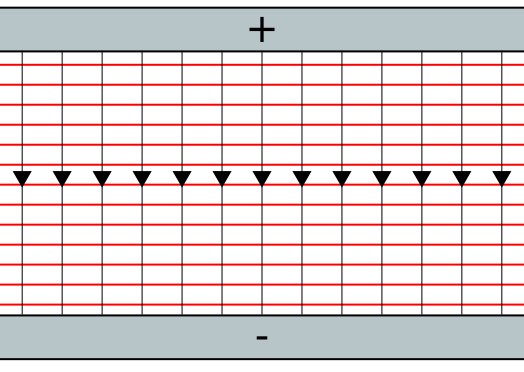
Two large parallel conducting plates with equal-and-opposite charge produce the simplest possible field: uniform and constant between the plates.
This uniform field is the workhorse of MCAT electrostatics. A charged particle between the plates experiences a constant force () → constant acceleration → projectile-motion-style problems. Charge between plates is geometrically the same as a ball thrown in gravity — and you solve it with the same kinematic equations.
Conductors in Electrostatic Equilibrium
Three facts about conductors at electrostatic equilibrium that often appear on the MCAT:
- The electric field inside the conductor is exactly zero.
- All excess charge sits on the outer surface.
- The field just outside the surface is perpendicular to the surface.
All three follow from charges being free to move. If there were any field inside the conductor, the charges would move in response — until there wasn’t. Equilibrium = no field inside.
From the + charge toward the − charge. The + charge produces a field pointing away from it (so toward the midpoint, then on toward the − side). The − charge produces a field pointing toward it (also toward the − side). Both fields point the same way → they add → strong nonzero field from + to −.
4000 V/m (or 4000 N/C). V/m. Uniform across the gap, pointing from + plate to − plate.
At the origin: (fields from each charge cancel). Above the midpoint: field is nonzero and points upward — the horizontal components from the two charges cancel by symmetry, but the vertical components add. This is a classic symmetry-based MCAT problem.